

For years, Canada’s economy operated on a simple assumption…
when in doubt, sell to the Americans.
That approach made sense when the relationship was stable. Today, stability is in shorter supply than common sense on social media.
While headlines continue to focus on tariffs, trade fights, and political theatrics south of the border, something far more important just happened.
A Canadian company landed a defence contract in Europe.
No, it’s not a giant deal.
Not yet.
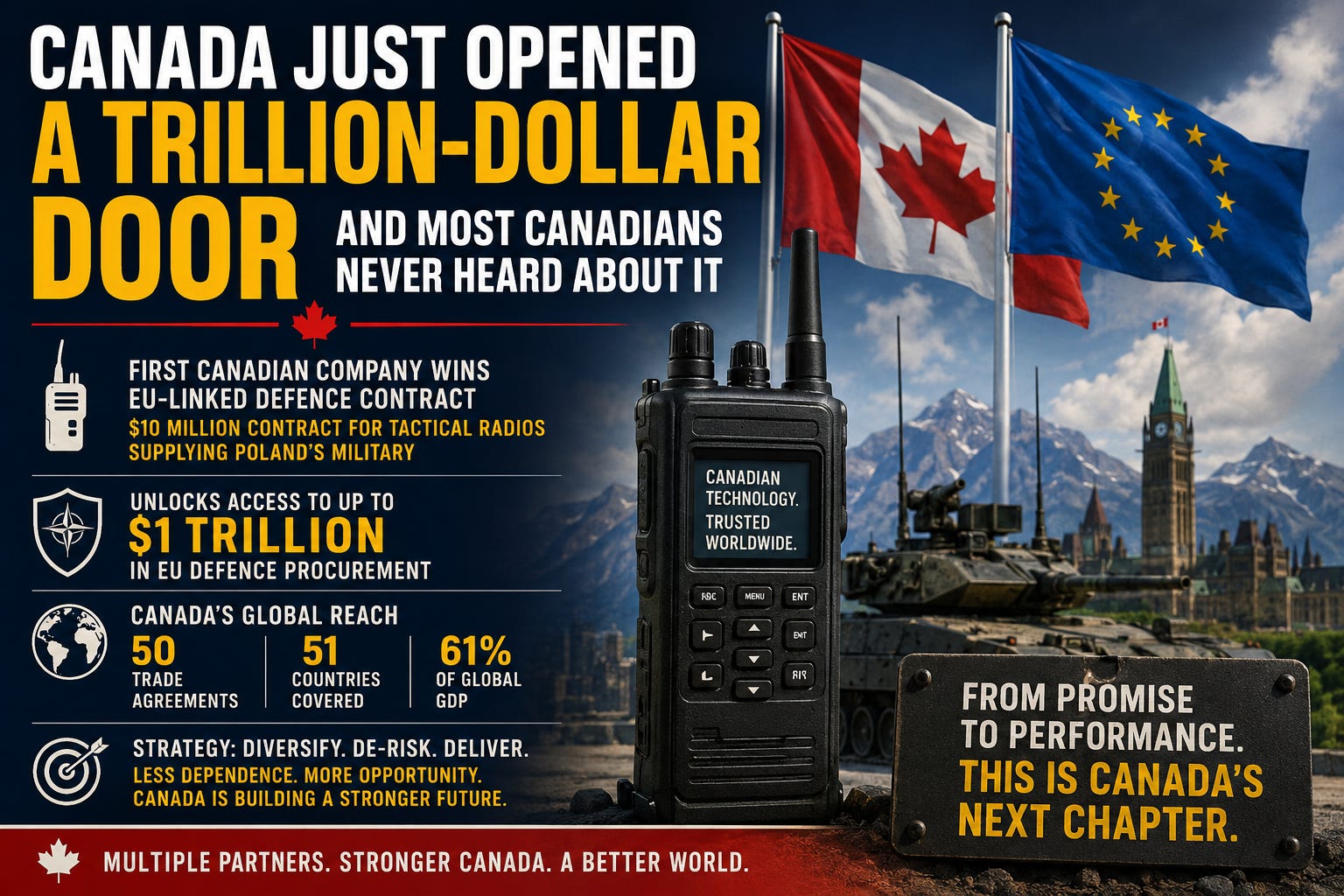
The contract is worth about $10 million and involves tactical military radios for Poland’s armed forces. On its own, that number won’t move Canada’s economy.
What matters is the door it opened.
This is the first visible result of the Canada-European Union defence procurement agreement signed in June 2025.
That agreement allows Canadian firms to compete for contracts within a European defence spending pool that could eventually approach $1 trillion.
Think about that for a moment.
Canada didn’t just sell a product.
Canada secured a seat at the table.
There’s a big difference.
The real money in defence isn’t found in one-off contracts. It’s found in becoming part of long-term supply chains. Once a company proves it can deliver, future opportunities tend to multiply.
That’s why this announcement matters.
It marks the shift from paperwork to reality.
A year ago, the agreement was a promise.
Today, it’s producing contracts.
Tomorrow, it could produce many more.
The timing is interesting as well.
The world is becoming less predictable by the month.
Alliances are shifting. Trade patterns are changing. Governments are scrambling to secure supplies of everything from critical minerals to military equipment.
Countries that rely too heavily on one customer or one supplier are discovering the risks the hard way.
Canada appears to have gotten the message.
Over the past year, Ottawa has expanded cooperation with Europe, strengthened ties with countries like India and Australia, deepened relationships with the United Kingdom and Germany, and continued building economic links across multiple regions.
Some critics keep asking why Canada isn’t chasing giant new free trade agreements.
The answer may be simpler than they realize.
Canada already has trade agreements covering 51 countries through 50 separate arrangements. Together, those relationships provide access to more than 61 percent of global GDP.
At some point, signing another headline-grabbing agreement matters less than making better use of the ones you already have.
That’s what this defence contract represents.
Execution.
Not promises.
Not press conferences.
Not photo opportunities.
Results.
The broader strategy is becoming easier to see.
Instead of depending heavily on one dominant partner, Canada is spreading its bets across multiple markets, industries, and alliances.
That doesn’t mean abandoning the United States.
The Americans will remain Canada’s largest trading partner for the foreseeable future.
But it does mean reducing vulnerability.
If one market becomes unstable, others remain open.
If one government changes direction overnight, Canada’s future isn’t tied to a single decision made elsewhere.
That’s not anti-American.
That’s basic risk management.
Every successful investor understands diversification.
Apparently countries are starting to relearn the same lesson.
The world is becoming more fragmented, more competitive, and more unpredictable.
In that environment, flexibility becomes a strategic advantage.
The $10 million contract itself isn’t the story.
The story is that Canada is now inside the room.
And once you’re inside the room, the opportunities tend to get much bigger.
Quietly, without much fanfare, Canada just positioned itself inside a defence market measured in trillions.
That’s not a headline.
That’s a strategy.
The Recap…
A Montreal company just won a military contract supplying Poland.
The dollar value isn’t the important part.
The important part is that Canada now has access to a European defence market worth up to $1 trillion.
That’s what diversification looks like when it moves from theory to reality.
The Gut-Punch…
For decades, Canada acted like a business with one customer.
Now it’s acting like a business that plans to survive.
There’s a big difference between making a sale and securing a future. This week, Canada may have done both.
Source credit:
Based on publicly reported details regarding the June 2025 Canada–EU defence procurement agreement, the June 2026 Poland tactical radio contract awarded to Montreal-based Marconi Technologies, and related government announcements concerning Canada’s trade diversification and defence cooperation strategy.
🔎 The GeezerWise Standard
This space is built on disciplined thinking.
Facts over spin.
Verification before amplification.
Good-faith discussion over tribal noise.
I use AI tools to help shape my spoken drafts into clear writing.
The judgment, conclusions, and final message are mine.
If you’re new here, this explains how I decide what’s worth sharing:
How I Decide What’s Worth Sharing → [link]
💌 Subscribe at GeezerWise.com to receive future letters:
www.geezerwise.com/subscribe
— Fred Ferguson
GeezerWise
#CanadaStrong
Wow! Exciting post Fred!!!! Key word I grabbed was "business" & yes, we are starting to work like a business & that's the key to a country being successful. Eventually we'll ban the orange ball entirely, until a NICE leader is voted back in, then things can change some. Thanks for the awesome post :)
Diversification isn’t anti-American. “That’s basic risk management”. I couldn’t have said it better myself!