

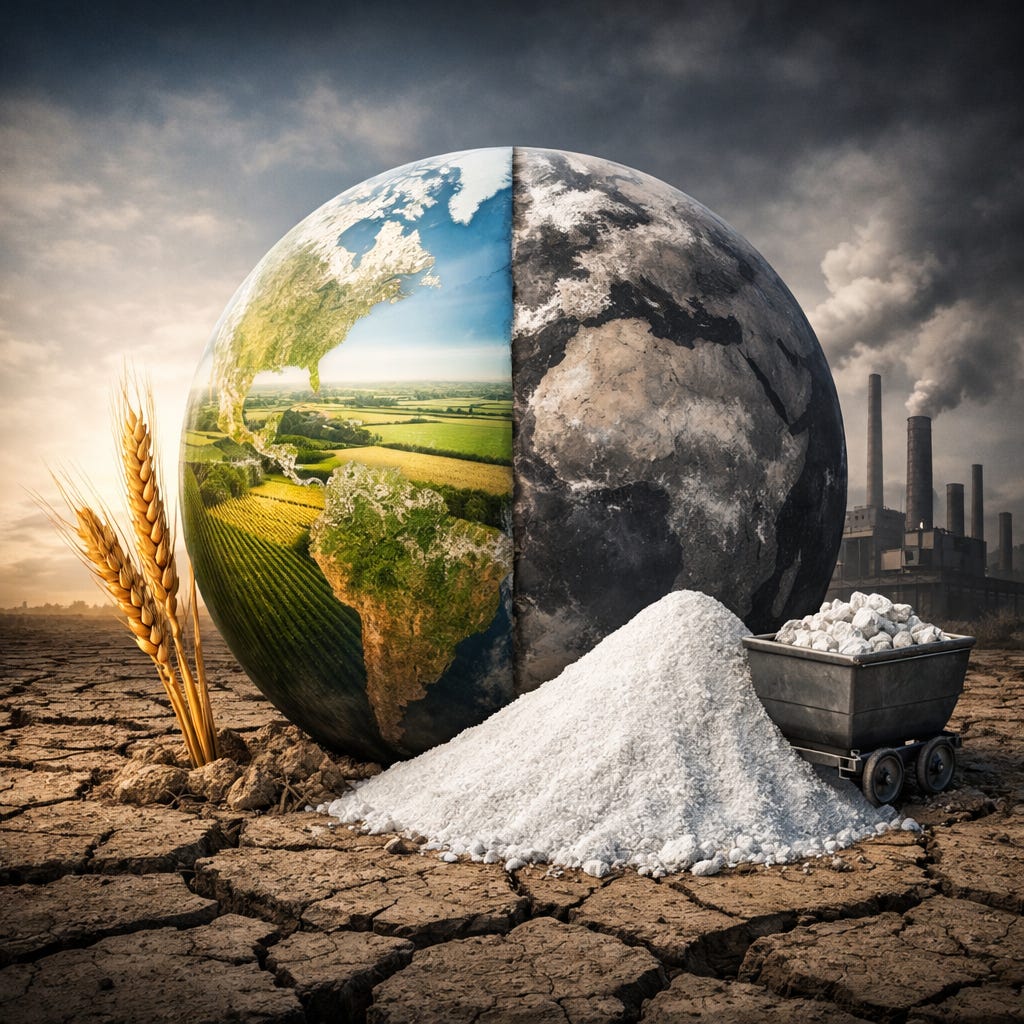
While everyone’s arguing about trade deals, tariffs, and political theatre…
Canada just made a move that quietly changes the global power map.
Not next year.
Not maybe.
Structurally.
A $14 billion bet buried under Saskatchewan soil.
And most people still think this is just “another mine.”
It’s not.
Let’s get one thing straight first…
You don’t grow food without fertilizer.
And you don’t make fertilizer without potash.
Potassium… one of the three core nutrients crops must have… doesn’t magically regenerate in soil fast enough to keep up with modern farming.
No potassium = lower yields
Lower yields = less food
Less food = higher prices
Simple math.
Now here’s where it gets interesting…
Canada isn’t just in the game — it is the game
Canada holds roughly half of the world’s potash reserves
Saskatchewan alone produces about one-third of global supply
Canada controls over 40% of global exports
There’s no diversification here.
There’s concentration.
And concentration means leverage.
Enter the Janssen Mega-Mine
Buried about 140 km east of Saskatoon…
A single project is about to change the scale of everything…
Total investment: $14 billion CAD
Expected output: 8.5 million tonnes per year
That’s roughly 10% of global production — from ONE mine
Lifespan: 100 years
And that’s just the first phases.
Future expansion could push it to 16–17 million tonnes annually.
Let that sink in.
One site… potentially rivaling entire countries.
Meanwhile… the U.S. has a problem
American farmers rely heavily on imports.
And here’s the uncomfortable truth…
Around 85–90% of U.S. potash imports come from Canada
Domestic production? Roughly 400,000 tonnes
Annual demand? About 5.3 million tonnes
That gap doesn’t magically fill itself.
And the “backup options”?
Russia and Belarus.
Which… let’s just say… aren’t exactly stable or politically convenient suppliers these days.
So what happens when politics meets dependency?
In 2025, tariffs were floated on Canadian fertilizer.
On paper, that sounds like leverage.
In reality?
It’s like taxing your own oxygen supply.
Because fertilizer isn’t optional.
Farmers don’t get to “wait it out.”
They plant in a narrow seasonal window… weeks, not years.
And building new domestic mines?
That’s a 10–15 year timeline, minimum.
Here’s the part nobody’s saying out loud
Fertilizer costs already make up…
30% to 45% of farm operating expenses
Raise that cost?
You don’t hurt Canada.
You squeeze farmers.
And then food prices follow.
Every. Single. Time.
This isn’t about mining… it’s about control
Let’s zoom out.
Global population is heading toward 10 billion
Arable land per person is shrinking
Crop efficiency isn’t optional anymore — it’s survival
And fertilizer?
It’s estimated to support roughly half the global population
Half.
So when one country controls a massive chunk of that supply…
That’s not economics anymore.
That’s leverage at a civilization level.
And Canada just doubled down
The Janssen project isn’t replacing supply.
It’s adding a whole new layer on top of an already dominant position.
This isn’t cyclical.
This is structural.
A 100-year asset tied directly to global food production.
The quiet shift nobody’s tracking
While headlines scream about oil, tech, and currencies…
The real game is moving underground.
Because…
Oil controls energy
Chips control technology
But fertilizer?
Fertilizer controls food
And food controls everything else.
Bottom line
Canada didn’t just build a mine.
It strengthened a position that was already unmatched…
And turned it into long-term leverage over something the world can’t function without.
No drama.
No headlines.
Just arithmetic.
And the math is getting harder to ignore.
The Recap…
Most people still think power comes from oil.
They’re looking in the wrong place.
Canada just made a move that affects food…— not fuel.
And once this thing goes live…
the balance shifts.
The Gut-Punch…
Control energy… you influence economies.
Control food… you influence survival.
Source Credit:
Based on The Global Shift analysis - compiled and summarized from industry data reporting.
🔎 The GeezerWise Standard
This space is built on disciplined thinking.
Facts over spin.
Verification before amplification.
Good-faith discussion over tribal noise.
I use AI tools to help shape my spoken drafts into clear writing.
The judgment, conclusions, and final message are mine.
If you’re new here, this explains how I decide what’s worth sharing:
How I Decide What’s Worth Sharing → [link]
💌 Subscribe at GeezerWise.com to receive future letters:
www.geezerwise.com/subscribe
— Fred Ferguson
GeezerWise
#CanadaStrong
Fertilizer is an incredibly valuable commodity. I’ve read elsewhere that without fertilizer the world’s crop production would drop by roughly 50%. The Gulf region is a large producer of nitrogen based fertilizer, and let’s just say that shipping through the Gulf region is currently “constrained”.
Fred, this is a very strong piece — and clearly grounded in serious work.
The way you frame fertiliser as leverage is exactly right, and it points to something even deeper.
You describe this as:
“Canada locking up the world’s food supply.”
That captures the intuition very well.
More precisely, what Canada is shaping here is not food supply itself — but yield.
And in some ways, that is even more powerful.
Because fertiliser — especially potash — doesn’t determine whether food is grown.
It determines how much margin the system has.
Crops still grow without it
But yields fall
Soil depletes faster
And volatility increases
So the effect is not immediate collapse.
It is systemic tightening over time.
That’s where your argument becomes strategically important.
In a world of:
shrinking buffers
climate variability
and fragmented supply chains
yield becomes the difference between:
stability
and persistent pressure
Seen that way, Canada’s position is not just about scale.
It’s about reliability over time:
100-year asset
predictable output
politically stable environment
At a moment when:
Belarus is constrained
Russian supply is uncertain
and new capacity takes a decade or more
That combination is rare.
What your piece really highlights is something broader:
This isn’t just about dominance —
it’s about concentration inside a system that has very little slack.
Because the fertiliser system has some structural characteristics that amplify this:
Geographic concentration (Canada, Russia, Belarus)
Political exposure (sanctions, trade friction)
Time sensitivity (farmers can’t delay decisions)
So when pressure appears, it moves quickly into:
yields
prices
and food security
Which is why your core insight lands:
“This isn’t about mining… it’s about control.”
Yes — and at a deeper level:
it’s about control over how efficiently the global food system can operate under stress.
And that connects to something even larger we’re seeing across sectors:
Oil → flow constraints
Chips → production bottlenecks
Fertilizer → yield constraints
Different domains — same pattern:
power is shifting toward control of bottlenecks.
So your conclusion is exactly right:
“Control food… you influence survival.”
And perhaps one step further:
Control yield… and you determine how much stress the system can absorb before it starts to fracture.
That’s the quiet shift your piece captures very well.