

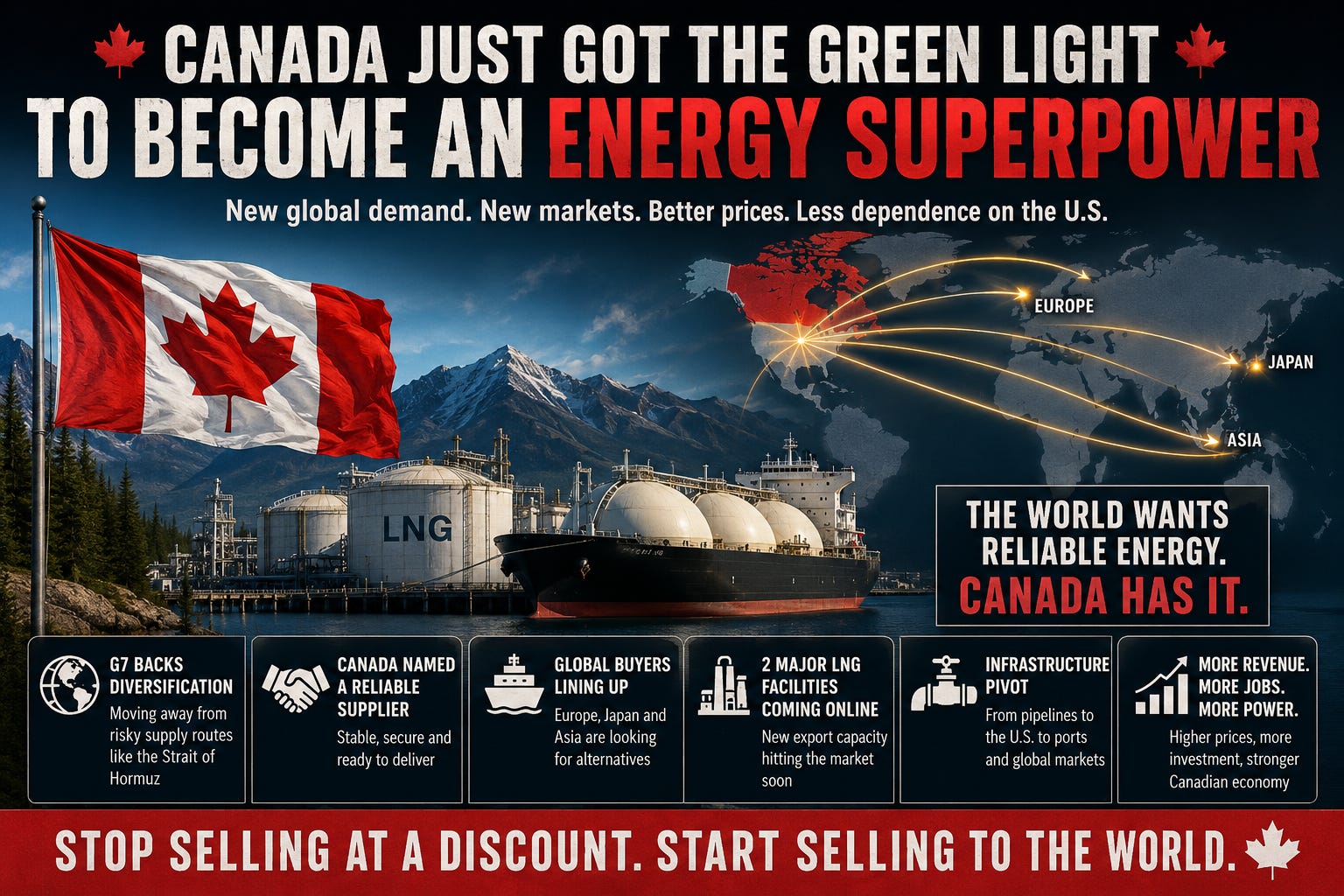
For years, Canada has been the guy with a truckload of firewood selling to one customer down the road.
The customer set the price.
The customer dictated the terms.
And because there weren’t many other buyers within reach, Canada took the deal.
That may finally be changing.
The latest signals coming out of the G7 point toward a growing global effort to diversify energy supplies away from vulnerable regions and unstable shipping routes.
At the top of that concern list sits the Strait of Hormuz, one of the world’s most critical energy chokepoints.
When the world starts looking for safer suppliers, Canada suddenly looks a lot more attractive.
We have what many countries need.
Oil.
Natural gas.
LNG.
Fertilizer.
Critical minerals.
And perhaps most importantly, political stability.
That last one has become surprisingly valuable.
Europe wants secure energy.
Japan wants secure energy.
Much of Asia wants secure energy.
Nobody wants to wake up one morning and discover that a conflict halfway around the world has shut down a major supply route and sent prices through the roof.
That is creating a window of opportunity for Canada.
The real story isn’t simply that we can sell more energy.
It’s who we sell it to.
For decades, Canada has largely functioned as a continental supplier.
We shipped massive volumes south and accepted pricing structures heavily influenced by the U.S. market.
When you only have one major customer, you’re negotiating from weakness.
When multiple customers are competing for your product, everything changes.
Suddenly you’re not a price taker.
You start becoming a price setter.
That shift could be worth billions over time.
The conversation is also changing around infrastructure.
For years, much of Canada’s energy strategy revolved around north-south connections into American markets.
Now the focus is increasingly shifting westward toward Pacific export capacity and broader access to global buyers.
The goal isn’t to replace the United States.
The goal is to stop depending on it.
Those are two very different things.
Diversification isn’t anti-American.
It’s simply smart business.
Every investor knows not to put all their money into a single stock.
Countries shouldn’t put all their economic future into a single customer either.
The timing may work in Canada’s favour.
Two major LNG export facilities are nearing operation, creating new pathways into international markets.
At the same time, governments are discussing ways to reduce regulatory delays and accelerate strategic infrastructure projects.
The world wants reliable energy.
Canada wants new customers.
Those interests are finally lining up.
None of this means the path will be easy.
Environmental concerns remain real.
Infrastructure projects still face opposition.
Global energy markets can shift quickly.
And Canada remains deeply connected to the U.S. economy whether some people like it or not.
But the larger trend is difficult to ignore.
The world is searching for dependable suppliers.
Canada is increasingly being viewed as one.
That changes how investors see us.
It changes how allies see us.
And eventually it changes how we see ourselves.
The biggest mistake would be assuming this opportunity will wait forever.
Windows like this open.
Then they close.
If Canada moves quickly, expands export capacity, and builds direct access to global markets, we could emerge from this decade with far more economic leverage than we had entering it.
Not because America got weaker.
Not because anyone else failed.
But because Canada finally stopped acting like it only had one customer.
And that may be the most important shift of all.
The Recap…
Canada may have just been handed the biggest energy opportunity in a generation.
The G7 wants safer, more reliable suppliers.
Europe and Asia are looking beyond unstable regions.
For the first time in decades, Canada has a real chance to sell to the world instead of depending on one customer.
The Gut-Punch…
The biggest story isn’t that Canada has energy.
We’ve always had energy.
The biggest story is that the world suddenly wants more of it… and for the first time, Canada may have enough buyers to stop asking one customer what it’s worth.
Source credit:
Based on G7 energy diversification discussions, global concerns over supply-route vulnerability, Canadian LNG expansion plans, and ongoing Canadian trade and infrastructure policy developments.
🔎 The GeezerWise Standard
This space is built on disciplined thinking.
Facts over spin.
Verification before amplification.
Good-faith discussion over tribal noise.
I use AI tools to help shape my spoken drafts into clear writing.
The judgment, conclusions, and final message are mine.
If you’re new here, this explains how I decide what’s worth sharing:
How I Decide What’s Worth Sharing → [link]
💌 Subscribe at GeezerWise.com to receive future letters:
www.geezerwise.com/subscribe
— Fred Ferguson
GeezerWise
#CanadaStrong
A Quick Note About Getting in Touch
One thing I’d like to ask as GeezerWise grows...
Please keep questions, ideas, and conversations in the comments whenever possible.
That’s where I spend my time, and when a good question is asked publicly, everyone benefits from the discussion.
I can’t promise to reply to every comment, but I do read them, and many of my best ideas come directly from our conversations here.
Thanks for helping make GeezerWise a community where we all learn from one another.This post is public. Share with someone who prefers evidence over adrenaline.
"The goal isn’t to replace the United States.
The goal is to stop depending on it.
Those are two very different things.
Diversification isn’t anti-American.
It’s simply smart business."
I really like the twist in your words today Fred... especially "it isn't anti-American". Being a Canadian senior citizen enraged from the beginning of the tariffs and watching the sick regime down there cause so much damage to the world, being sick to my stomach at every glance of his photo on the news or my feed, I do appreciate turning that curve towards owning our changes and elevating above the "anti-U.S", anti-American people. This curve has gradually brought me great respect and honour for Canada, and great excitement to see our Prime Minister churning away for our greater good. My focus will stay on buying Canadian whenever I can, but maybe not to be so much "anti-American" as being a more focused member of my own country, Canada. Arlene Dickinson, on Instagram/Threads has begun posting photos and statements of what she loves about Canada, our history, our accomplishments, our spectacular land - and this has begun turning me also... towards appreciation - and away from thinking it was only the U.S. that had all the beauty, all the excitement, all the everything. It actually feels weird now to be giving so much attention and appreciation for another country without valuing my own. This looking away has I believe made us stagnant. What a grand place we are in right now and how damn lucky we are to have seen the writing on the wall and voting in PM Mark Carney.
I feel you beginning to move in a direction that is just as informative and easy to take in but now kind of adding in some healing. And I appreciate this Fred.
Canada has H2 Hydrogen, clean hydrogen escaping from rocks underground if they can capture it and liquidity it better than a Gold Mine.