

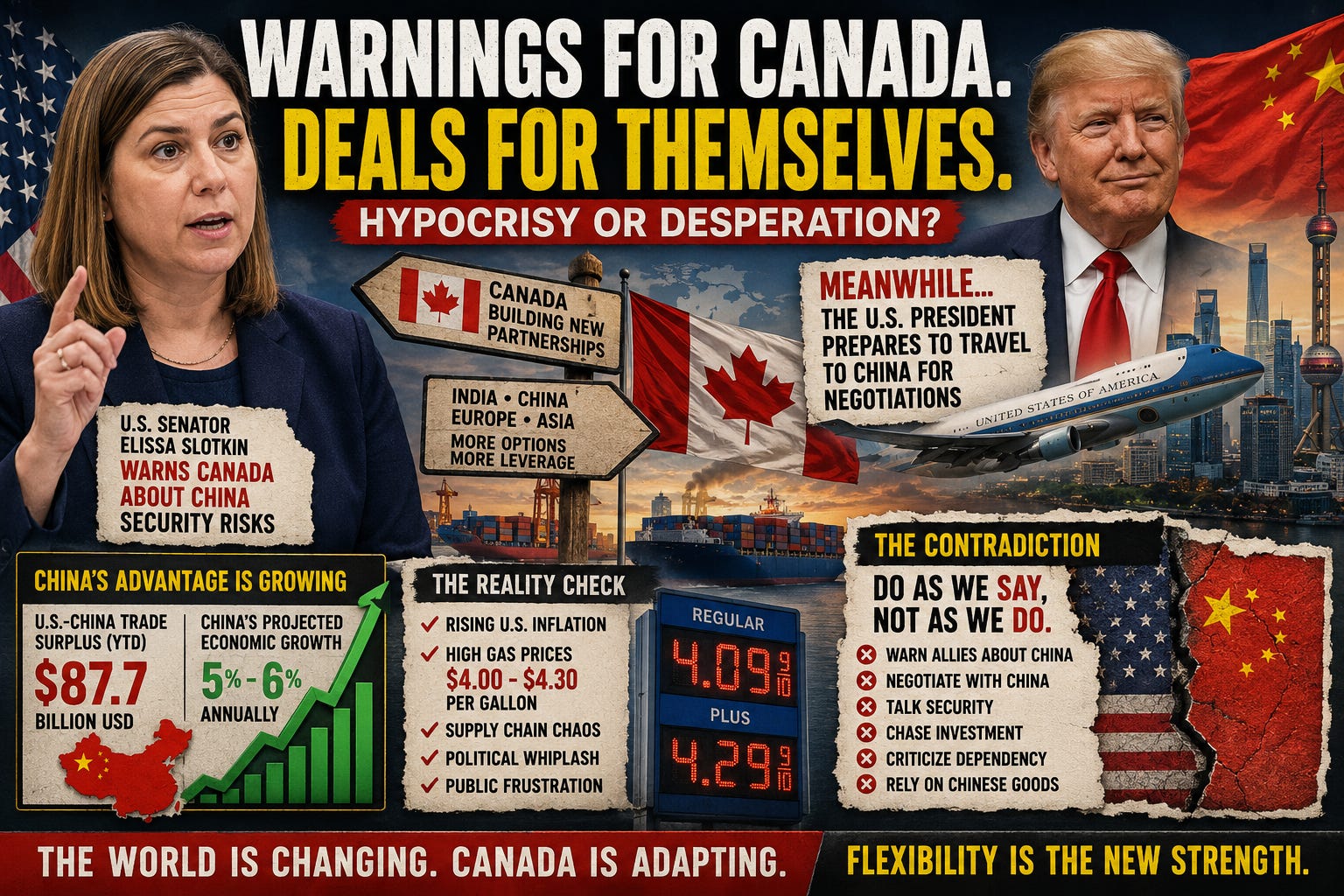
“Don’t trust China”… while American officials line up their own negotiations…
behind closed doors.
The old version of the world is breaking apart right in front of us.
And you can tell because the lectures are getting louder.
This week, U.S. Senator Elissa Slotkin warned Canada about getting too close to China. The concern? Security.
Chinese surveillance. Data collection. Economic dependence. The usual list.
Now look… some of those concerns are real.
China absolutely plays the long game.
Chinese EV technology absolutely raises questions about data collection, mapping, and geolocation systems.
Here’s where the thing starts smelling like burnt toast.
At almost the exact same moment Canada is being warned not to deepen ties with China… the United States itself is preparing economic discussions and negotiations with Beijing.
That’s the part nobody can ignore anymore.
The message sounds less like:
“China is dangerous.”
And more like:
“Please don’t build your own relationship without us.”
Because the global balance of power is changing faster than Washington is comfortable admitting.
For decades, the United States operated like the undisputed centre of gravity. Allies orbited around it because they had little choice.
America was the market. America was the military umbrella. America was the financial system.
Now?
Countries are quietly building backup plans.
Canada included.
And honestly, after the last couple years, can you blame us?
Trade fights. Tariff threats. Constant political whiplash.
One administration signs agreements. The next one treats them like expired coupons found in a junk drawer.
That changes how countries think.
You stop building your entire future around one customer when that customer keeps threatening to burn down the loading dock every election cycle.
So Canada has been doing something smart…
expanding options.
India. Europe. Asia. New supply chains. New partnerships. More leverage.
Not because China is some magical saviour.
It isn’t.
But because depending entirely on one increasingly unstable partner is how countries get trapped.
Meanwhile, China keeps gaining economic ground whether Washington likes it or not.
The numbers matter here.
China’s trade surplus with the United States reportedly sits around $87.7 billion year-to-date.
That is not the profile of a collapsing power.
That’s leverage.
And while American politicians publicly posture about economic toughness, the reality underneath is messier…
the U.S. economy still depends heavily on Chinese manufacturing, supply chains, rare earths, industrial capacity, and investment flows.
Which is why the anti-China rhetoric always seems to collide headfirst into economic reality.
Every. Single. Time.
That contradiction is becoming impossible to hide now.
One minute:
“China is a threat.”
The next minute:
“Let’s negotiate.”
One minute:
“Canada should be careful.”
The next minute:
“American companies need market access.”
It’s geopolitical whiplash.
And regular people feel the consequences downstream.
Inflation stays sticky.
Gas prices climb.
Supply chains wobble.
Consumers get squeezed.
Then politicians start blaming each other like raccoons fighting over the last french fry in a parking lot.
Meanwhile China keeps playing the patient game.
That’s the real shift happening underneath all this noise.
China thinks in decades.
The West increasingly thinks in election cycles and viral clips.
And countries like Canada are stuck navigating the middle of it… trying to maintain sovereignty without becoming economically cornered by either side.
That’s why this moment matters.
Because Canada is slowly starting to behave less like a subordinate… and more like an independent country with its own strategic interests.
That’s a psychological shift as much as an economic one.
Washington still talks to Canada like the junior partner at the table.
But the world that created that dynamic is fading.
Fast.
And when American officials warn allies away from China while simultaneously negotiating their own deals with China, people notice.
Especially Canadians.
It starts sounding less like principle…
…and more like ownership anxiety.
The truth is simpler than most politicians want to admit:
The world is becoming multipolar whether anybody likes it or not.
The United States is still enormously powerful.
China is still enormously ambitious.
And countries caught between them are increasingly choosing flexibility over loyalty.
That’s not betrayal.
That’s survival.
The Recap…
Canada just got warned about China by the same country heading into negotiations with China.
That’s the part people are noticing now.
The old “do as we say, not as we do” foreign policy model is starting to crack… and Canada is quietly building more options while the global power balance shifts underneath everybody’s feet.
The Gut-Punch…
The real story isn’t whether China can be trusted.
It’s that America no longer has enough leverage to stop other countries from making their own calculations.
And deep down?
Washington knows it.
Source credit:
Research notes and summarized source material provided by user.
🔎 The GeezerWise Standard
This space is built on disciplined thinking.
Facts over spin.
Verification before amplification.
Good-faith discussion over tribal noise.
I use AI tools to help shape my spoken drafts into clear writing.
The judgment, conclusions, and final message are mine.
If you’re new here, this explains how I decide what’s worth sharing:
How I Decide What’s Worth Sharing → [link]
💌 Subscribe at GeezerWise.com to receive future letters:
www.geezerwise.com/subscribe
— Fred Ferguson
GeezerWise
#CanadaStrong
It would be nice if China turned trump over to the intl. court for prosecution
"Washington still talks to Canada as a junior partner at the table" but that is changing, and rather rapidly, whether the Americans like it or not.