

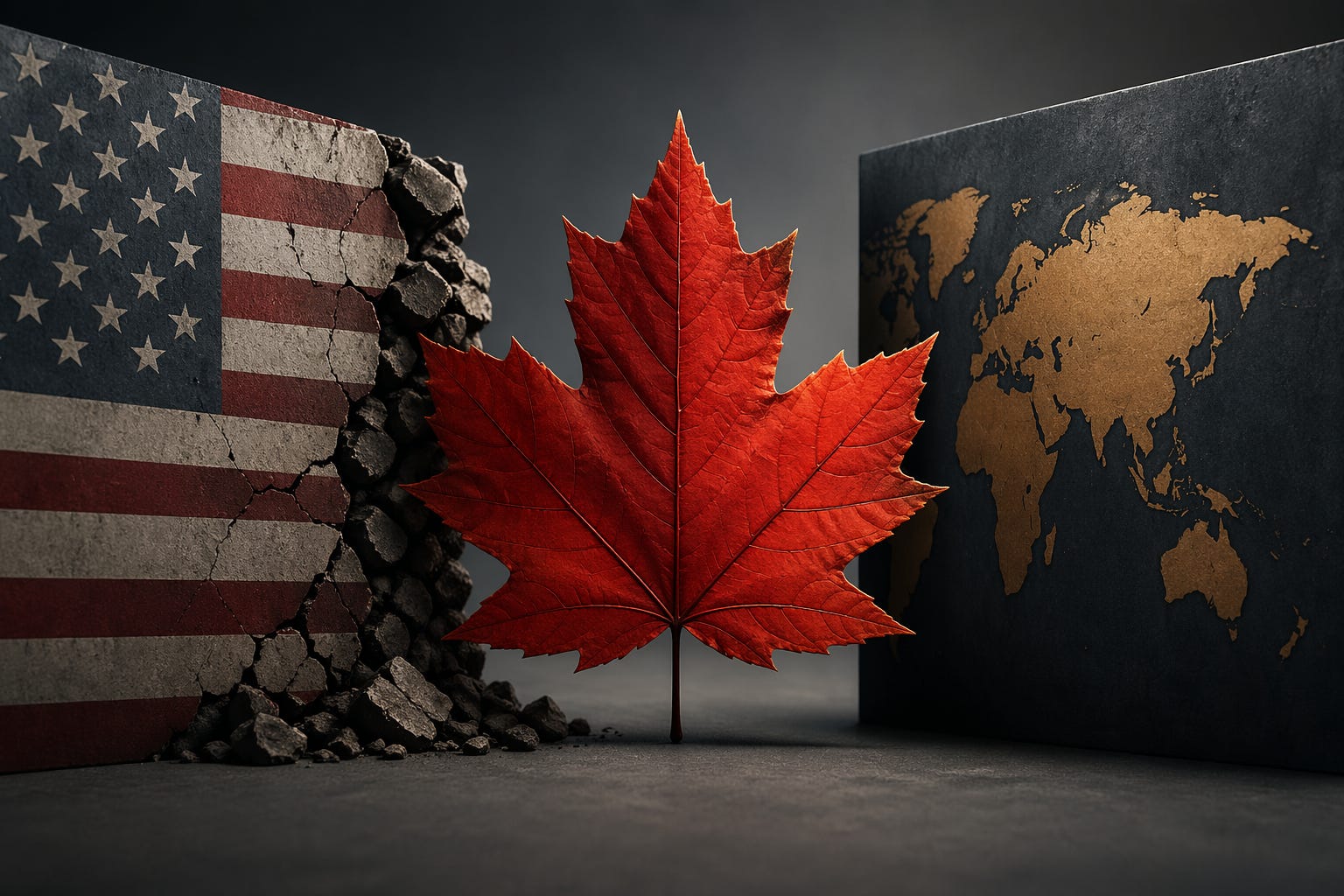
This didn’t come out of nowhere…
It just finally got said out loud.
Canada’s Prime Minister publicly called the country’s economic dependence on the United States a “strategic weakness.” Not a concern. Not a risk.
A weakness.
And once you use that word… you don’t walk it back.
This wasn’t just talk either. The numbers behind it tell the real story.
Canada dumped $20.5 billion in U.S. Treasury bonds in late 2025. That’s not symbolic. That’s a deliberate move away from American financial exposure.
At the same time…
Canadian travel to the U.S. dropped 35%
Nearly 25% of Canadians cancelled U.S. trips
That alone cost the U.S. economy about $4.5 billion
That’s not politics.
That’s behavior changing.
And behavior is what shifts power.
Now zoom out.
Canada isn’t acting alone. It’s just the first one to say the quiet part clearly.
Europe has been moving in the same direction:
Wind and solar now generate 30% of EU electricity
A plan is in place for 300 gigawatts of North Sea wind capacity
The goal? Cut reliance on imported energy — including U.S. LNG
Translation… build systems that don’t need America.
Then look at money.
China’s U.S. Treasury holdings dropped from $1.3 trillion (2013) to $693 billion (2026) … a 48% decline
Gulf funds are reviewing up to $2 trillion in U.S. investments
Saudi Arabia cut U.S. commitments by 70%
That’s not a trend.
That’s a slow, steady exit.
Back to Canada.
They’ve already laid out the next move…
Double non-U.S. exports by 2035
Expand trade with China and India
Reduce reliance on a system where 97% of energy exports go to the U.S.
And the shift has already started…
Exports to the UK up $7.6 billion
China exports up 18.4%
EU exports up 11.4%
U.S. exports? Down
This isn’t emotional.
It’s math.
So what triggered it?
Simple.
When your biggest ally starts acting unpredictable… tariffs, threats, public pressure… you stop calling it “partnership.”
You start calling it risk.
And once something lands in the “risk” column, the next move is always the same:
You reduce exposure.
Here’s the part most people miss…
Nobody is “breaking up” with the U.S.
They’re building backup systems.
Think of it like this:
If your main supplier keeps threatening to cut you off… you don’t argue.
You build a second supplier.
Then a third.
And eventually, the original supplier stops being essential.
That’s what’s happening here.
Supply chains are shifting
Energy systems are being rebuilt
Trade routes are being diversified
Capital is being reallocated
And none of that reverses quickly.
You don’t spend decades building infrastructure… just to flip it back because the mood changed.
There’s also a deeper shift happening underneath all this.
For years, countries had to justify moving away from the U.S.
Now?
They have to justify staying dependent.
That’s a complete inversion of the narrative.
And here’s where it gets interesting…
Military alliances like NATO were built for physical threats.
Tanks.
Missiles.
War.
But they don’t protect against…
Tariffs
Trade pressure
Financial leverage
So countries are solving a different problem now.
Not “Who protects us?”
But…
“What happens if our protector becomes a source of pressure?”
That question changes everything.
And once that question is asked publicly…
The shift is already underway.
The Recap…
Canada didn’t just criticize the U.S. — it started reducing its exposure.
Money is moving. Energy is shifting. Trade routes are being rebuilt.
Europe, China, and Gulf states are doing the same thing.
This isn’t noise. It’s a slow-motion repositioning of global power.
The Gut-Punch…
Nobody storms out anymore.
They just build a world where they don’t need you.
Source credit:
Geopolitical and economic data from House of El research notes (trade flows, treasury holdings, energy data, and policy statements).
🔎 The GeezerWise Standard
This space is built on disciplined thinking.
Facts over spin.
Verification before amplification.
Good-faith discussion over tribal noise.
I use AI tools to help shape my spoken drafts into clear writing.
The judgment, conclusions, and final message are mine.
If you’re new here, this explains how I decide what’s worth sharing:
How I Decide What’s Worth Sharing → [link]
💌 Subscribe at GeezerWise.com to receive future letters:
www.geezerwise.com/subscribe
— Fred Ferguson
GeezerWise
#CanadaStrong
I love how your post is saying things are "quietly" happening rather than "screaming" at the dufus, BUT, we all want to. For me this post is peace promoting & very informative. We are quietly moving on & many are following. We can all take this to a personal level, I do it all the time. I am shopping at a store that I like, & normally, staff are friendly & polite, but, today is different, you have a lady spending a LOT of money & all 3 staff concentrate on her & ignore me...the person who always comes back. I walk out without buying the items I need & quietly go to another shop & never return to the old one. Same thing, just on a personal level & I love seeing our country doing what I do, only on a much larger scale. We don't have to beg rude & unfriendly people to consider us, walking is the 100% right thing to do. We still love our friends & family over there & all the good people who have always been good :)
Carney needs to lead those ‘middle nations’ he talked of in Davos to create a NATO style economic alliance. Like minded nations, who will work together and defend each other against attacks by the powerful countries, USA, China, Russia. So any economic attack on one, becomes an attack on all and will be met with the combined economic might of every member. It’s the only way to survive in a world if Trumps & Putins.