

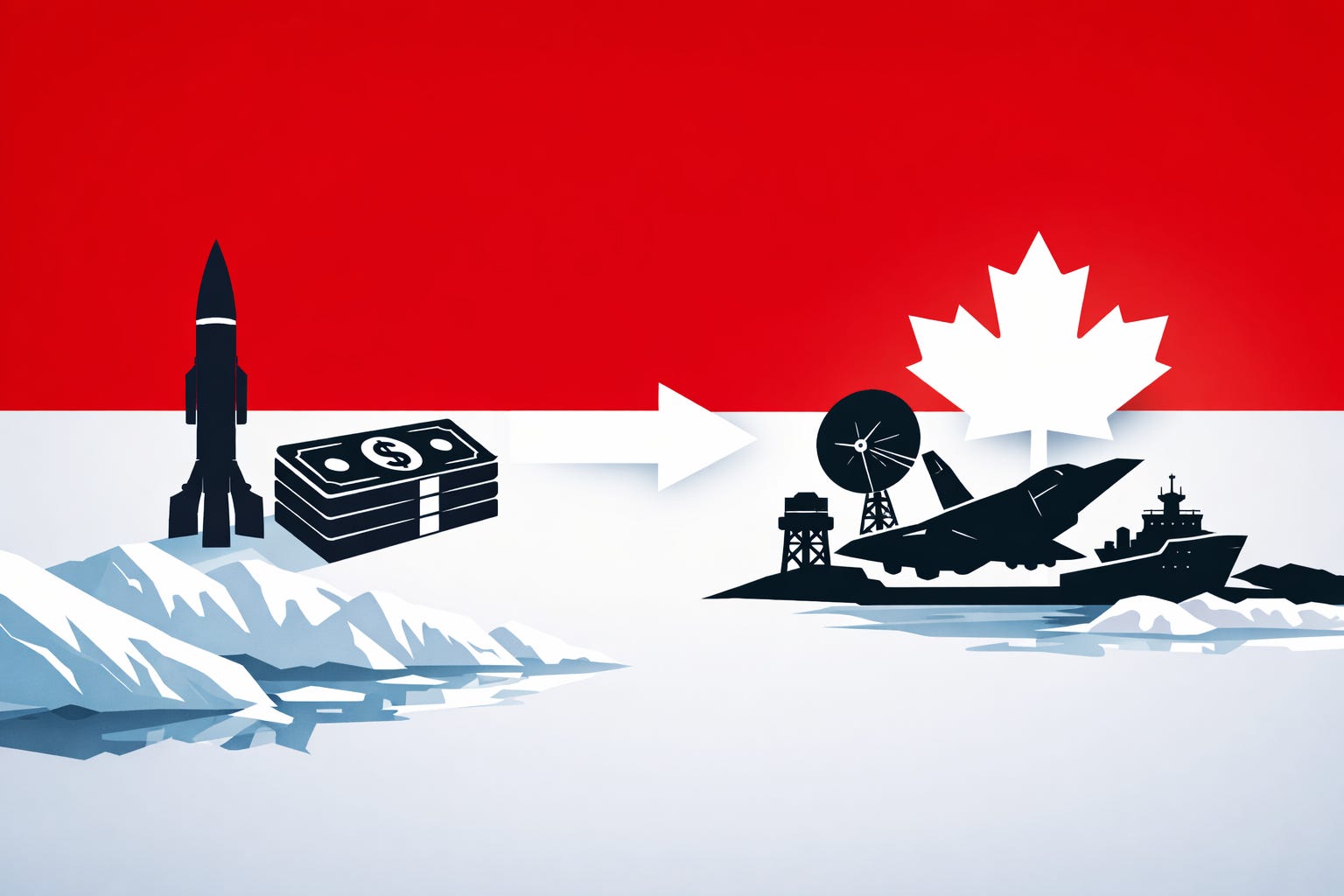
For decades, when Canada talked about “defence spending,” it usually meant one thing.
Write a big cheque.
Send it to the United States.
Buy equipment.
That pattern is quietly changing.
On March 12, Prime Minister Mark Carney announced a $35-billion investment focused on defence infrastructure across Canada’s Arctic and northern regions.
Not millions.
Billions.
And most of the funding…about $32 billion… comes from money originally earmarked years ago to modernize NORAD, the joint Canada-U.S. aerospace defence system.
But the way that money will be spent tells a very different story about where Canada’s priorities are heading.
Instead of simply buying hardware abroad, Ottawa is putting the money into building the North.
The Arctic Is No Longer an Afterthought
Carney described past Arctic development as fragmented… small projects scattered over decades.
Ports here.
Roads there.
A radar installation somewhere else.
Useful pieces, but never part of a coherent strategy.
The new plan flips that approach.
Multiple infrastructure and defence projects will move forward at the same time, forming what the government calls economic and security corridors across northern Canada.
The goal is straightforward…
Strengthen sovereignty, boost the economy, and finally connect regions that have spent generations isolated.
What the $35 Billion Actually Builds
Several major projects are already identified.
• Upgrades to four northern forward operating bases, allowing them to host Canada’s incoming F-35 stealth fighter fleet
• New Arctic over-the-horizon radar systems, developed with Australia
• Air-to-air refueling aircraft
• Short, medium, and long-range missile systems
• Command, communications, and surveillance upgrades
Two additional operational hubs will also be created in…
• Whitehorse, Yukon
• Resolute, Nunavut
These hubs will store equipment and ammunition and allow forces to stage operations quickly in the Arctic.
But the Bigger Story Is the Civilian Infrastructure
Defence is only part of the picture.
The plan also includes major nation-building projects:
1️⃣ Mackenzie Valley Highway
An 800-kilometre all-season road linking northern communities and creating a new economic corridor.
2️⃣ Grays Bay Road and Port
A 230-kilometre road and deep-water Arctic port with both civilian and military uses.
3️⃣ Arctic Security and Economic Corridor
A proposed 400-kilometre transportation route linking the Northwest Territories and Nunavut resource regions.
4️⃣ Taltson Hydro Expansion Project
A project expected to double hydroelectric capacity in the Northwest Territories and connect northern power grids.
Civilian airport upgrades are also planned for communities such as Rankin Inlet and Inuvik.
These projects do more than move troops.
They connect communities, unlock resource development, and build long-term economic infrastructure in regions that have historically been difficult to access.
Why This Counts as Military Spending
There’s also a strategic accounting shift happening.
Canada has committed to increasing defence spending to 2% of GDP this year, with a goal of 5% by 2030.
Infrastructure that supports Arctic security… roads, ports, energy, radar… can be counted toward that defence spending target.
Instead of simply buying equipment abroad, Canada can now meet NATO expectations while building domestic infrastructure and jobs at the same time.
Build at Home First
Another key policy element is procurement.
Federal legislation now requires Canadian firms to be prioritized for government contracts tied to these projects.
That means…
Canadian materials
Canadian construction
Canadian engineering
Canadian labour
In other words, the money circulates inside the Canadian economy instead of leaving it.
The Strategic Context
This investment also arrives at a moment when Canada is reassessing its economic relationship with the United States.
Trade diversification takes time.
Infrastructure can start now.
By strengthening northern transportation, energy systems, and logistics, Canada positions itself to expand mining, shipping routes, and Arctic security at the same time.
The North holds enormous resource potential… from critical minerals to new shipping routes opened by melting Arctic ice.
For decades, development lagged behind geography.
This plan suggests Ottawa intends to change that.
The Bottom Line
For a long time, Canada treated the Arctic like a distant backyard.
Important.
But neglected.
That era may be ending.
A $35-billion investment in roads, ports, radar, bases, and energy isn’t just a defence announcement.
It’s a statement of intent.
Canada is finally preparing to defend, connect, and develop the North — all at once.
And about time.
The Recap…
Canada just announced a $35-billion Arctic strategy.
New roads.
New ports.
New radar systems.
And upgraded northern air bases.
For decades defence spending meant writing cheques abroad.
Now Ottawa is building the North instead.
This is a much bigger shift than it looks.
The Git-Punch…
Canada used to protect the Arctic with maps and speeches.
Now it’s finally building the infrastructure to defend it.
Source Credit:
Source: Government announcement and reporting on Canada’s $35-billion Arctic defence and infrastructure strategy (March 12).
🔎 The GeezerWise Standard
This space is built on disciplined thinking.
Facts over spin.
Verification before amplification.
Good-faith discussion over tribal noise.
I use AI tools to help shape my spoken drafts into clear writing.
The judgment, conclusions, and final message are mine.
If you’re new here, this explains how I decide what’s worth sharing:
How I Decide What’s Worth Sharing → [link]
💌 Subscribe at GeezerWise.com to receive future letters:
www.geezerwise.com/subscribe
— Fred Ferguson
GeezerWise
#CanadaStrong
An excellent and thought-provoking piece, Fred.
What strikes me most in your analysis is the quiet strategic logic behind Canada’s moves. Diversifying trade relationships and strengthening ties with partners across the Indo-Pacific and Europe is not simply economic policy — it is geopolitical risk management. For a country that has long relied heavily on one dominant neighbour, building options may prove to be the most rational long-term strategy.
The real challenge, as you suggest, is patience. Structural shifts in trade networks and supply chains rarely produce immediate results, but they can profoundly reshape a country’s strategic freedom over time.
If Canadians understand that this is a long game rather than a quick fix, the Carney strategy could turn out to be one of the more consequential adjustments in Canada’s modern economic diplomacy.
— Hans
Take care of your own, take care of your home. I've noticed Canadian Armed Forces commercials on TV as well. WE're waking up!