

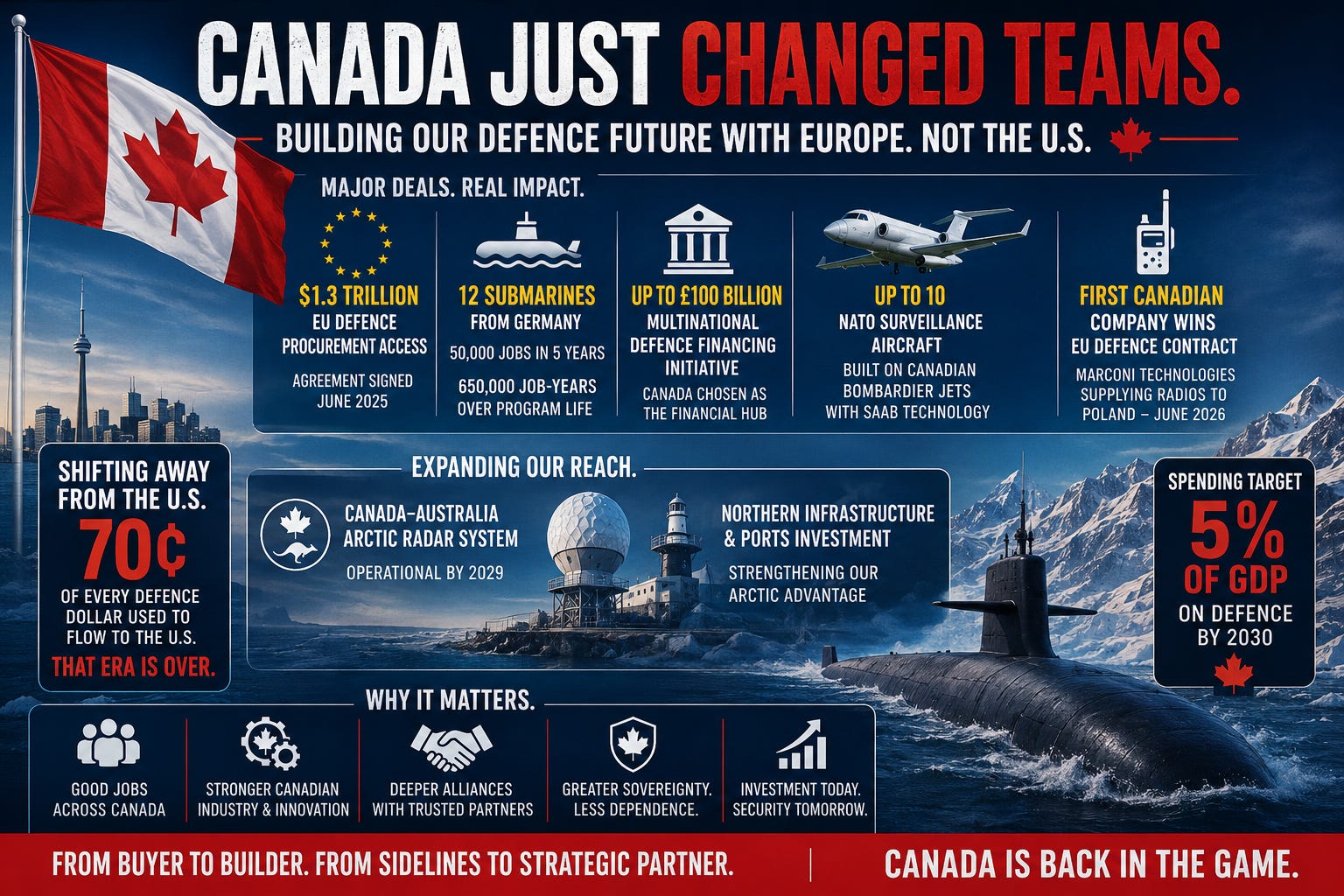
For decades, Canada’s defense strategy was simple…
buy equipment, write cheques, and rely heavily on the United States.
That model is being dismantled.
What we’re watching now isn’t a routine military spending increase.
It’s a wholesale redesign of where Canada builds, who Canada partners with, and how Canada fits into the Western alliance.
And for once, Canada isn’t being positioned as the customer.
It’s being positioned as a partner.
The Biggest Shift Is Happening Outside Washington
Most Canadians still think of defense through a North American lens.
That’s becoming outdated.
Over the past year, Canada has been quietly weaving itself into a growing network of European and NATO defense projects that are designed to spread production, financing, and technology across allied countries.
The clearest example may be the European defense procurement agreement signed last year.
That deal opened the door to roughly $1.3 trillion worth of European defense purchasing opportunities.
Within months, a Canadian company had already landed one of the first contracts, supplying communications equipment to Poland.
That may sound like a small story.
It isn’t.
It’s the first sign that Canada is moving from the sidelines onto the field.
Canada Is No Longer Just Buying Equipment
For years, a large share of Canadian defense spending flowed south.
Buy American.
Maintain American.
Upgrade American.
Repeat.
Now the strategy is changing.
Canada’s submarine agreement with Germany isn’t simply about acquiring vessels.
It’s about creating industrial capacity, supply chains, manufacturing work, and long-term employment here at home.
Early projections suggest tens of thousands of jobs in the first years of the program and hundreds of thousands of job-years over its lifespan.
That transforms defense spending from an expense into an economic development strategy.
The equipment matters.
The jobs matter too.
Europe Isn’t Looking for Customers
Europe is looking for partners.
That’s an important distinction.
European governments increasingly want defense production spread across trusted allies rather than concentrated in a single country.
Canada checks several boxes.
Stable government.
Reliable institutions.
Strong banking system.
Advanced aerospace sector.
Abundant natural resources.
Political alignment with NATO partners.
Those advantages are starting to attract attention.
A proposed multinational defense financing initiative reportedly worth up to £100 billion is expected to use Canada as a central hub because of confidence in Canada’s financial system.
Think about that for a moment.
For years, Canadians were told we were too small to matter.
Now allies are discussing building major defense financing structures around Canadian stability.
That’s a different conversation entirely.
Bombardier’s Surprise Return to the Global Stage
One of the more fascinating developments involves aerospace.
NATO is reportedly advancing plans for a fleet of airborne surveillance aircraft built around Canadian-made Bombardier jets equipped with advanced Saab systems.
If approved, those aircraft would become part of NATO’s intelligence and surveillance network.
That matters for two reasons.
First, it puts Canadian manufacturing inside a critical alliance capability.
Second, it signals that allies increasingly see Canadian industry as part of the solution rather than merely another customer standing in line.
Canada hasn’t occupied that role often enough.
The Arctic Is No Longer an Afterthought
The North has moved from a distant political talking point to a strategic priority.
Canada’s partnership with Australia on next-generation Arctic radar systems is one example.
The system is expected to become operational before the end of the decade.
At the same time, new investments in northern infrastructure, surveillance, logistics, and military readiness continue to accelerate.
That’s not happening by accident.
Every major NATO country understands the Arctic is becoming more important economically and strategically.
Canada happens to own a large piece of the map.
Ignoring it is no longer an option.
Why The Spending Target Matters
For years, Canada struggled to meet NATO expectations.
Defense spending routinely sat below alliance targets.
That era appears to be ending.
The new goal of reaching 5% of GDP by 2030 represents a dramatic shift in ambition.
Whether every dollar ultimately gets spent is almost beside the point.
The signal matters.
Canada is telling allies that defense is no longer a secondary priority.
It’s becoming part of national economic policy, industrial policy, and foreign policy all at once.
The Political Fight Is About More Than Defense
Here’s where things get interesting.
This isn’t simply a debate about submarines, aircraft, or radar systems.
It’s a debate about Canada’s future orientation.
One vision sees Canada deeply integrated with allies, building things jointly, financing projects jointly, and sharing industrial capacity.
The other focuses more heavily on domestic grievance politics, cultural battles, and ideological branding.
Voters will ultimately decide which vision they prefer.
But one side is announcing contracts, factories, partnerships, and procurement agreements.
The other is largely talking about them.
Those aren’t the same thing.
Canada’s New Role
The biggest story isn’t the submarines.
It’s not the surveillance aircraft.
It’s not even the defense bank.
The real story is that Canada is beginning to occupy a different position inside the Western alliance.
For decades, Canada was often viewed as a dependable but secondary player.
Useful.
Trusted.
Not central.
Now allies are increasingly treating Canada as a manufacturing partner, a financing partner, an Arctic partner, and a strategic partner.
That doesn’t happen overnight.
And it doesn’t happen by accident.
It happens because countries see value in working with you.
For the first time in a long time, Canada appears to be building exactly that kind of reputation.
The Recap…
Canada’s defense strategy is being rebuilt from the ground up.
Europe is opening trillion-dollar procurement opportunities, NATO is looking at Canadian-built surveillance aircraft, and major defense projects are creating jobs at home instead of exporting dollars abroad.
This isn’t just military spending.
It’s a bet on Canadian industry, Canadian sovereignty, and Canada’s place in the world.
The Gut-Punch…
For decades, Canada bought security from others.
Now it looks like we’re trying to build it ourselves… and getting paid to help our allies do the same.
That’s a very different country than the one we were ten years ago.
Source credit:
Based on publicly reported developments involving NATO procurement planning, Canada-EU defense cooperation agreements, Canada-Australia Arctic defense initiatives, European defense financing proposals, Canadian defense procurement announcements, and related reporting from July 2025–July 2026.
If you enjoy thoughtful conversations, Canadian stories, and the occasional smart-ass observation about the world we’re living in, you’re in the right place.
Subscribe free and get new stories, insights, and observations delivered directly to your inbox.
No paywall.
No spam.
No nonsense.
Leave anytime with a single click.
I promise not to take it personally.
Thank you Fred, again you translated in your clear point style writing what I have watched on several YouTube channels, which leaves me with questions. Am slowing down my consumption of Glen Deisen, the hook, and several others. My ever curious brain gets overly stimulated as I age😂. I see I have the 9th part of the series in my in box. Will relax with that now🤗
Stay on your feet, keep your eye on the ball because the american lobby from the military complex will crawl to the bosses of nato, People on the wheel, with promisses of wealth and other deals only believe every thing when the papers are seald and signd. With rutte, the crawling boy to trump , he has no spine only a velvet tonque and silky smooth lips anything can happen. Backroom deals and dishonesty, corruption, greed are a great motivation to change minds. When money goes around honor is gone, ears become deaf and eyes become blind. One great tv show from many years a go had a great slogan , TRUST NO ONE and that still is great advice