

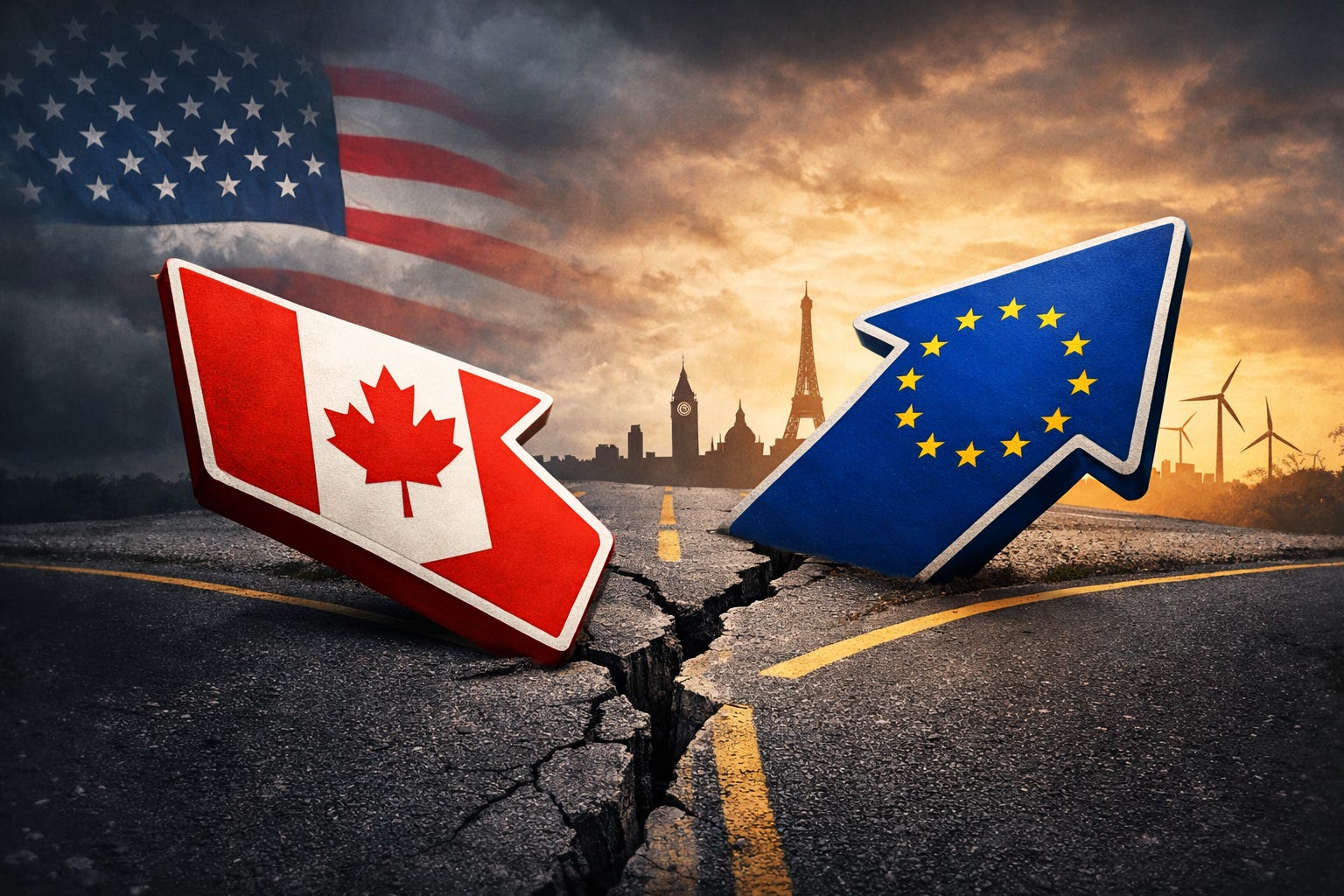
Something shifted.
Not loudly.
Not with a headline screaming panic.
Just… quietly.
And when you look at the numbers, it’s not subtle anymore.
The Mood Change Nobody’s Talking About
Recent polling shows something that would’ve sounded ridiculous just a couple years ago…
Only 24% of Canadians have a positive view of the United States
The UK and EU sit at 66% positive
Even Mexico ranks higher than the U.S.
Let that sink in.
Canada… the country tied at the hip economically, culturally, geographically… is cooling hard on its closest partner.
That’s not a blip.
That’s a shift.
The Real Shocker Isn’t Today… It’s What Comes Next
When asked who Canada’s most important partner is right now, it’s basically a tie…
U.S. and Europe neck-and-neck
UK, China, Mexico trailing behind
But here’s where it gets interesting…
When asked about the next 3–5 years, the leaderboard flips…
European Union jumps to #1 (52%)
China moves up
The U.S. drops to third
That’s not just opinion.
That’s forward positioning.
Trust Is Breaking… And That’s the Whole Game
Here’s the number that should make people sit up…
Only 10% say the U.S. is “very reliable”
39% say “not reliable at all”
That’s not skepticism.
That’s erosion.
And Canada tends to feel this first.
We’re the test case.
If trust is cracking here… it’s cracking everywhere.
So… Are Canadians Looking for a New Club?
Now we get to the uncomfortable question…
74% support deeper cooperation with the EU
48% support actually joining the EU
Only 28% oppose it
Almost half the country is open to something that would’ve been laughed out of the room not long ago.
That’s not about Europe.
That’s about uncertainty.
Let’s Be Real… Joining the EU Isn’t Simple
Technically? Possible.
Practically? Good luck.
Every single EU country would have to agree. All 27 of them.
And then ratify it.
Anyone who’s ever tried to get five people to agree on dinner knows how that ends.
Now multiply that by 27 governments.
And There’s a Bigger Issue Nobody Mentions
Joining the EU isn’t just about trade.
It’s about control.
Trade policy shifts to Brussels
More bureaucracy
Free movement rules kick in
Border dynamics with the U.S. get tighter
In plain English…
You gain access… but you give up autonomy.
Here’s the Part Most People Miss
Canada doesn’t actually need to join anyone.
We’re in a rare position.
We’ve got…
Energy
Minerals
Agriculture
Water
Land
Stability
There aren’t many countries on Earth that can say that.
We don’t need to “join a club” to be relevant.
We just need to stop acting like we only have one dance partner.
The Smarter Move?
Not marriage.
Partnerships.
More trade with Europe.
More with Asia.
More with whoever makes sense.
Diversify… without surrendering control.
Bottom Line
This isn’t really about Europe.
It’s about confidence.
When trust drops, countries start looking around.
Canada just did.
And for the first time in a long time…
we’re not automatically looking south.
The Recap…
Something changed in Canada… and most people missed it.
For the first time in decades, the U.S. isn’t the obvious answer anymore.
The numbers don’t lie… and they’re a little shocking.
This one’s worth your time.
The Gut-Punch…
When trust cracks… even the closest allies start checking the exits.
Source Credit:
Based on recent Canadian polling data and analysis of public opinion trends
🔎 The GeezerWise Standard
This space is built on disciplined thinking.
Facts over spin.
Verification before amplification.
Good-faith discussion over tribal noise.
I use AI tools to help shape my spoken drafts into clear writing.
The judgment, conclusions, and final message are mine.
If you’re new here, this explains how I decide what’s worth sharing:
How I Decide What’s Worth Sharing → [link]
💌 Subscribe at GeezerWise.com to receive future letters:
www.geezerwise.com/subscribe
— Fred Ferguson
GeezerWise
#CanadaStrong
Canada Isn’t Looking South Anymore... And…
Response to Fred
There is something in your observation that feels right, Fred—and perhaps precisely because it is not presented as a dramatic break, but as a gradual shift that has been building for some time.
Canada has always lived with a certain duality: deeply integrated with the United States in geography, trade, and security, and yet intellectually and politically inclined toward Europe. That balance has held for decades, not because it was perfectly stable, but because it was *predictable*. And predictability, in international relations, often matters more than alignment.
What seems to be changing now is not the relationship itself, but the *confidence in its continuity*. When that confidence weakens—even slightly—the system begins to adjust. Quietly at first, as you say. Through sentiment, expectations, positioning.
And Canada, as you point out, is often an early indicator. Not because it is exceptional, but because it sits so close to the centre of the system. If trust shifts there, it tends to reflect something broader.
But I would perhaps frame the development a little differently.
This is not Canada “looking away” from the United States.
It is Canada beginning to **rebalance within a system that has become less predictable**.
And that distinction matters.
Because the alternative is not a simple pivot—from Washington to Brussels—but a more complex pattern of diversification. Energy, minerals, trade routes, financial flows—these are not aligned to a single partner anymore. They are spread, hedged, layered.
Which brings us to your most interesting point.
Canada does not need to “join a club.” That is true. But it also cannot operate entirely alone—not in a world where scale increasingly determines influence. So what we are likely to see is not autonomy in the classical sense, but something closer to **managed interdependence**.
And that is where the real shift lies.
Not in choosing Europe over the United States.
Not in abandoning one system for another.
But in recognising that the old assumption—
that one relationship could anchor everything—
no longer holds.
So the question is no longer *who Canada trusts most*.
It is whether the system itself still allows for that kind of singular trust.
At the moment, it doesn’t.
That polling shift toward the EU caught my attention. I looked at the official government response to the House International Trade committee report. Since the Canada-EU trade agreement took effect in 2017, two-way merchandise trade expanded by 66 percent. Exports rose 72 percent. Details at https://www.ourcommons.ca/content/Committee/451/CIIT/GovResponse/RP13856744/451_CIIT_Rpt3_GR_PDF/451_CIIT_Rpt3_GR-e.pdf. Parliament is already steering us toward more partners without ditching the big one south of the border.