

For most of my life, one assumption sat quietly in the background of global politics.
The United States led the Western alliance.
You could argue with American presidents.
You could disagree with American policies.
But NATO, Europe, Canada, and Washington were generally moving in the same direction.
Today, that assumption is being questioned in public.
And that may be the biggest geopolitical story most people aren’t paying attention to.
The headlines often focus on trade fights, tariff threats, military spending demands, or the latest political controversy.
Those stories matter, but they’re symptoms of something larger.
The real issue is trust.
Once trust starts disappearing inside an alliance, everything else gets harder.
Military planning gets harder.
Trade negotiations get harder.
Intelligence sharing gets harder.
Long-term investments get harder.
And rebuilding trust can take years.
Recent tensions have exposed a growing divide between Washington and many of its traditional partners.
The latest flashpoint came after American military action against Iran. Several NATO countries made it clear they viewed the operation as a U.S. decision rather than a
NATO mission. That’s not a minor distinction.
NATO was built as a defensive alliance.
Many member nations showed little interest in being drawn into offensive military operations that they did not help authorize.
At the same time, criticism of allies intensified. Trade retaliation threats surfaced. Long-standing partners found themselves being publicly targeted.
Even discussions about Greenland returned to the political stage, creating fresh uncertainty among European governments.
Taken individually, these events look like separate disputes.
Together, they tell a different story.
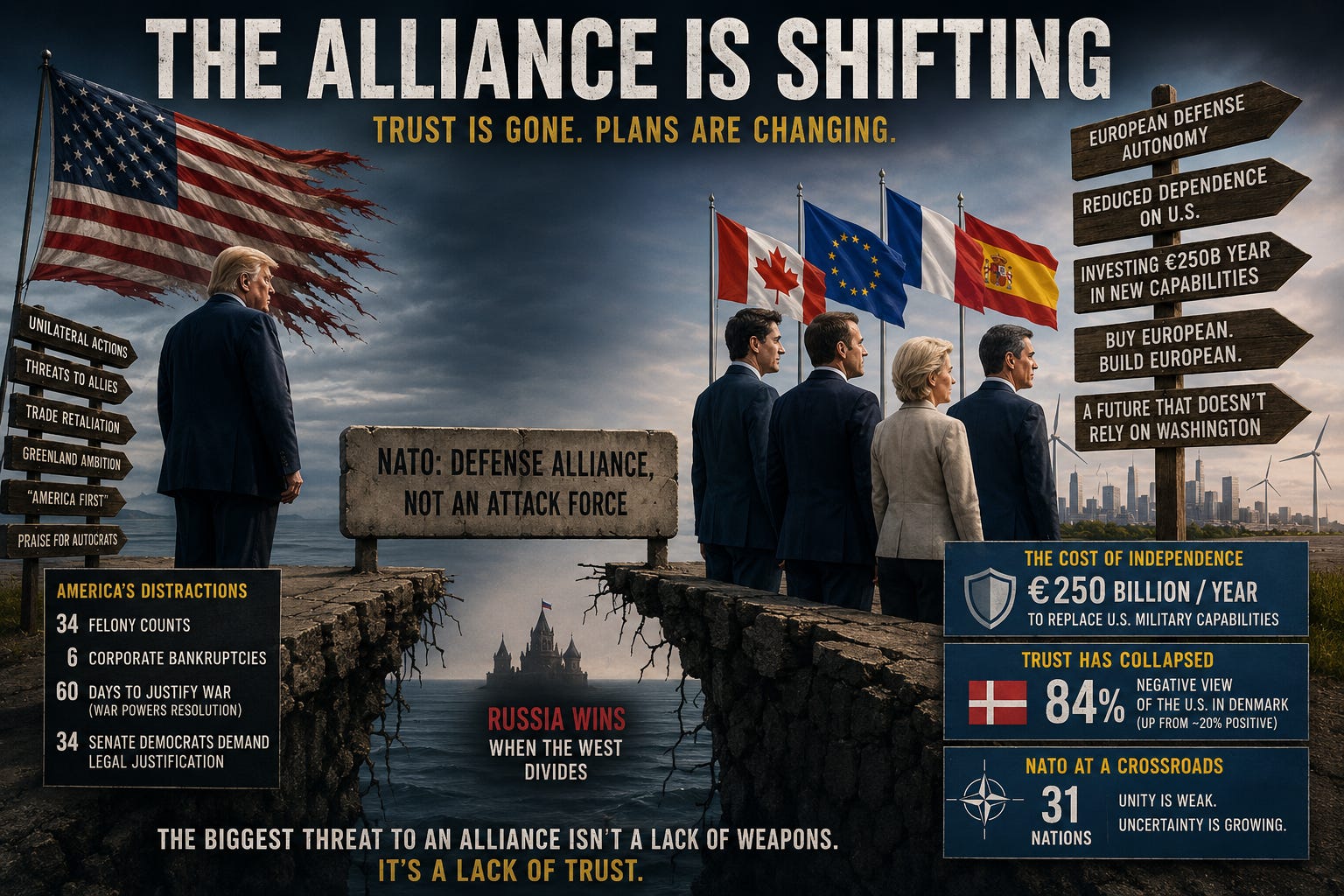
Europe is increasingly planning for a future where American support cannot automatically be assumed.
That’s a remarkable shift.
For decades, European security planning started with one basic question…
“What will the Americans do?”
Now a growing number of governments are asking a different question:
“What happens if the Americans don’t show up?”
Those are not the same conversation.
Defense planners across Europe are discussing how to reduce dependence on U.S. military capabilities, supply chains, logistics, intelligence systems, and equipment.
Some estimates suggest replacing the military capabilities currently provided by the United States could cost Europe roughly €250 billion per year.
That’s an enormous number.
But the fact that serious people are even discussing it tells you how much the conversation has changed.
A few years ago, that idea would have sounded fringe.
Today, it’s becoming strategic planning.
Canada finds itself in a familiar position.
Whenever the United States changes direction, Canada has to adjust.
We’re seeing that already.
Canada has expanded military and defense cooperation with Europe.
New defense procurement agreements are opening European markets to Canadian companies.
Military partnerships are broadening.
Trade diversification efforts are accelerating.
Ottawa isn’t abandoning the United States.
It is reducing risk.
There’s a difference.
If your largest customer keeps changing the rules, eventually you start looking for additional customers.
That’s not hostility.
That’s common sense.
Meanwhile, public opinion in parts of Europe is shifting rapidly.
In Denmark, surveys have shown an extraordinary collapse in confidence toward the United States, with negative views reaching levels that would have been difficult to imagine only a few years ago.
Governments notice those changes.
Politicians notice those changes.
Defense planners definitely notice those changes.
Public trust may not seem as important as aircraft carriers and missile systems, but alliances run on political support.
When voters stop believing in the relationship, leaders start building alternatives.
The biggest winner in all of this may be Russia.
Not because Russia is suddenly stronger.
But because division among Western allies has always been one of Moscow’s long-term strategic goals.
A divided alliance is less predictable.
Less coordinated.
Less effective.
Less capable of presenting a united front.
You don’t have to defeat an alliance if you can convince its members to stop trusting each other.
None of this means NATO is about to collapse tomorrow.
It doesn’t mean American troops are packing their bags next week.
And it doesn’t mean Europe suddenly becomes independent overnight.
But something important has changed.
The conversation has changed.
The assumptions have changed.
The contingency plans have changed.
The world that emerged after the Second World War was built on the belief that American leadership inside the Western alliance was permanent.
Today, more countries are treating that assumption as a risk rather than a certainty.
And once governments start building backup plans, they rarely stop.
The Recap…
For decades, Europe planned its security around American leadership.
Now many governments are quietly planning for the possibility that leadership may not always be there.
Canada is diversifying. Europe is rearming. NATO members are preparing contingency plans that would have sounded unthinkable a few years ago.
This isn’t a sudden breakup.
It’s a slow rearrangement of the furniture.
The Gut-Punch…
The biggest threat to an alliance isn’t a lack of weapons.
It’s a lack of trust.
Once allies start making plans for life without you, the relationship has already changed.
And right now, Europe and Canada aren’t asking whether America is still powerful.
They’re asking whether America is still predictable.
Source credit:
Based on public reporting, NATO discussions, European defense planning, trade and security developments, and international polling data regarding trust in the United States and Western alliance relationships.
If you enjoy thoughtful conversations, Canadian stories, and the occasional smart-ass observation about the world we’re living in, you’re in the right place.
Subscribe free and get new stories, insights, and observations delivered directly to your inbox.
No paywall.
No spam.
No nonsense.
Leave anytime with a single click.
I promise not to take it personally.
Well said. Absolutely the issue is Trust! The orbit is shifting. Important distinction to be sure. And we need to put our faith and support into the orchestrators (or is that conductors?) of such rupture.
Also, when you write: "You don’t have to defeat an alliance if you can convince its members to stop trusting each other," you state a truism, belonging in the category of "divide and conquer".
It is a true manipulation strategy, like propaganda, that I believe is being used by U.S.A. upon us to weaken our Elbows Up! and We're Stronger Together stances. And doesn't misery love company? So then the ordinary folks jump on the "bash a bit" bandwagon and the snowball grows.
I also believe that the more Canadians awaken to this tactic and refuse to get suckered into these internecine rodeos sponsored by outside forces, then the better off we will all be. ❤️🇨🇦
An important read for all Canadians (and Cath Millage’s comment)! TRUST- we are living in a time of misinformation,angst and overload. The people around me turning more radical minded , fear seems to have replaced trust. My consumption of reporting has been dwindled down to writing like yours and a few YouTube channels like House of El..I absolutely trust PM Carney’s long term strategy…I feel lighter already