

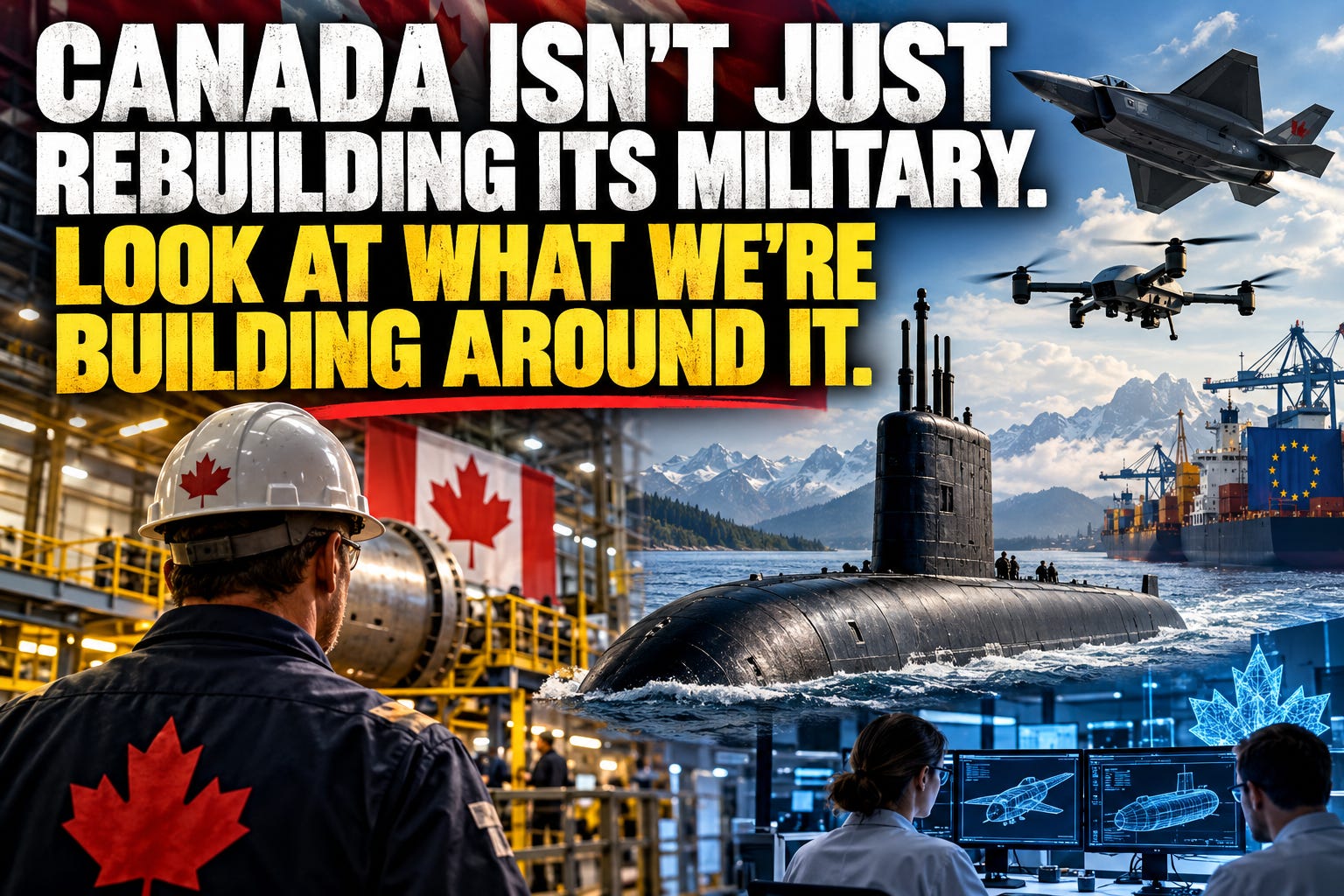
I started watching a speech by Defence Minister David McGuinty expecting to hear the usual defence stuff.
This is the video:
More money.
More equipment.
More promises about fixing a Canadian military that everybody has known for years needs fixing.
Then I realized I was listening to something else.
This wasn’t really a speech about buying military equipment.
It was about building an industry.
And that’s a hell of a difference.
Canada has committed to spending roughly half a trillion dollars on defence over the coming decade as it works toward NATO’s new defence investment commitment.
NATO members agreed in 2025 to reach 5% of GDP by 2035, with 3.5% devoted to core defence requirements and another 1.5% to defence- and security-related investments.
That’s the number everybody notices.
But I think we’re missing the more interesting part.
Where is all that money going to go?
For decades, Canadian defence procurement too often worked something like this…
Figure out what we need.
Find somebody who makes it.
Buy it.
Wait forever for it to arrive.
Canada’s new Defence Industrial Strategy is trying to change that equation.
The government calls its approach Build-Partner-Buy.
In plain English…
Build it in Canada when we reasonably can.
Build it with trusted partners when that makes more sense.
Buy it elsewhere when that’s the best or fastest option.
That may sound like bureaucratic rearranging until you look at the targets.
Over the next decade, the strategy aims to increase the share of Canadian defence acquisitions awarded to Canadian firms to 70%, increase Canadian defence exports by 50%, and create an estimated 125,000 jobs.
Those are targets, not achievements. Ottawa still has to deliver them.
But they tell us what the plan actually is.
Canada doesn’t simply want a bigger military.
It wants a bigger Canadian defence economy.
And we’re already seeing pieces of it.
Canada has selected Germany’s TKMS as the preferred supplier and begun negotiations for up to 12 new submarines.
The government says the first four are now targeted for delivery in 2034, ahead of the retirement of the existing Victoria-class fleet.
But here’s the part I find more interesting.
The deal is being structured so Canadian companies can become part of TKMS’s global supply chains, including through licensing and intellectual-property transfers.
In other words, don’t just sell us submarines.
Bring some of the business home with them.
We’re seeing the same thinking elsewhere.
Canada launched a Defence Drone Initiative in July designed to move Canadian drone and autonomous-system technology faster from development through testing and, where it meets military requirements, into production.
A secure defence innovation hub for autonomous systems has opened in Mirabel.
Another in Calgary is concentrating on quantum technologies.
An earlier hub in Halifax focuses on maritime technology.
These aren’t aircraft carriers and tanks.
They’re laboratories, researchers, software developers, engineers, startups and manufacturers.
That’s what a modern defence industry increasingly looks like.
Then there’s something else happening that I think Canadians should pay attention to.
We’re making new friends.
In July, Canada became the first observer country in the Global Combat Air Programme being developed by Britain, Italy and Japan.
That’s the project developing their next-generation combat aircraft.
Observer status doesn’t mean Canada has decided to buy the aircraft. It gives Canada access to the program’s development, governance and industrial framework while keeping future options open.
Canada has also formally applied to join the British-led Joint Expeditionary Force, a group of ten northern European NATO countries built around rapid military cooperation.
And then there’s Europe.
This one is worth stopping on.
Canada became the first non-European country allowed to participate in the European Union’s SAFE defence procurement program.
The Council of the European Union confirmed the agreement in June.
Think about what that means.
Canada isn’t simply shopping for European military equipment.
Canadian companies are being positioned to participate in a much larger European defence market.
That’s diversification with a helmet on.
And private money is beginning to notice.
At September’s Canada Investment Summit in Toronto, investors from nearly 30 countries managing more than $100 trillion in assets attended.
Canada’s major banks announced nearly $325 billion in new financing commitments for Canadian businesses and infrastructure.
CIBC alone committed $2 billion specifically for Canadian defence-related and dual-use small and medium-sized businesses.
Now, let’s keep our feet on the floor.
A financing commitment isn’t a factory.
A strategy isn’t a submarine.
A target isn’t 125,000 paycheques.
And anybody who has watched Canadian defence procurement for more than five minutes knows Ottawa has traditionally been capable of turning buying a canoe paddle into a 14-year consultation process.
McGuinty himself acknowledged the problem.
Strategies are easy.
Execution is harder.
That’s probably the most important sentence in his entire speech.
Because this thing should ultimately be judged by what actually gets built, delivered, exported and put into service.
But something has unquestionably changed.
Canada is connecting national defence with industrial policy, technology policy, skilled trades, exports, investment and trade diversification.
The military needs submarines.
Somebody has to maintain them.
The military needs drones.
Somebody has to design them, build them, program them and improve them.
The military needs quantum systems, cybersecurity, satellites, sensors and artificial intelligence.
Those require researchers, engineers, technicians, manufacturers and Canadian companies capable of competing internationally.
Suddenly defence spending isn’t only money leaving the treasury.
Some of it becomes industrial capacity.
Some becomes intellectual property.
Some becomes Canadian jobs.
Some becomes exports.
And some becomes something we’ve spent far too little time thinking about…
the ability to make more of the things we depend on ourselves.
That’s sovereignty too.
This doesn’t mean Canada builds everything.
It can’t.
No country does.
It means Canada decides what capabilities matter enough to maintain here, what should be developed with reliable partners, and what simply makes sense to purchase.
That is a much more grown-up conversation than arguing about whether Canada bought enough tanks this year.
The world has changed.
Supply chains have become security issues.
Technology has become a sovereignty issue.
Industrial capacity has become a national-security issue.
Canada appears to have finally noticed.
Now comes the hard part.
Building the damn thing.
The Recap…
Canada’s defence rebuild is becoming something much bigger than buying military equipment.
The government is trying to turn hundreds of billions in defence spending into Canadian factories, technology, skilled jobs, exports and stronger partnerships outside our traditional procurement patterns.
The targets are ambitious.
Now Canada has to deliver them.
The Gut-Punch…
A country that can’t build anything eventually depends on countries that can.
Canada appears determined to change that.
Source Credit:
This article was inspired by remarks by Canadian Defence Minister David McGuinty and independently checked against Government of Canada, NATO, European Union and other primary documentation.
Canada’s Defence Industrial Strategy
Canadian Patrol Submarine Project
Canada joins GCAP as its first observer nation
European Union SAFE agreement with Canada
Canada Investment Summit commitments
NATO’s 5% defence investment commitment
If you enjoy thoughtful conversations, Canadian stories, and the occasional smart-ass observation about the world we’re living in, you’re in the right place.
Subscribe free and get new stories, insights, and observations delivered directly to your inbox.
No paywall.
No spam.
No nonsense.
Leave anytime with a single click.
I promise not to take it personally.
Very interesting stuff Fred. Back about 1981/82 when i joined the federal government, from a provincial background in a very different field, they had an urgent need for someone with my policy skills at Supply and Services Canada. Its primary role was to provision the military, and make or buy was one of the leading questions on materials and materiel. It was believed that we needed to maintain core capacity for certain delicate equipment, don t ask me what today, but I recall how very important it was that we be able to at least minimally arm our own forces. And that meant winter clothing and boots and zippers as well as preserved foods, devices, transport, tires and so on. Businesses depended on government contracts not to get rich but to keep them afloat. Slow clearing cheques were still worth bidding for despite some swearing.
And suddenly within a year or so, they removed that policy capacity along with other divisions and the department got absorbed into something else, and the transition to international agreements and dependancies began. NAFTA,streamlined service, downgrading rail in favour of trucks. Lots more things that have come back to haunt us. I m astonished to find myself living through the full circle and now seeing the historical folly though I can t exactly see us being a military producer all those years either, but after PET, there was a pro American reaction from the Mulroney set. And off we trundled. So many decisions my instincts fought, many were right in hindsight although there are always equivocations no matter what.
I sure hope we re doing better now. I m keeping an eye on Norway as a benchmark, they seem to have made a lot of good calls over the same time.
You keep bring back memories. Guess I had a more interesting career than I remembered.
Keeping more of our defence dollars at home, but more importantly, creating intellectual capital. I remember a contract where we were looking for industrial offsets in Canada for the money leaving the country. One of the proposals was that the vendor proposed buying jam from Canada! Great if you make jam, but not the intent. Hopefully defence needs and intelltual property development get priority.