

We’d spend billions on military equipment, write the cheque, and watch much of the money leave the country.
The equipment arrived.
The jobs didn’t.
The investment didn’t.
The leverage didn’t.
Now that appears to be changing.
Beneath the usual political shouting match, Ottawa is quietly rewriting the rules of how Canada buys military equipment, who gets the contracts, and where the economic benefits land.
And that’s a much bigger story than the daily headlines suggest.
The argument dominating political circles right now is whether recent announcements are “real” or merely promises.
That’s the wrong question.
The real question is this…
What happens when Canada starts using defence spending to build Canadian industry instead of simply importing military hardware?
That’s where things get interesting.
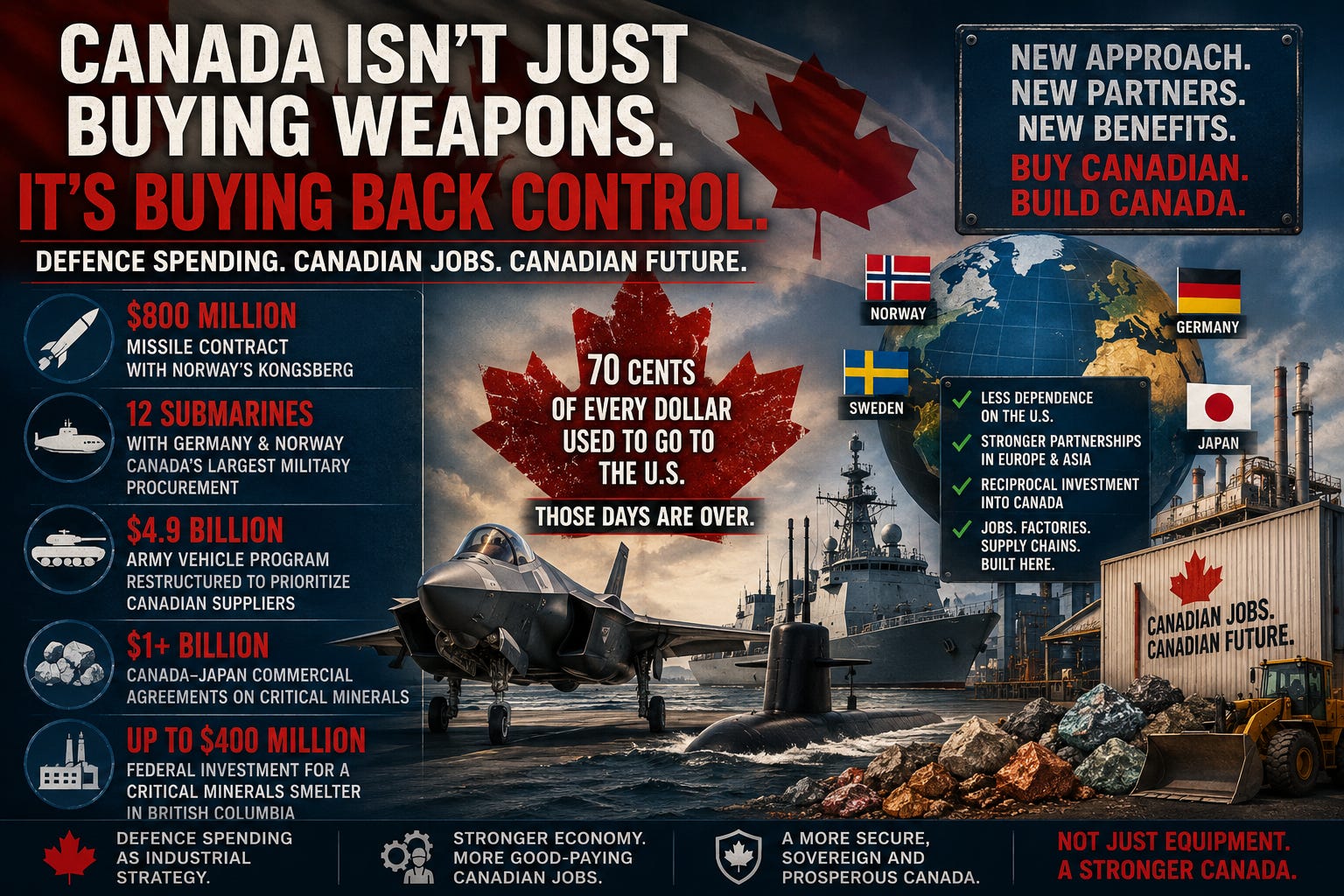
Recent agreements include an approximately $800 million missile contract with Norway’s Kongsberg, a proposed 12-submarine program involving Germany and Norway, more than $1 billion in Canada-Japan commercial agreements tied to critical minerals, and plans for a critical minerals smelter in British Columbia backed by up to $400 million in federal support.
Individually, each announcement matters.
Together, they point toward something larger.
A strategy.
For decades, Canadian military procurement heavily favoured American suppliers. By some estimates, roughly 70 cents of every defence dollar ultimately flowed south.
That approach made sense when the United States was unquestionably Canada’s dominant security and economic partner.
The world looks different today.
Europe is rearming.
Asia is securing supply chains.
NATO members are increasing defence spending.
Critical minerals have become strategic assets.
And governments everywhere are treating industrial capacity as a national security issue.
Canada is adapting to that reality.
The clearest signal may not be the submarines or missile systems.
It may be procurement policy itself.
The federal government is restructuring a $4.9 billion army vehicle competition to prioritize Canadian participation and reduce dependence on foreign suppliers.
That sounds technical.
It’s actually a power move.
Whoever controls procurement controls where the jobs go.
Whoever controls the jobs influences where factories get built.
Whoever controls the factories shapes future supply chains.
That’s how long-term economic leverage is created.
Think of it this way.
When you buy a house, the accepted offer isn’t the same thing as getting the keys.
There are inspections.
Financing.
Legal paperwork.
Conditions.
Closing dates.
Nobody calls the deal fake because you haven’t moved into the living room yet.
Major defence contracts work the same way.
There are negotiations, frameworks, industrial commitments, environmental reviews, financing arrangements, training programs, and years of implementation.
The announcement is the beginning of the process, not the end of it.
That’s why the debate over whether a deal is “real” often misses the point.
The important question isn’t whether every signature has been placed on every document.
The important question is whether the direction of travel has changed.
And it clearly has.
Canada is increasingly looking to Norway, Germany, Sweden, Japan, and other partners for both military procurement and industrial cooperation.
Many of these arrangements include reciprocal investment rather than simple purchases.
In other words, Canada buys equipment.
Partners invest in Canada.
Canadian workers get jobs.
Canadian facilities get built.
Canadian supply chains expand.
That’s a very different model from writing a cheque and hoping for the best.
The critical minerals agreements with Japan are a perfect example.
The minerals themselves matter.
But so does the processing, refining, transportation, and manufacturing infrastructure that follows.
Those investments create economic activity that lasts long after the initial announcement disappears from the news cycle.
The same principle applies to defence spending.
The weapon system may be the headline.
The industrial base is the real prize.
Of course, none of this means results appear overnight.
Factories don’t emerge from the ground in a month.
Shipyards don’t train skilled workers in a weekend.
Supply chains take years to develop.
That’s the nature of long-term planning.
And that’s why political debates often struggle with these issues.
One side wants immediate proof.
The other is building projects designed to deliver results a decade from now.
Both timelines exist simultaneously.
What seems clear is that Canada is becoming less comfortable sending massive amounts of strategic spending outside the country without demanding something in return.
That’s not anti-American.
It’s not anti-anybody.
It’s simply the behaviour of a country that wants more control over its own future.
In a world that feels increasingly unstable, that’s probably not the worst idea.
The biggest change may not be the submarines.
Or the missiles.
Or the smelters.
It may be a simple shift in thinking.
Canada is beginning to treat defence spending as an investment rather than an expense.
And those are two very different things.
The Recap…
Canada’s defence strategy isn’t just about military hardware anymore.
It’s becoming an economic strategy, too.
The real story isn’t whether every deal is finalized today.
It’s that Canada is changing who it buys from, where the money goes, and who benefits when the cheque gets written.
Sometimes the biggest shifts happen long before the ribbon-cutting ceremony.
The Gut-Punch…
For decades, Canada spent defence money to buy equipment.
Now it’s starting to spend defence money to build Canada.
That’s a much harder asset for anyone else to take away.
Source Credit:
Research compiled from NATO announcements, Canada-Japan critical minerals agreements, federal procurement policy changes, defence industry reporting, and publicly reported government investment plans.
If you enjoy thoughtful conversations, Canadian stories, and the occasional smart-ass observation about the world we’re living in, you’re in the right place.
Subscribe free and get new stories, insights, and observations delivered directly to your inbox.
No paywall.
No spam.
No nonsense.
Leave anytime with a single click.
I promise not to take it personally.
Well said, Fred
Another great one Fred & while you were writing, I was listening to, well, how to keep Canada strong LOL Enjoy! Not your 51st state! https://www.youtube.com/watch?v=dAarxgXav9A