

For most of my lifetime, Canada’s economic strategy was simple.
Sell to the United States.
Buy from the United States.
Build supply chains around the United States.
Hope the relationship stayed stable.
It worked well enough when Washington was predictable.
But when tariffs become negotiating tools, trade agreements become bargaining chips, and allies wake up wondering what tomorrow’s rules will be,
dependence starts looking less like efficiency and more like risk.
What we’re watching now isn’t a breakup.
It’s Canada quietly building options.
And options are power.
The biggest clue isn’t in a speech.
It’s in a contract.
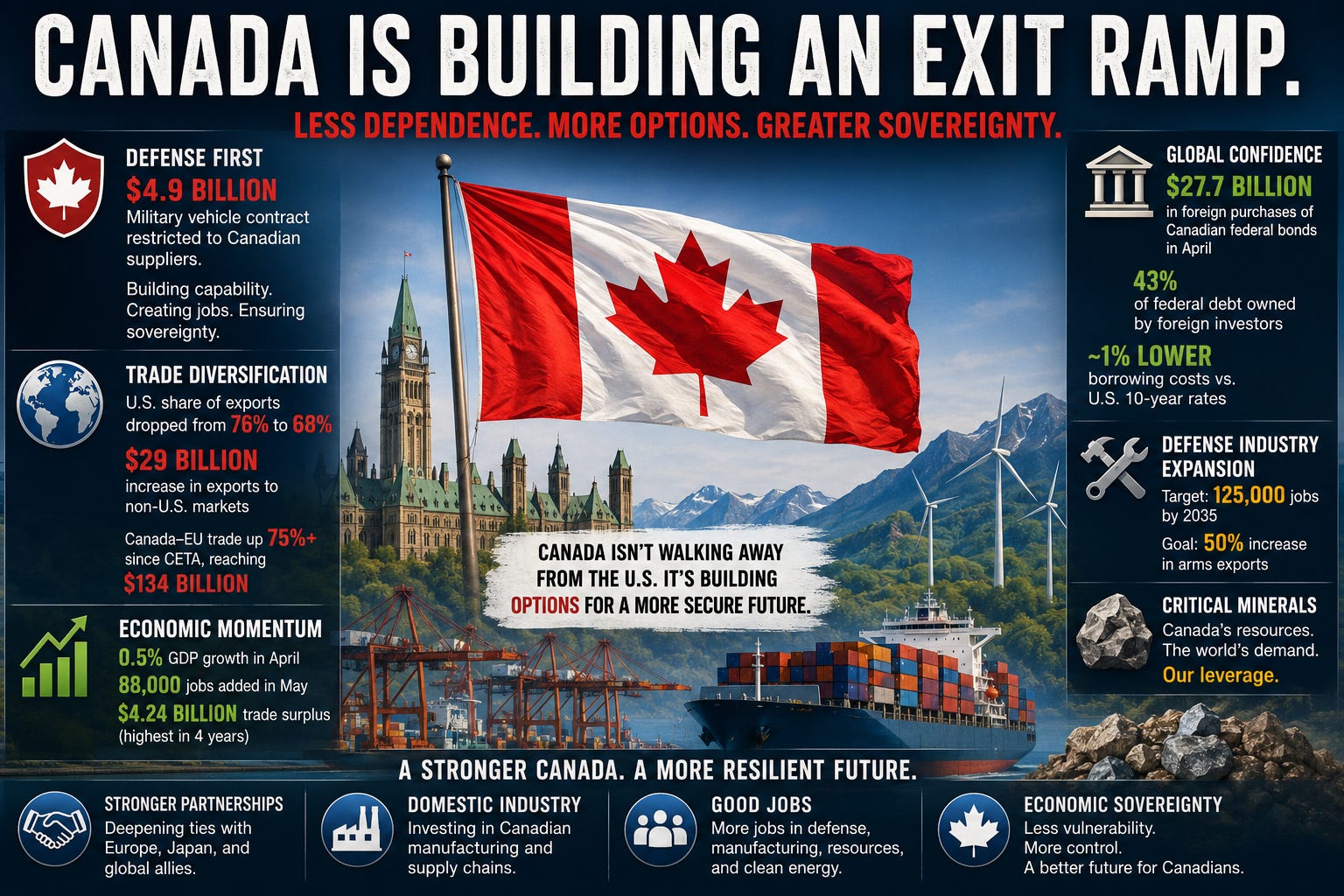
Recently, Ottawa restricted a $4.9 billion military vehicle procurement to Canadian suppliers rather than leaving it open to foreign bidders, including American firms.
That may sound like a procurement decision.
It’s actually a strategic decision.
Governments don’t build sovereign defense industries by exporting jobs and technology.
They build them by creating domestic demand first and allowing local companies to scale.
For years Canada talked about industrial strategy.
Now we’re starting to see it.
The goal isn’t just military equipment.
The goal is capability.
The country that manufactures critical systems has more freedom than the country that imports them.
At the same time, Canada is looking beyond Washington for both customers and partners.
The numbers tell the story.
The U.S. once accounted for roughly 76% of Canadian exports. That figure has fallen to about 68%.
That’s still a huge share.
But the direction matters more than the destination.
Exports to non-U.S. markets have risen by approximately $29 billion.
Trade with Europe has expanded dramatically since CETA came into force, growing more than 75% and reaching roughly $134 billion annually.
Japan, Europe, and other partners are becoming larger pieces of Canada’s economic puzzle.
Not replacing America.
Balancing America.
There is a difference.
The financial markets are sending a signal too.
Foreign investors purchased roughly $27.7 billion in Canadian federal bonds in April.
Foreign ownership of federal debt has climbed to around 43%.
Investors don’t buy government debt because they’re feeling patriotic.
They buy it because they believe they’ll get their money back.
In plain English, global investors are increasingly treating Canada as a safe place to park capital.
That’s one reason Canadian borrowing costs have remained lower than comparable U.S. rates.
Confidence matters.
And money usually votes before politicians do.
Meanwhile, Canada’s economy has been producing a few surprises.
GDP grew 0.5% in April.
The country added 88,000 jobs in May.
Canada posted a trade surplus of roughly $4.24 billion, the strongest in several years.
None of these numbers alone changes the country’s future.
Together, they suggest something important…
Canada is not making these moves from a position of weakness.
It’s making them while the economic engine is still running.
That gives policymakers room to think long term.
The most interesting part of this story may be defense.
Ottawa wants significant growth in Canada’s defense manufacturing sector over the next decade.
Targets being discussed include approximately 125,000 additional jobs and major increases in arms exports by 2035.
Whether those goals are fully achieved remains to be seen.
But the direction is unmistakable.
Canada is trying to move from being primarily a resource supplier to becoming a producer of higher-value strategic goods.
That shift creates jobs.
It creates expertise.
And it creates leverage.
Then there are critical minerals.
This may be the most important card Canada holds.
The modern economy runs on minerals that power batteries, electronics, military systems, renewable energy projects, and artificial intelligence infrastructure.
Canada sits on enormous reserves of many of them.
For years we treated those resources mainly as commodities.
Increasingly, governments are viewing them as strategic assets.
The country that controls supply gains influence.
The country that depends on imports gains vulnerability.
That’s not ideology.
That’s geopolitics.
Now, let’s be honest.
Canada is not becoming independent of the United States.
Not even close.
America remains our largest trading partner by a wide margin.
Supply chains remain deeply integrated.
The economies remain intertwined.
Anyone claiming otherwise is selling fantasy.
But there is a big difference between dependence and partnership.
Dependence means having no alternative.
Partnership means having options.
Canada is trying to create those options.
And that’s what this story is really about.
Not trade.
Not defense.
Not bonds.
Not minerals.
Sovereignty.
The practical kind.
The boring kind.
The kind built through contracts, factories, infrastructure, investment, and long-term planning.
For decades Canada put most of its eggs in one basket because the basket seemed safe.
Today, the basket looks a little shakier.
So Canada is buying a few more baskets.
That isn’t anti-American.
It’s simply what adults do when they learn that certainty is no longer guaranteed.
The Recap…
Canada isn’t cutting ties with America.
It’s reducing its exposure.
Trade is diversifying. Defense contracts are staying closer to home. Global investors are buying Canadian bonds. Critical minerals are becoming strategic assets.
For the first time in a long time, Canada appears to be building leverage instead of relying on goodwill.
The Gut-Punch…
Strong countries don’t bet their future on a single customer, a single supplier, or a single ally.
They build options.
And right now, Canada looks like a country that has finally remembered that lesson.
Source credit:
Economic and trade data compiled from publicly reported Canadian government statistics, trade figures, bond market activity, defense procurement announcements, and Canada–EU economic partnership developments.
If you enjoy thoughtful conversations, Canadian stories, and the occasional smart-ass observation about the world we’re living in, you’re in the right place.
Subscribe free and get new stories, insights, and observations delivered directly to your inbox.
No paywall.
No spam.
No nonsense.
Leave anytime with a single click.
I promise not to take it personally.
Thanks Fred- nice to see the facts in point form. We had a much needed wake up call and obviously have the leadership to move us forward on world trade and security
I am also happy to see our Canadian government move towards diversity in trade. One thing we must remember is that trade with other countries comes with a shared give and take! Each new trade deal expects something in exchange. I would like to see what these new trade deals mean to Canada! I'm certainly not against trade and opening our country to new products but I'd like more detail.