

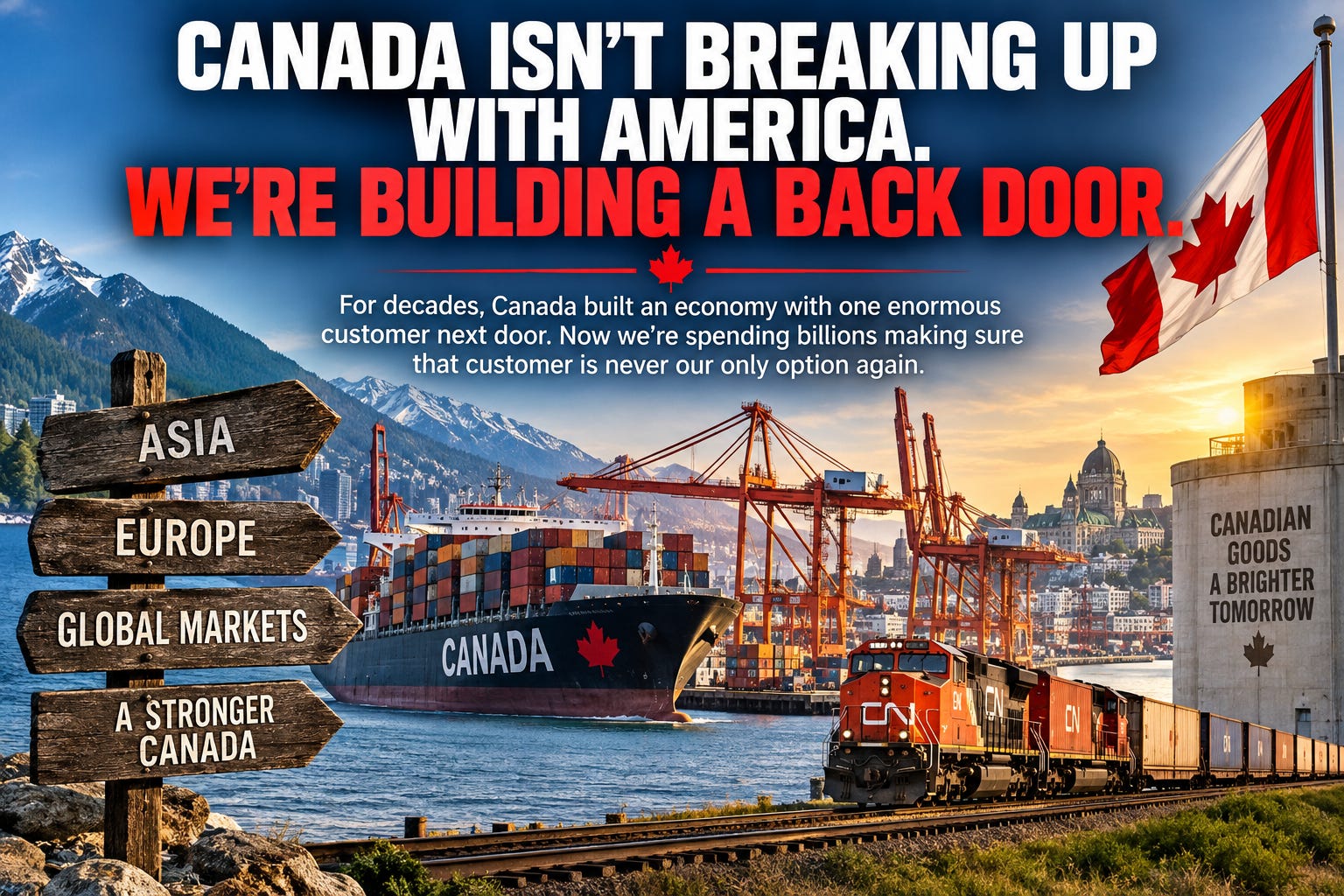
There’s a difference between announcing independence and building it.
Politicians can stand behind a podium and talk about diversifying trade until everybody in the room needs another coffee.
But if you want to know whether Canada is actually changing direction, don’t listen to the speeches.
Look at the ports.
Look at the railways.
Look at the icebreakers.
Look at the cranes.
Because something much bigger than another argument with Donald Trump is happening in Canada.
We’re building exits.
And after decades of depending overwhelmingly on one customer, it’s about bloody time.
Vancouver Is Pointing West
The Port of Vancouver is already Canada’s largest port and our most important gateway to Asia.
According to the figures cited in the research behind this piece, cargo volumes have been hitting records as Canadian exporters increasingly look beyond the United States.
And Ottawa is looking at billions more in infrastructure investment designed to expand Canada’s ability to reach overseas markets.
Think about what that means.
You can sign all the trade agreements you want.
But wheat sitting in Saskatchewan doesn’t magically appear in Japan.
Potash doesn’t teleport to India.
Lumber doesn’t beam itself to South Korea.
If Canada wants more customers, Canada needs the physical machinery required to reach them.
Ports.
Rail.
Roads.
Terminals.
Warehouses.
Ships.
That’s the unsexy part of trade diversification.
It’s also the part that actually matters.
Montreal Is Expanding Too
Now swing around to the other side of the country.
Construction is underway on the Port of Montreal’s Contrecoeur expansion project.
The project is valued at roughly $2.3 billion and is expected to substantially increase Montreal’s container-handling capacity.
That gives Canadian businesses more capacity to reach Europe and other Atlantic markets.
Again, this isn’t somebody announcing a memorandum about forming a committee to study another committee.
They’re building the damn thing.
And every additional tonne of Canadian goods that can move efficiently through Montreal gives Canadian producers another option.
That’s the word I keep coming back to.
Options.
For too long, geography made America the easy option.
Eventually the easy option became the automatic option.
And the automatic option became dependence.
We’re finally starting to unwind that.
Then There’s Churchill
This one particularly interests me.
The Port of Churchill sits on Hudson Bay.
For years it was treated almost like a Canadian curiosity… an interesting northern port that never quite became what it could have been.
Now grain is moving through Churchill again.
The research notes cite a shipment of roughly 30,000 tonnes of Canadian wheat headed for Europe, along with a more diversified shipping season involving additional commodities.
That matters enormously to Western Canada.
Because if you’re a producer on the Prairies, another route to world markets isn’t some abstract geopolitical theory.
It’s competition.
It’s resilience.
It’s bargaining power.
And potentially, it’s money in your pocket.
Canada is also investing heavily in new icebreakers.
Put those pieces together and Churchill starts looking less like an old northern outpost and more like something Canada should have been thinking seriously about years ago…
another front door to the world.
Prince Rupert Isn’t Sitting Still Either
Then we get to Prince Rupert.
A new export facility worth roughly $750 million has opened as part of a much larger expansion of the port.
Prince Rupert has one enormous geographical advantage.
It’s sitting on Canada’s Pacific coast with relatively short shipping routes to major Asian markets and excellent rail connections into the Canadian interior.
Vancouver.
Prince Rupert.
Churchill.
Montreal.
Different oceans.
Different trade routes.
Different customers.
Same strategy.
Canada is building more ways to get Canadian stuff to people who want to buy it.
That’s not anti-American.
That’s Business 101.
And Here’s the Part We Somehow Missed for 40 Years
Canada has spent decades arguing about trade as though the only question was…
How do we sell more to the United States?
Perfectly reasonable question.
The Americans are next door.
They have a gigantic economy.
They’re probably always going to be our largest trading partner.
I don’t want Canada to stop trading with America.
That would be nuts.
I want Canada to stop being afraid of losing America.
There’s a huge difference.
A customer who represents 20% of your business is important.
A customer who represents most of your business can dictate terms.
Every old salesman understands that.
And I spent enough years selling things to know something else…
The best time to find your second-biggest customer is before your biggest customer starts squeezing you.
Canada waited too long.
Trump simply made the problem impossible to ignore.
Even the Auto Story Is Getting Interesting
Here’s another development that doesn’t fit very neatly into the “everything is leaving Canada” narrative.
Canadian workers at GM recently approved an agreement connected to adding truck production at an Ontario plant amid the U.S.-Canada trade fight.
That’s worth watching.
It doesn’t mean Canada’s auto industry is suddenly safe.
Far from it.
Trump’s auto tariffs remain a serious threat.
But investment decisions aren’t behaving quite as neatly as Trump’s rhetoric suggests they should.
We’ve already seen GM commit additional money to Oshawa.
Meanwhile, other automakers are making different choices.
That’s why I’ve become increasingly suspicious of sweeping declarations that Canada is either “winning” or “losing.”
Real economies aren’t hockey games.
Some industries grow.
Some shrink.
Some investments come here.
Others leave.
The useful question isn’t whether we won Tuesday afternoon.
It’s whether we’re building a country that’s harder to push around ten years from now.
That’s the Time Horizon Canadians Need to Understand
None of this fixes Canada’s dependence on the United States next Tuesday.
Probably not next year either.
Infrastructure takes time.
Ports take years.
Rail capacity takes years.
New trade relationships take years.
Supply chains take years.
Businesses don’t abandon relationships built over generations because a prime minister gives a good speech in Brussels.
But give Canada ten years of consistently building east-west and overseas capacity?
That’s different.
Imagine Canada entering the next trade dispute with the United States knowing that substantially more of our energy, minerals, agricultural products, manufactured goods and technology have alternative buyers.
Now the conversation changes.
Washington says…
Take our terms.
Canada can say…
No thanks.
Not because we’re angry.
Not because we’re waving flags.
Because we have somewhere else to sell the stuff.
That’s sovereignty with a balance sheet attached.
Trump Accidentally Taught Canada Something Useful
Donald Trump wanted leverage over Canada.
Tariffs were supposed to remind us how dependent we were on the American market.
And in fairness, they did.
But there was another lesson hiding inside that threat.
Never allow yourself to become that dependent again.
That’s bigger than Trump.
Presidents change.
Governments change.
Political parties change.
American interests don’t necessarily change with them.
Canada shouldn’t build its future around hoping the next American president likes us better.
We should build a Canada that can prosper whether Washington likes us, dislikes us, ignores us or wakes up grumpy on a Tuesday morning.
That’s what Vancouver matters.
That’s what Montreal matters.
That’s what Prince Rupert matters.
That’s what Churchill matters.
Not because Canada is abandoning America.
Because we’re finally building something we should have built decades ago.
A second door.
And a third.
And a fourth.
America can remain our biggest customer.
It just doesn’t get to be our only serious choice anymore.
The Recap…
Canada keeps talking about diversifying away from the United States.
Here’s the part that matters…
We’re finally building the infrastructure to do it.
Vancouver. Montreal. Prince Rupert. Churchill.
Ports, rail, terminals and icebreakers aren’t political slogans.
They’re options.
And options are how Canada gets its leverage back.
The Gut-Punch…
Canada doesn’t need to stop selling to America.
We need to reach the point where America knows we don’t have to.
Source credit: Based on research notes drawing on reporting cited from CBC, Reuters, Canadian port and infrastructure announcements, and other Canadian trade and transportation reporting. Figures and project timelines should be checked against the latest official releases before publication.
If you enjoy thoughtful conversations, Canadian stories, and the occasional smart-ass observation about the world we’re living in, you’re in the right place.
Subscribe free and get new stories, insights, and observations delivered directly to your inbox.
No paywall.
No spam.
No nonsense.
Leave anytime with a single click.
I promise not to take it personally.
INDEPENDENCE is the BEST thing in the World. 👍
I'd just like to add a couple of Atlantic ports to your excellent survey. The ports of Saint John, NB, and Halifax, NS, are also undergoing significant expansion, specifically to deal with growing non-US trade.