

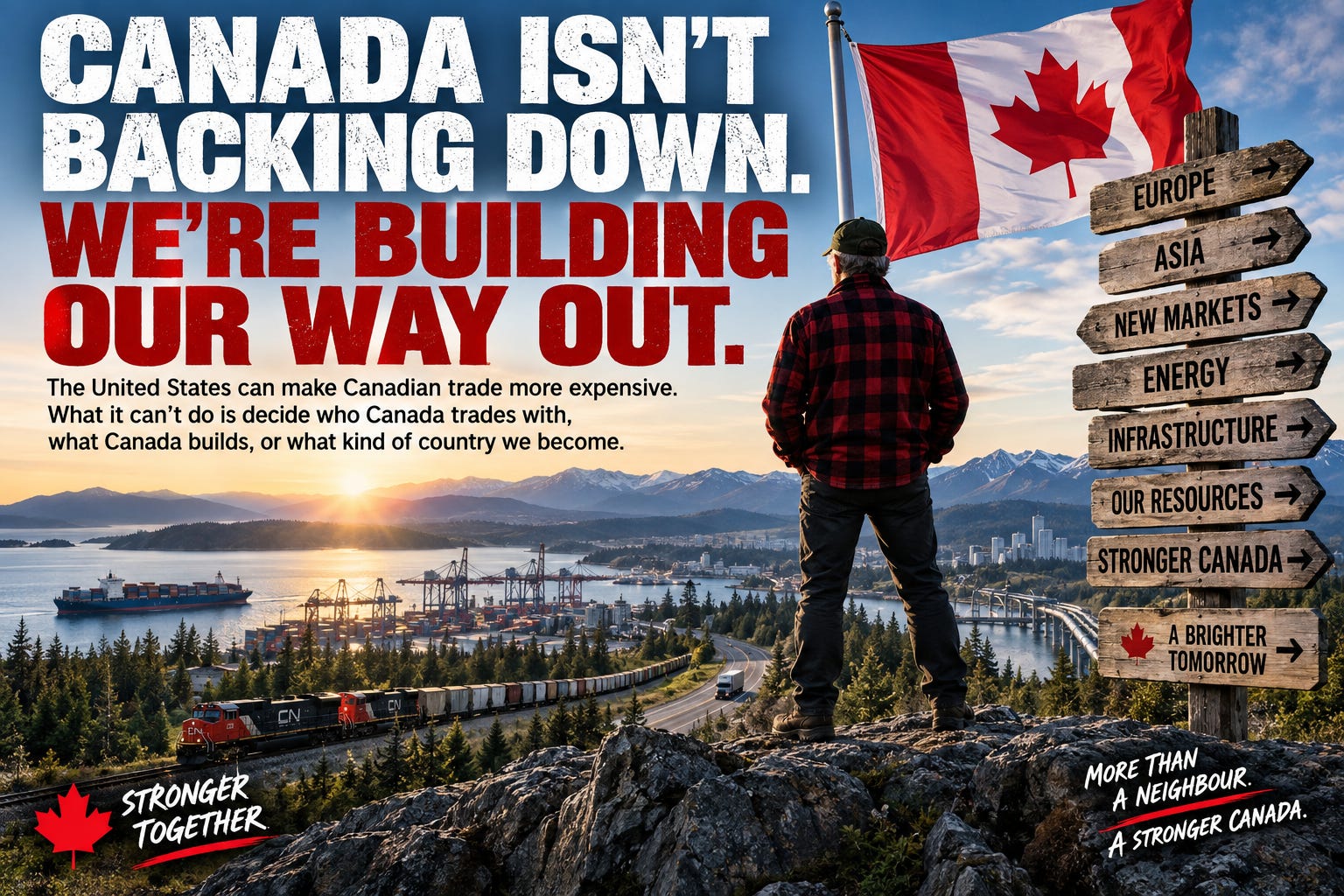
There’s something much bigger happening in Canada than another round of tariffs.
We’re changing direction.
For most of my lifetime, the Canadian economy operated on one wonderfully convenient assumption…
The United States would always be there.
They were rich.
They were close.
They bought an enormous amount of our stuff.
And for decades, building our economy around easy access to the biggest market on Earth made perfect sense.
Until it didn’t.
Because once your biggest customer starts using access to its market as leverage against you, dependence stops looking convenient.
It starts looking dangerous.
And that is the part of the Prime Minister’s latest address that caught my attention.
This wasn’t simply another speech about fighting American tariffs.
It was about building a Canada that doesn’t have to be scared shitless every time Washington changes its mind.
We’ve Been Here Before
There was an interesting bit of history in the address.
Long before Donald Trump discovered tariffs, William McKinley was one of America’s great champions of them.
The McKinley Tariff of 1890 dramatically raised American import duties, including on Canadian goods.
The theory was familiar…
Put enough economic pressure on Canada and eventually Canada would become more dependent on the United States.
Instead, Canada went looking for other opportunities.
That lesson is worth remembering.
Pressure doesn’t always create obedience.
Sometimes it creates options.
And Canada desperately needs more of those.
We’re Retaliating… But That Isn’t the Real Strategy
Canada is matching new American tariffs with tariffs of our own.
I understand why.
If Washington makes Canadian products more expensive in the United States while American products continue entering Canada untouched, that’s not free trade.
That’s Canada volunteering to be the sucker.
But retaliatory tariffs aren’t the part that interests me most.
They’re defensive.
The bigger move is reducing the amount of leverage America has over us in the first place.
That means finding new customers.
Building infrastructure.
Processing more of our own resources.
Connecting our provinces.
Expanding our ports.
And giving Canadian businesses more ways to reach the rest of the world.
That’s how you turn a trade war into an economic strategy.
Forty Million Canadians Have Some Leverage Too
There was another point in the address I particularly liked.
Governments aren’t the only ones who can respond.
We can.
Every Canadian decides where some of their money goes.
Which groceries we buy.
Where we vacation.
Which car we purchase.
Which Canadian businesses we support.
None of us individually can change a trade war.
Forty million Canadians changing millions of purchasing decisions?
Now you’ve got something.
We’ve already watched Canadians rethink American travel and American products.
That isn’t government policy.
That’s the kitchen table.
And Washington can’t negotiate with your kitchen table.
Here’s the Number I’m Watching
The Prime Minister said Canadian businesses currently have tariff-free access to markets representing roughly 1.5 billion consumers around the world.
Then he made a hell of a commitment…
Double it within six months.
That would mean access approaching three billion consumers.
There are major trade files involving large markets already in play.
Whether the government can actually deliver that target on that timetable is something I’ll be watching very carefully.
Because I’m not interested in cheerleading.
Promises are promises until somebody delivers.
But the direction is exactly where Canada needs to go.
For decades our economic map basically pointed south.
Now we need arrows pointing east, west and across the oceans too.
And Then Comes the Building
This is where the Canadian strategy gets really interesting.
The address described a new phase of nation-building involving electricity, pipelines, ports, nuclear power and transportation infrastructure.
Think about what Canada built in earlier generations.
The railway.
The Trans-Canada Highway.
Infrastructure that tied a gigantic country together from Atlantic to Pacific.
Now the challenge is different.
We need to connect our energy.
Our northern resources.
Our critical minerals.
Our ports.
Our electricity grids.
And ultimately our industries.
The address pointed to projects and ambitions involving Churchill Falls, expanded electricity transmission, new nuclear generation in Ontario, the Port of Churchill, British Columbia’s Pacific Gateway and a new route connecting Alberta resources to Pacific markets.
See the pattern?
We’re building exits.
Not exits from America.
Exits from dependence.
There’s a big bloody difference.
Canada Has Spent Too Long With One Extension Cord
I’ve written before about Canada’s ridiculous energy problem.
We produce enormous amounts of power and energy, but we still haven’t built enough of the infrastructure needed to move it efficiently across our own country.
We have provinces sitting beside provinces that sometimes have better connections south than they do to each other.
That’s nuts.
A stronger national electricity grid changes that.
More port capacity changes that.
More east-west transportation changes that.
More access to Asian and European markets changes that.
Processing more resources here instead of simply digging them up and shipping them away changes that.
None of this happens next Tuesday.
But that’s precisely the point.
We’re finally talking about something bigger than surviving the next tariff announcement.
The Numbers Deserve Watching
The Prime Minister also made several substantial economic claims.
He said Canada’s non-U.S. exports are rising sharply and are on track to double over the next decade.
He said foreign direct investment is at its highest level in two decades.
He said Canada is attracting investment at twice the rate of its nearest G7 competitor.
And he argued Canada is now one of the world’s most attractive destinations for infrastructure investment, while Canadian economic growth is projected near the top of the G7.
Those are exactly the kinds of claims Canadians should track.
Not because Mark Carney said them.
Not because Pierre Poilievre dislikes them.
Because results matter more than political jerseys.
If the numbers hold up, say so.
If they don’t, say that too.
That’s how adults are supposed to run a country.
Trump May Have Accidentally Done Canada a Favour
I don’t mean the tariffs are good.
They’re not.
Canadian workers and businesses can get hurt.
Families can get hurt.
Communities can get hurt.
But Donald Trump may have accomplished something Canadian governments couldn’t accomplish for decades.
He scared the complacency out of us.
Suddenly Canadians are asking questions we should have asked twenty years ago.
Why don’t we trade more with Europe?
Why aren’t we processing more Canadian resources in Canada?
Why aren’t our provincial electricity grids better connected?
Why don’t we have more pipelines reaching Canadian ports?
Why aren’t our northern ports bigger?
Why don’t we build more of the things we need right here?
And perhaps the biggest question of all:
Why did we ever allow one country to have this much leverage over our economy?
America isn’t disappearing.
We’re still neighbours.
We’ll still trade hundreds of billions of dollars’ worth of goods.
We should.
But there’s a difference between having a great customer and having a customer you can’t afford to lose.
Canada needs the first.
Never again the second.
The Recap…
Canada isn’t just answering American tariffs with Canadian tariffs.
We’re building new trade routes, energy connections, ports and markets.
The goal isn’t to abandon America.
It’s to make sure America can never hold the Canadian economy hostage again.
The Gut-Punch…
The best response to an American tariff isn’t another Canadian tariff.
It’s making the American tariff matter less.
Source credit:
Research notes based on commentary discussing the Prime Minister of Canada’s national address on Canada’s response to U.S. tariffs, trade diversification, infrastructure development and investment. Economic targets and forward-looking claims attributed to the Prime Minister in the source material should be checked against the full official address and current government data before publication.
If you enjoy thoughtful conversations, Canadian stories, and the occasional smart-ass observation about the world we’re living in, you’re in the right place.
Subscribe free and get new stories, insights, and observations delivered directly to your inbox.
No paywall.
No spam.
No nonsense.
Leave anytime with a single click.
I promise not to take it personally.
Often, in a situation where the abused partner leaves the marriage, they become stronger, more self oriented and less partnership dependent. People develop in this situation because of a need for survival, then experience growth and it feels good! The abuser is left yelling curses at the empty walls because the victim has escaped. Just be careful, because the mad abuser sometimes seeks revenge.
CANADIANS NEVER SURRENDER “….dont mistake our kindness for weakness”.