

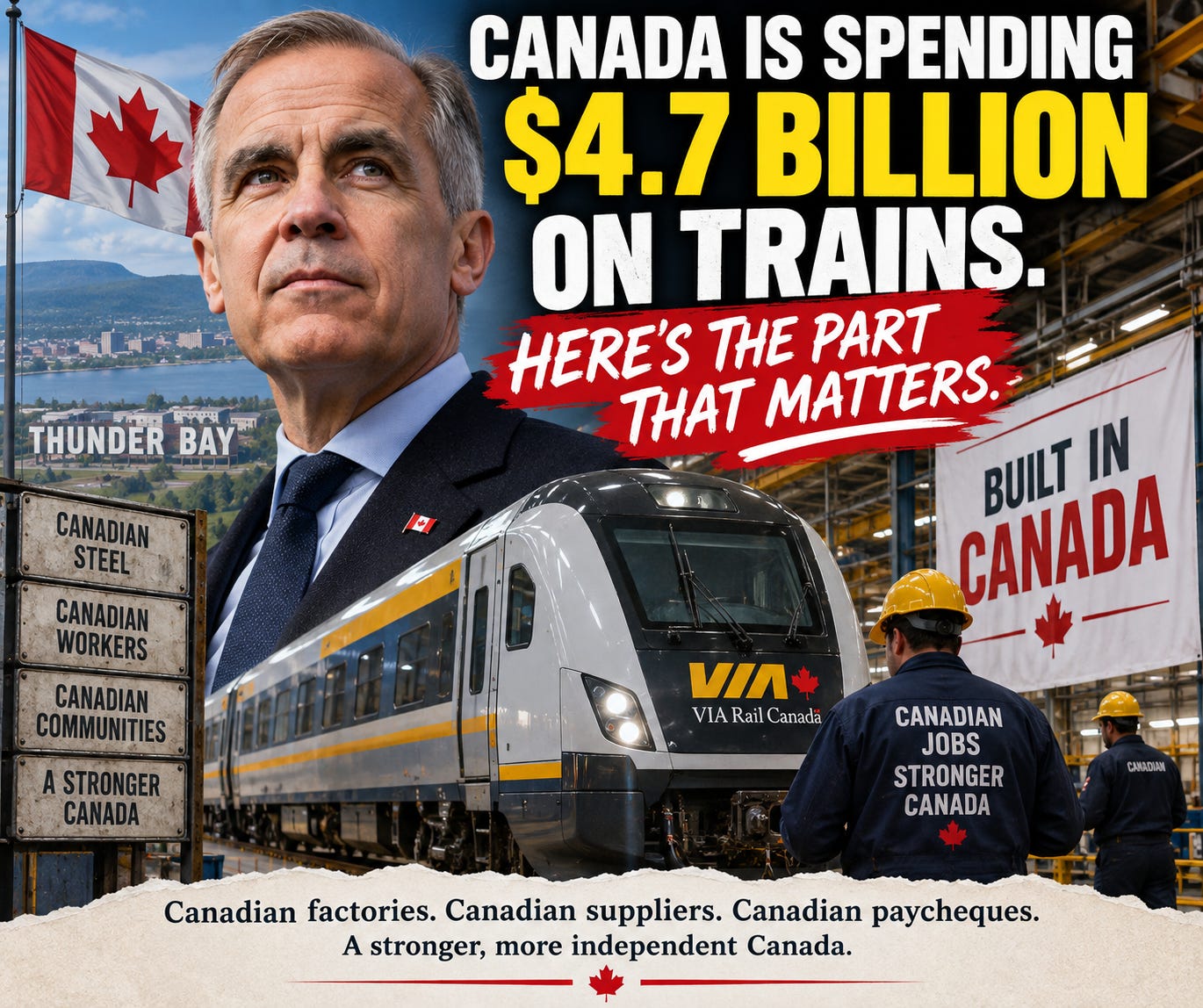
There’s a sentence Canadians should probably get used to hearing…
We can build it here.
Not everything.
Not overnight.
And certainly not without spending some serious money.
But Canada has spent far too many years behaving as though our natural role in the world was to dig stuff out of the ground, ship it somewhere else, buy back the finished product and congratulate ourselves for participating in the global economy.
That was a hell of a business plan.
The federal government has just announced a $4.7-billion investment to manufacture and maintain 313 new passenger rail cars for VIA Rail’s long-distance, regional and remote routes.
But here’s the part that caught my attention.
They’re going to be built in Canada.
At Alstom’s Thunder Bay plant.
For the first time in roughly four decades, these VIA Rail cars will be produced, assembled and maintained in this country.
And according to Prime Minister Mark Carney, cars that previously would have been built in the United States will now be built in Thunder Bay.
Now we’re talking.
This Is Bigger Than 313 Railway Cars
I’ve been writing for months about Canada reducing its dependence on the United States.
Not ending the relationship.
Not building a wall along the 49th parallel.
Not pretending we can replace the biggest trading relationship on Earth by next Tuesday.
I’m talking about something much simpler.
Options.
If Donald Trump has taught Canada anything, it’s that depending too heavily on one country leaves you vulnerable when that country decides to use the relationship as leverage.
We’ve seen tariffs.
We’ve seen threats.
We’ve seen demands Canada decided it couldn’t accept.
According to Carney, Canada suspended its latest trade negotiations with the United States after deciding it could not accept what Washington offered or give the Americans what they demanded.
So what do you do next?
You can spend the next four years bitching about Donald Trump.
Or you can start building.
This rail announcement falls squarely into the second category.
Follow the Money
The 313 rail cars are only the most visible part.
The project is expected to directly support nearly 700 jobs in Ontario and Quebec.
Alstom has a Canadian network of more than 900 suppliers that can participate in delivering the new fleet.
The government says the project will generate more than $1.6 billion in economic benefits, with additional jobs flowing through the supply chain.
And Canadian steel is supposed to be used extensively in structural assemblies and fabricated components.
Think about what that means.
Canadian electricians doing the wiring.
Canadian machinists producing precision parts.
Canadian welders building frames.
Canadian steel going into the cars.
Canadian suppliers filling orders.
Canadian workers getting paycheques.
And those paycheques being spent in Canadian communities.
That’s what people sometimes miss when governments announce industrial projects.
A railway car isn’t just a railway car.
It’s a whole chain of people getting paid to make the damn thing.
Thunder Bay Knows How to Build Things
There’s another reason Thunder Bay matters.
This isn’t some factory somebody threw together last Thursday so politicians could stand in front of it wearing hard hats.
The site has a remarkable industrial history.
More than a century ago, workers there were building railway cars, streetcars and buses.
During the Second World War, the plant produced more than 1,400 Hawker Hurricane fighter aircraft.
At peak production, nearly 5,000 Canadians worked there, more than half of them women, producing as many as 15 aircraft a week.
Think about that for a moment.
Canada didn’t suddenly acquire the ability to manufacture complicated things in 2026.
We’ve always had the ability.
What disappeared wasn’t necessarily the skill.
It was the assumption that building things here mattered.
For decades, efficiency became the magic word.
Find the cheapest supplier.
Move production somewhere cheaper.
Stretch supply chains across continents.
Save a few bucks.
Then COVID arrived.
Then supply chains broke.
Then geopolitical tensions grew.
Then Donald Trump rediscovered tariffs.
Suddenly having the ability to make your own stuff doesn’t look quite so old-fashioned.
It looks like insurance.
And These Trains Actually Need Replacing
This isn’t make-work disguised as industrial policy.
Some of VIA Rail’s cars serving long-distance and remote routes are more than 70 years old.
Seventy.
Carney joked they were built when NHL goalies didn’t wear masks and the Toronto Maple Leafs could still win the Stanley Cup.
I don’t care which party you vote for.
When your railway equipment is old enough to remember a Leafs Stanley Cup, perhaps replacement is overdue.
The new fleet is intended to be more reliable, comfortable, accessible and energy-efficient, while being engineered to handle Canada’s extreme temperatures.
That’s particularly important because these aren’t all tourist trains carrying people through the Rockies while they admire the scenery.
Some of these routes are essential transportation.
For Some Canadians, The Train Is the Road
VIA’s regional and remote services connect communities that don’t have the transportation options most of us take for granted.
According to the announcement, the network serves communities including 165 First Nations.
Routes such as Winnipeg to Churchill and Jasper to Prince Rupert can provide access to medical care, groceries, education and other essential services.
In some places, there isn’t another convenient highway sitting beside the tracks.
The train is the connection.
So Canada isn’t simply replacing old railway cars.
We’re replacing critical infrastructure.
And we’re using that replacement to rebuild some industrial capacity at the same time.
That seems like a pretty sensible two-for-one deal to me.
This Is the Pattern I’m Watching
This is where the announcement gets more interesting.
Carney described the rail investment as part of a much larger strategy.
The government says 27 nation-building initiatives have been referred to the new Major Projects Office, representing the potential for roughly half a trillion dollars in private investment.
Projects mentioned include nuclear development at Darlington, the Contrecœur terminal at the Port of Montreal, mining projects in Quebec and the Mackenzie Valley Highway in the Northwest Territories.
Add new icebreakers.
New energy infrastructure.
Ports.
Mines.
Transportation corridors.
Rail.
Now a pattern starts emerging.
Canada isn’t simply trying to survive American tariffs.
Canada is trying to become harder to push around.
That requires trade diversification.
But it also requires something we’ve neglected for too long…
industrial capacity.
You cannot call yourself economically sovereign if you have to phone another country every time you need something important built.
Buying Canadian Can’t Just Be a Bumper Sticker
I’ve heard “Buy Canadian” most of my life.
Usually it meant choosing Canadian bacon or checking the label on a box at the grocery store.
But governments are enormous buyers.
Rail cars.
Ships.
Military equipment.
Transit systems.
Energy infrastructure.
Steel.
Technology.
Construction.
Those procurement decisions can determine whether billions of dollars circulate through Canadian factories and Canadian communities… or disappear across the border.
If Canadian taxpayers are footing the bill anyway, asking how much of that money stays in Canada seems like a perfectly reasonable question.
That doesn’t mean every nut, bolt and computer chip must be Canadian.
That’s fantasy.
Modern manufacturing depends on international supply chains.
But there’s a huge difference between participating in global supply chains and surrendering your ability to make anything yourself.
Canada drifted too far toward the second one.
Now we’re finding our way back.
Trump May Have Done Canada a Strange Favour
I doubt this was the favour he intended.
For decades, Canada could afford to assume the United States would always be the reliable neighbour.
Then Trump started using trade as a weapon.
Suddenly Canadians began asking questions we should probably have asked twenty years ago.
What can we build ourselves?
What resources should we process ourselves?
What markets can we develop besides the United States?
Where are our vulnerabilities?
What happens if Washington says no?
Those are healthy questions for an independent country.
Maybe we became too comfortable.
Maybe it took a shock to wake us up.
But we’re awake now.
And this $4.7-billion rail investment is another little piece of something much larger.
Not separation from America.
Not isolation.
Not some chest-thumping fantasy that Canada doesn’t need anybody.
Options.
The ability to trade with America without being completely dependent on America.
The ability to negotiate without having a gun pointed at our economic head.
And the ability to say…
No thanks. We’ll build this one ourselves.
That may be the most important thing coming out of Thunder Bay.
Not 313 railway cars.
The return of an idea Canada should never have forgotten.
We can build things here.
The Recap…
Canada is spending $4.7 billion replacing VIA Rail’s aging passenger fleet.
But here’s the part I care about:
313 rail cars. Built in Canada. Nearly 700 direct jobs. More than 900 Canadian suppliers.
Cars previously built in the United States will now be built in Thunder Bay.
Maybe “Buy Canadian” is finally becoming something bigger than a slogan.
The Gut-Punch…
Economic sovereignty doesn’t mean refusing to buy from your neighbour.
It means being able to say no to your neighbour without wondering whether your own economy falls apart.
Canada is finally rebuilding that ability.
Source credit:
Prime Minister Mark Carney announcement and remarks at Alstom’s Thunder Bay manufacturing facility regarding the Government of Canada’s $4.7-billion VIA Rail fleet investment; transcript supplied as research material.
If you enjoy thoughtful conversations, Canadian stories, and the occasional smart-ass observation about the world we’re living in, you’re in the right place.
Subscribe free and get new stories, insights, and observations delivered directly to your inbox.
No paywall.
No spam.
No nonsense.
Leave anytime with a single click.
I promise not to take it personally.
Trump breaking the status quo was the wake up call Canada needed. The US is going to spend years sorting out and paying for the messes he's made. Canada seems poised to become a world leader.
PM Carney is the single best “change agent” we have had in my lifetime! This, and everything he’s done in the last 20 months is the foundation of my belief! And he’s a really good, genuine man, that is the foundation for everything he does so well. Thank you Fred for providing yet more evidence that Mark Carney has become the leader of the free world. And he’s has rightfully earned that title - something, I might add, Poilievre has absolutely NO conception of whatsoever. Just my opinion. 👏👏👏🇨🇦🇨🇦🇨🇦🇨🇦🇨🇦🇨🇦🇨🇦🇨🇦🇨🇦