

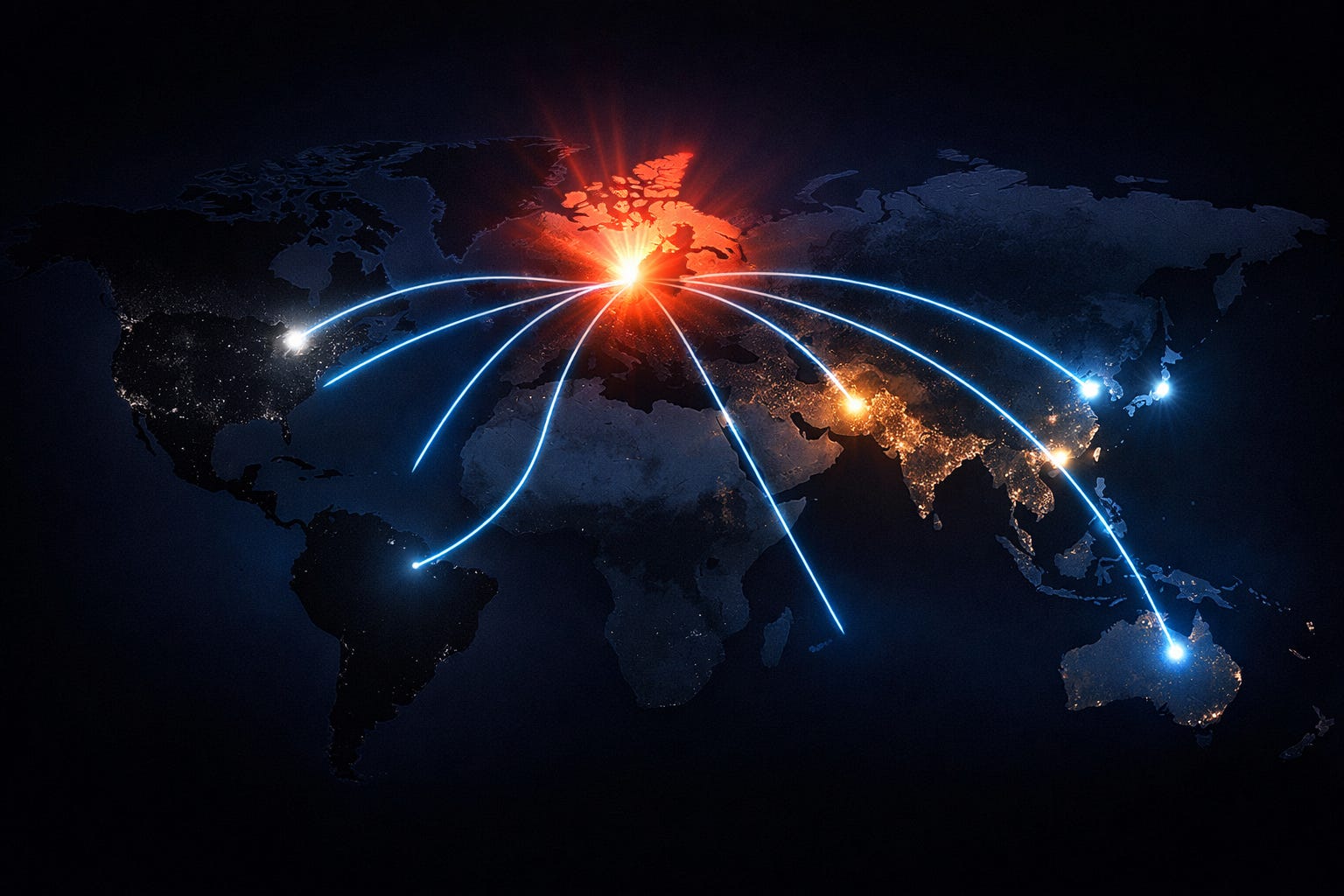
If you want to understand what Canada is doing right now, stop listening…
to political noise and look at the pattern.
The pattern says everything.
Canada just signed a comprehensive defense agreement with South Korea. Not symbolic. Real cooperation… classified information sharing, industrial collaboration, procurement frameworks, legal coordination between militaries.
That kind of agreement doesn’t happen by accident. It happens when countries decide they need each other.
And the timing matters.
This deal came about a month after Prime Minister Mark Carney stood in Davos and openly called for “middle powers” to work together to resist economic coercion from larger countries.
Translation… build alternatives before you need them.
South Korea isn’t the only move on the board either.
Canada is actively deepening ties with Germany on auto manufacturing, batteries, and critical minerals.
South Korean companies are being courted for manufacturing investment inside Canada. Chinese and European partnerships are also expanding in targeted sectors.
At the same time, Ottawa is negotiating or advancing trade agreements with countries like Indonesia, Ecuador, India, and several Southeast Asian and Middle Eastern partners.
This isn’t random diplomacy.
It’s diversification… the national version of not putting all your money in one stock.
Right now, about 70% of Canadian exports still go to the United States. That level of dependence has always been a vulnerability. For decades, it worked because the relationship was stable.
But stability is no longer guaranteed.
And the numbers already show change underway.
In early 2025, Canadian exports to non-U.S. countries jumped nearly 25% month-over-month… one of the largest increases ever recorded… while exports to the United States dropped more than 6% in the same period.
That’s not a collapse. That’s a pivot.
Meanwhile, Canada is also exploring major defense procurement decisions that could shift billions of dollars away from American suppliers toward partners like South Korea and Germany, including a potential fleet of up to 12 submarines.
Again… pattern.
Trade diversification. Defense diversification. Industrial diversification.
All roads lead to the same conclusion… reduce dependence.
Carney has also been explicit about the strategy. His government has talked about doubling non-U.S. trade over time and positioning Canada as a bridge between Europe and the Indo-Pacific economies.
There’s also a technology dimension. Canada, India, and Australia launched a trilateral partnership focused on innovation, supply chains, and critical technologies… cooperation that deliberately spreads risk across multiple partners.
Why does this matter?
Because economic dependence equals leverage.
If one country controls most of your trade, they can pressure you. Tariffs, sanctions, regulatory barriers… all tools of influence.
The Asia-Pacific policy community has been saying for years that diversification isn’t just about money. It’s about strategic autonomy… the ability to make decisions without fear of retaliation.
Canada appears to have finally taken that lesson seriously.
There’s also a domestic angle.
Reports suggest Canada is looking to expand its own defense industry capacity while increasing military spending, with projections that such investments could create over 100,000 jobs.
That strengthens internal resilience while reducing reliance on foreign supply chains.
In simple terms… build more at home, buy from more partners abroad.
What we’re watching isn’t anti-American sentiment.
It’s risk management.
When a partner becomes unpredictable, smart countries create options.
The United States still matters enormously to Canada… geographically, economically, militarily. That won’t change overnight.
But the era of automatic dependence may already be ending.
Think of it like a homeowner who finally realizes their entire income depends on one employer. The smart move isn’t quitting the job.
The smart move is creating other income streams.
That’s what Canada is doing… at national scale.
And once diversification starts, it tends to accelerate.
New supply chains create new incentives. New partners create new trust networks.
New investments create political momentum.
Over time, the system rewires itself.
The South Korea agreement isn’t the story.
It’s the signal.
The Recap…
Canada just signed a major defense deal with South Korea.
Most people think it’s about submarines.
It’s not.
It’s about something much bigger… Canada quietly reducing its dependence on the United States.
That’s what’s really happening.
The Gut-Punch…
Dependence feels safe — right up until the day it isn’t.
Source Credit:
Based on publicly reported government announcements, trade data, and international policy analysis regarding Canada’s recent defense and trade agreements.
🔎 The GeezerWise Standard
This space is built on disciplined thinking.
Facts over spin.
Verification before amplification.
Good-faith discussion over tribal noise.
I use AI tools to help shape my spoken drafts into clear writing.
The judgment, conclusions, and final message are mine.
If you’re new here, this explains how I decide what’s worth sharing:
How I Decide What’s Worth Sharing → [link]
💌 Subscribe at GeezerWise.com to receive future letters:
www.geezerwise.com/subscribe
— Fred Ferguson
GeezerWise
#CanadaStrong
These alliances and agreements are all good things but there is a fly in the ointment. South Korea and Germany have talked about auto assembly in Canada as a carrot leading to contract, but Japan pointed out that auto assembly in Canada for a foreign national only makes sense if CUSMA is in place.
Canada offers a workforce, stability and property with energy and waste management in place. However, these companies aren't going to build cars for the Canadian market. They want a safe place to build so they can sell cars into the U.S. marketplace TARIFF FREE. Otherwise, no deal.
the U.S. is already on record as saying tariffs will be part of any trade agreement. That may depend on whether or not the tariffs are legal, whether the House renews the tariffs every 150 days, who wins the House in the midterms if there are midterms and a number of other variables I've not thought of.
This is suddenly not a safe haven to build AND SELL cars, The intended market has too many variables. It's a long time before shovels are in the ground, and maybe the U.S. sorts itself out eventually. In the meantime Canada keeps making every trade agreement possible to prepare for the worst with the U.S. but also to grow as an independent country.
This is not a doom and gloom diatribe, just a "heads up" so people are aware.