

If you only looked at the latest inflation numbers, you’d think things are finally settling down.
Not so fast.
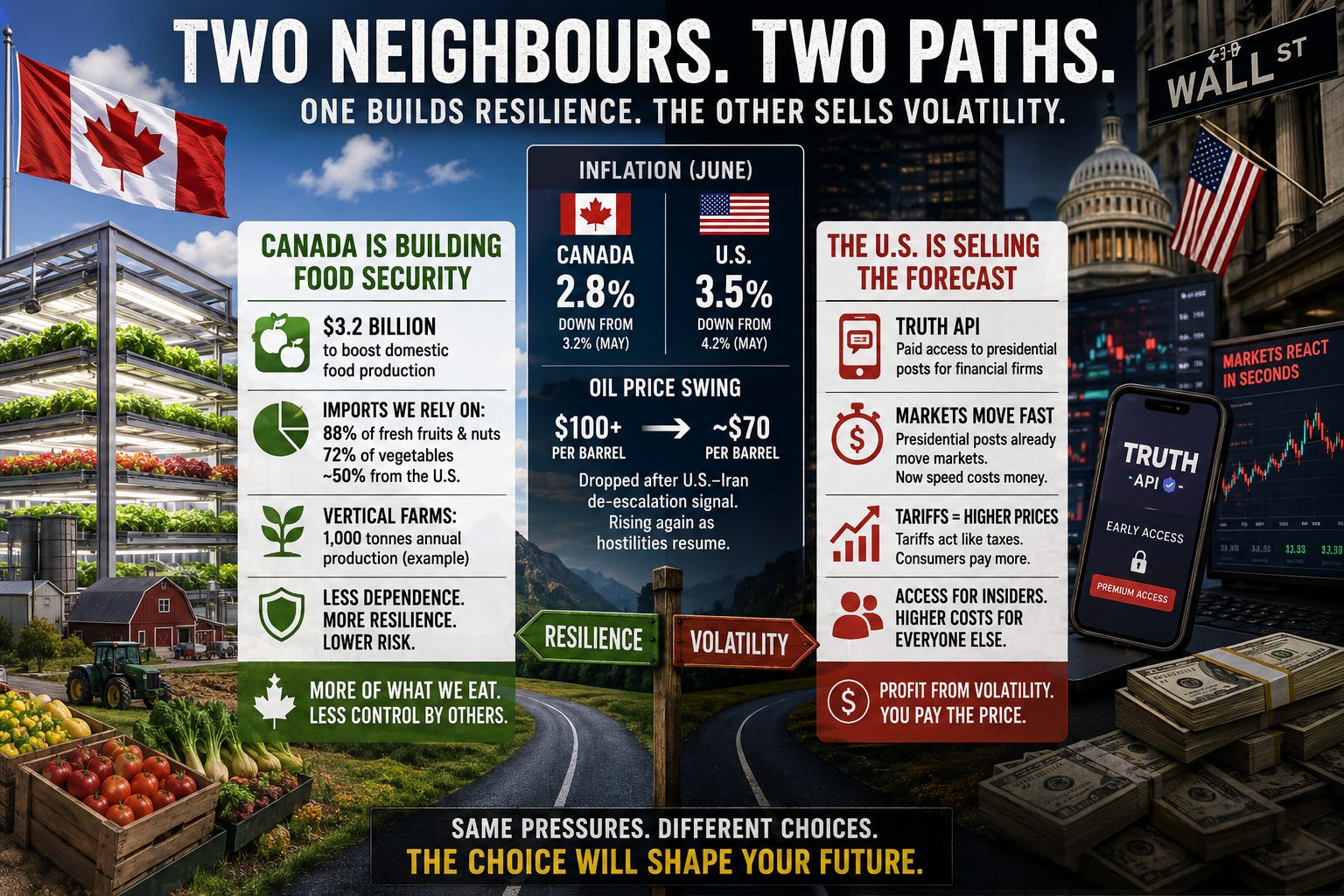
Canada’s inflation eased to 2.8% in June, down from 3.2% in May. South of the border, U.S. inflation slipped from 4.2% to 3.5%.
On paper, that looks like progress.
But the reason matters more than the number.
A big part of the drop came from cheaper oil after tensions between the United States and Iran appeared to cool. Crude fell from more than US$100 a barrel to roughly US$70, pulling transportation and energy costs lower.
Then the fighting heated up again.
Oil started climbing.
Which tells us something important.
Inflation didn’t suddenly disappear. It simply caught a lucky break.
That’s the difference between solving a problem and getting a temporary discount.
Canada seems to have taken that lesson to heart.
Instead of assuming cheaper imports will always be available, Ottawa is investing $3.2 billion to strengthen domestic food production.
That isn’t just an agriculture story.
It’s an economic security story.
Canada still imports most of its fresh fruit and nuts, nearly three-quarters of its vegetables, and roughly half of those imports come from the United States.
That leaves us vulnerable every time a drought, trade dispute, war, transportation disruption, or currency swing hits somewhere else.
Every external shock eventually shows up at the checkout line.
Growing more food here won’t eliminate those risks overnight, but it reduces how much control other countries have over what Canadians pay to eat.
That’s resilience.
The United States appears to be taking a very different path.
A new paid Truth API is being developed to give financial firms faster access to presidential social media posts.
Anyone who watches the markets already knows presidential comments can move stocks, currencies and commodities within minutes.
Early access turns speed into money.
The faster you receive market-moving information, the faster you can trade before everyone else catches up.
That’s a business model built around information advantages.
Not productivity.
Not innovation.
Access.
At the same time, tariffs continue pushing up prices inside the United States.
Tariffs may be imposed on foreign goods, but consumers usually end up paying a good portion of the bill.
They’re taxes that arrive wearing different clothes.
Which creates an odd contradiction.
On one hand, governments talk about reducing inflation.
On the other, they introduce policies that increase costs while building systems that allow sophisticated investors to profit from the resulting volatility.
That’s not exactly reassuring for ordinary families trying to buy groceries.
Meanwhile, Canada is quietly looking inward.
Vertical farming offers one example of where this could go.
Modern facilities can produce around 1,000 tonnes of food annually while using far less land and water than traditional farming.
No, vertical farms won’t replace every field across the country.
But they can make fresh food available closer to where Canadians actually live.
Less transportation.
Less dependence.
Less exposure to global chaos.
That’s the direction worth watching.
Here’s what I think is happening.
Canada isn’t pretending it can control wars, oil prices or international politics.
It can’t.
But it can control more of what happens inside its own borders.
Produce more food.
Strengthen domestic supply chains.
Reduce dependence on outside decisions.
That’s a practical response to an unpredictable world.
The United States appears more comfortable allowing political messaging, financial markets and private access to collide in ways that reward those with the fastest information and the deepest pockets.
Those are two very different philosophies.
One tries to absorb shocks.
The other increasingly finds ways to profit from them.
The inflation numbers made the headlines.
The choices behind them are the real story.
One country is building a bigger pantry.
The other is selling front-row seats to tomorrow’s market moves.
History has a funny way of revealing which investment pays off.
The Recap…
Inflation eased on both sides of the border, but cheaper oil… not stronger economies… deserves much of the credit.
Canada is investing billions to grow more of its own food and reduce dependence on imports.
Meanwhile, the U.S. is exploring ways to monetize access to market-moving political information.
Same continent. Same economic pressures.
Very different playbooks.
The Gut-Punch…
You can build resilience before the next crisis... or build better ways to profit from the crisis after it starts. Those two choices reveal far more about a country’s priorities than a monthly inflation report ever will.
Source credit:
Research compiled from recent Canadian and U.S. inflation data, public reporting on Canada’s domestic food production strategy, energy market movements following Middle East developments, and reports regarding the proposed Truth Social API for financial market users.
If you enjoy thoughtful conversations, Canadian stories, and the occasional smart-ass observation about the world we’re living in, you’re in the right place.
Subscribe free and get new stories, insights, and observations delivered directly to your inbox.
No paywall.
No spam.
No nonsense.
Leave anytime with a single click.
I promise not to take it personally.
I never understood why we weren't investing in vertical farming. Grow food where the people are in an environment where you have control over every aspect. Grow indoors, all year, less need for pesticides. More automation, requires less labour intensive harvesting. The list goes on and on.
Good article, Fred.
Only one thing I would add to the "that leaves us vulnerable every time a drought . . . . ." sentence: " . . . or inspection system failure." Before, they would have caught Screwworm before it got anywhere close to their herds, and they were actively monitoring for Cyclospora (rather than chasing their tails right now, forensically, trying to piece together what happened in the system)
So now, we can't tell with reasonable confidence what's safe to eat, if it's been imported -- even IF the supply chain is working!
This isn't to say that we couldn't have similar failures here, but at least if we do, we can control what to do about it. These days, if we complained about it, they would throw on another tariff for our insolence!