

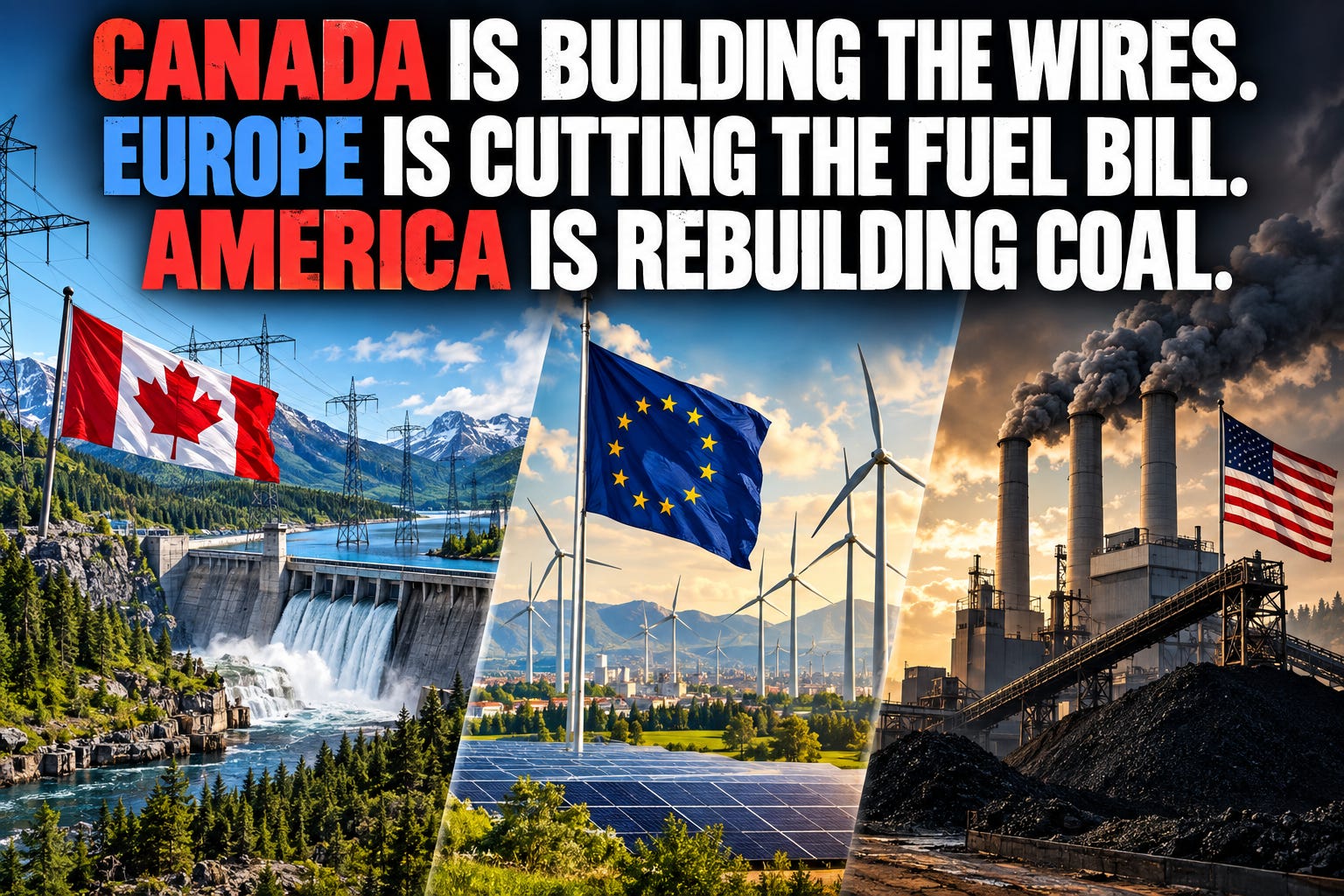
I started looking at this as an energy story.
I don’t think it is anymore.
I think it’s an industrial story.
Because while politicians keep arguing about electric cars, carbon and whether somebody is coming for your gas stove, something much bigger is happening underneath all that noise.
Countries are deciding what they want their economies to run on 10, 20 and 30 years from now.
And suddenly Canada is sitting in a very interesting position.
Europe did the math
In July, the European Commission laid out a remarkably blunt plan.
Today, electricity supplies about 23% of Europe’s final energy consumption.
Europe wants that number at 46% by 2040.
Why?
Climate is certainly part of it.
But read the European Commission’s own explanation and another word keeps showing up…
Independence.
Europe imports more than half of the fossil fuels it consumes. Recent geopolitical upheaval has demonstrated just how expensive that dependence can become.
The Commission estimates that accelerated electrification could reduce EU gas imports by more than 70% and crude-oil imports by more than 40% by 2040.
And here’s the number that grabbed me…
€260 billion a year.
That’s how much Europe says it could save on fossil-fuel imports by 2040 if the strategy works.
Not €260 billion once.
Every year.
That’s when this stops looking like an environmental program and starts looking like economic strategy.
Every tanker of imported fuel represents money leaving your economy.
Replace some of that imported fuel with electricity generated at home and you haven’t merely changed the energy source.
You’ve changed where the money goes.
Europe calls its ambition becoming the world’s first “electro-powered continent.”
Sounds like something dreamed up by a committee after too much coffee.
But the economics behind it aren’t silly at all.
Then I looked at Canada
And this is where things get interesting.
Canada already starts with an advantage most countries would kill for.
Roughly 80% of our electricity comes from non-emitting sources, depending on the year and how the statistics are counted.
Hydro does most of the heavy lifting, with nuclear, wind, solar and other sources contributing the rest.
Our problem isn’t a lack of energy resources.
Our problem has traditionally been connecting the damn things.
Canada’s electricity system developed largely province by province.
Which made sense historically.
It makes considerably less sense if electricity is becoming one of the foundations of national economic security.
The federal government’s new Powering Canada Strong strategy says Canadian electricity demand is expected to double by 2050 and calls for an electricity system capable of generating and delivering roughly twice as much power.
And this isn’t just about plugging in more Teslas.
The government’s own list of growing demand includes critical minerals, battery manufacturing, AI data centres, advanced manufacturing, new housing, transportation and building heating.
That’s the part worth paying attention to.
Electricity isn’t merely something you buy every month from BC Hydro.
It’s becoming industrial infrastructure.
And some of this has already moved beyond the PowerPoint stage.
In August, Ottawa announced up to $10 billion in federal financial support and investment tied to the enormous Labrador hydro expansion involving Churchill Falls, Gull Island and associated transmission and infrastructure.
The combined projects are valued at nearly $70 billion.
Then in September, construction officially began on Phase 1 of British Columbia’s North Coast Transmission Line, designed to carry substantially more electricity into the province’s northwest and enable mining, critical-mineral and industrial development.
There’s the connection I’ve been banging on about in our We Can Build It Here stories.
You don’t build advanced manufacturing first and then wonder where the electricity will come from.
You build the power that makes the manufacturing possible.
And yes, this is going to cost a fortune
Canada’s strategy estimates electricity-system expansion and modernization could require more than $1 trillion between now and 2050.
That’s a number large enough to make any taxpayer choke on his morning coffee.
But here’s the question we should be asking…
What happens if we don’t build it?
AI data centres require enormous amounts of electricity.
Mines require electricity.
Processing critical minerals requires electricity.
New factories require electricity.
Housing requires electricity.
Defence manufacturing requires electricity.
And if Canada wants to stop being merely the country that digs things out of the ground and ships them somewhere else to become valuable, we’re going to need a hell of a lot more power.
Preferably reliable.
Preferably affordable.
And preferably ours.
Then there’s the United States
This is where the comparison gets strange.
Coal produced about 17% of U.S. utility-scale electricity in 2025.
Natural gas produced 41%.
Renewables produced 24%.
Nuclear produced 18%.
So coal is no longer the backbone of American electricity generation.
Yet the Trump administration has made preserving and expanding coal generation an explicit federal priority.
And we’re not talking about a press release saying nice things about coal miners.
The U.S. Department of Energy announced $500 million in Defense Production Act funding to support coal-fired plants and coal-export infrastructure.
Yes.
The Defense Production Act.
Of that amount, up to $425 million is going toward coal-fleet projects and up to $75 million toward a West Coast export terminal.
That’s not all.
DOE also selected four coal modernization, recommissioning and development projects under another $350-million initiative, including work examining new coal plants and restarting or modernizing existing facilities.
Another $175 million was announced for six projects modernizing and extending the useful lives of existing coal-fired power plants.
Now, there’s an important distinction here.
Washington’s argument is that dispatchable coal generation strengthens grid reliability at a time when American electricity demand is growing rapidly.
That’s the government’s stated rationale.
Fine.
But it still leaves us looking at three very different bets.
Europe is trying to electrify its economy so it imports less fossil fuel.
Canada is preparing to roughly double its electricity system to support a more electrified and industrial economy.
The United States is using federal money and even national-security authorities to preserve and expand coal generation as part of its answer to growing electricity demand.
Those aren’t talking points.
Those are policy choices.
Here’s what I think Canada should notice
For years we talked about electricity mainly as an environmental issue.
I think that’s becoming obsolete.
Electricity is sovereignty.
It’s industrial capacity.
It’s national security.
It’s whether a mining company builds the processing plant here or somewhere else.
It’s whether the next AI data centre goes to Alberta, Quebec or Virginia.
It’s whether we sell somebody a tonne of ore or sell them the much more valuable product we manufactured from it.
And there’s another reason this matters.
The Strait of Hormuz has historically carried roughly one-fifth of global petroleum liquids consumption.
One narrow stretch of water.
About 20% of the world’s petroleum liquids moving through it.
You don’t need an environmental bumper sticker to understand the vulnerability in that.
You just need a calculator.
The more energy a country can reliably produce within its own borders, the less exposed part of its economy becomes to somebody else’s war, somebody else’s shipping lane and somebody else’s political tantrum.
That doesn’t mean Canada stops producing oil and gas.
I’ve never understood why this has to be an either/or argument.
Canada can sell oil.
Canada can sell LNG.
Canada can produce uranium.
Canada can build nuclear reactors.
Canada can expand hydro.
Canada can build wind and solar where they make economic sense.
And Canada can build the transmission lines connecting all of it.
The point isn’t choosing the politically approved energy source.
The point is building an energy advantage.
Norway figured out part of this a long time ago
Norway remains one of my favourite examples because it wrecks the simplistic argument.
Norway is a major oil and gas producer.
It is also one of the most electrified economies in the developed world.
The International Energy Agency reports that electricity supplies almost half of Norway’s total final energy consumption and that its electricity system is almost entirely renewable, overwhelmingly because of hydroelectricity.
And in 2025, 95.9% of all new passenger vehicles registered in Norway were electric.
Norway didn’t decide petroleum was evil.
It figured out that having abundant domestic electricity while selling valuable petroleum to somebody else wasn’t exactly the dumbest business model ever invented.
There’s a lesson there.
Canada has spent too much time thinking small
We have hydro.
We have uranium.
We have nuclear expertise.
We have natural gas.
We have wind.
We have critical minerals.
We have enormous geography.
We have engineering talent.
And now we’re finally talking seriously about connecting those advantages.
The Canadian electricity strategy even explicitly calls for greater interprovincial integration and new interties…
something this country should probably have been much more serious about decades ago.
Railways helped build Canada.
Highways helped build Canada.
Telecommunications helped build Canada.
Maybe the next nation-building project isn’t something Canadians ride on.
Maybe it’s the wires running over our heads.
Because almost everything we’re talking about building next needs the same thing.
Power.
Lots of it.
And for once, Canada doesn’t need to look south and ask what America is doing first.
We have enough resources to build our own answer.
We just need to connect the damn things.
The Recap…
Europe wants to increase electricity’s share of its energy use from 23% to 46% by 2040 and says doing so could cut fossil-fuel imports by €260 billion a year.
Canada expects electricity demand to roughly double by 2050 and has begun treating generation and transmission as nation-building infrastructure.
Meanwhile, Washington is putting hundreds of millions of federal dollars… including Defense Production Act money… into extending, modernizing and expanding coal generation.
The interesting question isn’t which country has the catchiest climate slogan.
It’s which one is building the energy system its economy will need 20 years from now.
The Gut-Punch…
Canada spent a century building pipelines, railways and highways to move what we produced.
This century, we’d better make damn sure we’ve got enough wires to power what we want to build.
Source credit:
Primary sources: Natural Resources Canada and Government of Canada, Powering Canada Strong: A National Strategy for an Electrified Canadian Economy and 2026 electricity-project announcements; European Commission, Electrification Action Plan; U.S. Department of Energy coal-program announcements and project selections; U.S. Energy Information Administration electricity and Strait of Hormuz data; International Energy Agency Norway energy analysis; Norway’s Road Traffic Information Council (OFV) 2025 vehicle-registration data.
If you enjoy thoughtful conversations, Canadian stories, and the occasional smart-ass observation about the world we’re living in, you’re in the right place.
Subscribe free and get new stories, insights, and observations delivered directly to your inbox.
No paywall.
No spam.
No nonsense.
Leave anytime with a single click.
I promise not to take it personally.
I'm glad that the need for electricity as the future has become the main direction for Canada, and also happy that we have so many ways of getting there. I've mentioned before, in other responses, that we sell the oil we produce, we don't burn it. It may be passing the environmental buck, but the countries that do burn it haven't yet developed alternatives. Besides, we need the money to build the new Canada.
With regard to the USA's drive for coal-fired electrical generation we need to remember that that's all they've got. They're running low on oil and gas and what they have they would rather sell then burn because profit is more important than need. They import oil from us to process it and resell it.
They import uranium and refuse to use sunshine in the red states where it's most prevalent. Coal is so Fortress America!
The statement you made, while off the cuff, leads to your next report, the one on defense systems. That statement was "Canada already starts with an advantage most countries would kill for." Our neighbor to the south has demonstrated that style of thinking and action. Ask Venezuela.
Thanks Fred! Stay warm everyone, start walking haha