

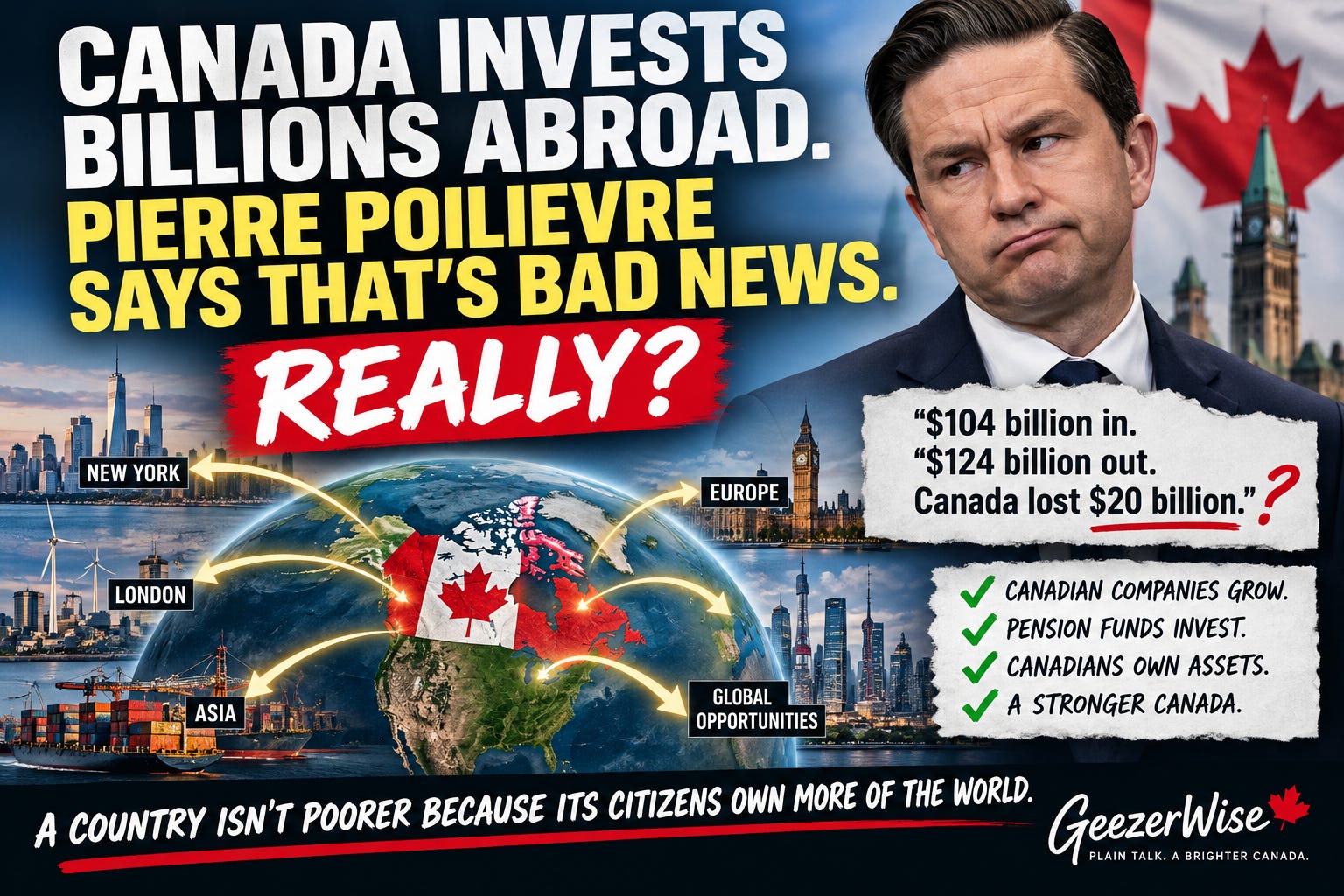
Pierre Poilievre wants you to subtract one from the other and call the difference a loss.
That’s not how investment works.
Here’s a strange way to measure whether Canada is doing well.
Count the money foreigners invest in Canada.
Then count the money Canadians invest in businesses and assets around the world.
Subtract one from the other.
And if Canadians invested more abroad?
Declare Canada the loser.
Apparently our money crossed the border and fell into a hole.
That’s essentially the argument Pierre Poilievre is making while Mark Carney is trying to attract more international investment into Canada.
And there’s a pretty big problem with it.
Investment isn’t an expense.
It buys something.
That seems worth mentioning.
Let’s Start With Pierre’s Numbers
The argument uses two figures.
Over the period being discussed, roughly $104 billion in foreign direct investment came into Canada, while Canadians invested roughly $124 billion abroad.
Pierre subtracts one from the other.
Voilà.
A $20-billion “net outflow.”
Presented that way, it sounds ominous.
Except Canada didn’t ship $124 billion overseas and wave goodbye to it.
Canadian investors bought assets.
Businesses.
Infrastructure.
Real estate.
Utilities.
Financial interests.
Things expected to generate income and increase in value.
That distinction changes the entire argument.
If I spend $500,000 buying a house, I haven’t “lost” $500,000.
I exchanged cash for an asset.
Whether it turns out to be a good investment is another question entirely.
But pretending the asset disappeared because the cash left my bank account would be ridiculous.
Yet somehow we’re supposed to use that arithmetic to judge an entire country’s economy.
Rich Countries Invest Outside Their Borders
Canadian businesses don’t stop being Canadian businesses when they expand internationally.
Our banks operate internationally.
Our resource companies invest internationally.
Our financial institutions own assets around the world.
And Canadian pension funds have become some of the biggest institutional investors on Earth.
According to the figures cited in the research behind this article, Canada ranks among the world’s leading sources of outward foreign direct investment, with roughly US$86 billion annually flowing into foreign investments.
The accumulated stock of Canadian direct investment abroad is cited at approximately C$2.42 trillion.
Think about that number for a second.
$2.42 trillion in Canadian-owned investment abroad.
That’s not evidence Canada has been emptied out.
It’s evidence Canadians own one hell of a lot of stuff outside Canada.
And there’s another part of this story most Canadians probably don’t think about.
Some of that money belongs, indirectly, to us.
Meet Canada’s Quiet Financial Heavyweights
Canada has built enormous pension investment organizations.
CPP Investments.
Quebec’s CDPQ.
Ontario Teachers’ Pension Plan.
OMERS.
British Columbia Investment Management Corporation.
Alberta’s AIMCo.
They don’t stick Canada’s retirement money into a giant savings account and wait for us to turn 65.
They invest it.
And because these organizations manage hundreds of billions of dollars, Canada simply isn’t big enough to provide every investment opportunity they need.
So they buy assets around the world.
Infrastructure.
Real estate.
Transportation.
Utilities.
Companies.
Private investments.
The transcript cites CPP Investments alone as managing more than three-quarters of a trillion Canadian dollars as of March 2026.
That’s Canadian capital working around the world.
For Canadians.
Now Flip the Telescope Around
Here’s where this gets interesting.
While Canadian institutions are investing abroad, Canada also wants the rest of the world investing here.
Those two things aren’t contradictory.
They’re exactly what you’d expect from an advanced economy integrated into global capital markets.
Foreign companies invest in Canadian mines, factories, technology, energy, infrastructure and businesses.
Canadian companies invest in opportunities elsewhere.
Capital moves both directions.
The important questions aren’t simply…
How much went in?
and
How much went out?
The useful questions are…
What did we buy?
What did they build?
What returns are Canadians earning?
What jobs and productive capacity are being created here?
And is Canada attracting enough investment to build the country we need for the next 20 years?
Those are questions worth arguing about.
And THAT Is Where Pierre Could Have Had a Point
There’s a legitimate debate sitting right in front of him.
Canada needs enormous amounts of capital.
Energy projects.
Critical-mineral processing.
Ports.
Rail.
Housing.
Defence manufacturing.
AI infrastructure.
Electricity generation and transmission.
The whole damn country needs upgrading.
So I’d be perfectly happy to hear Pierre Poilievre ask…
Why aren’t more Canadian investment dollars finding attractive opportunities inside Canada?
Good question.
I’d listen.
I’d also like to know what government can do to make Canadian projects competitive enough that our own institutional investors want to put more money into them.
But that’s very different from pretending Canadian investment abroad represents money disappearing from Canada.
Our pension funds aren’t government piggy banks either.
They’re independently managed investment organizations whose job is to produce long-term returns, not finance whatever project happens to be politically fashionable.
The research notes themselves make that distinction clear.
And that’s exactly how it should be.
Meanwhile, Carney Is Selling Canada
This argument is happening while Mark Carney is doing something Canada desperately needs.
Selling Canada as a place to invest.
Not with slogans.
With projects.
The government is trying to attract international capital for the nation-building investments Canada wants over the coming decades.
And after everything we’ve watched happen south of the border, Canada’s pitch has become increasingly straightforward…
We have resources.
We have energy.
We have critical minerals.
We have stable institutions.
We have access to major international markets.
And we’re looking for partners willing to build things here.
That’s the competition Canada needs to win.
Two Things Can Be True at the Same Time
Canada can attract massive amounts of foreign investment.
And Canadians can invest massive amounts overseas.
There is no contradiction.
We want foreign capital helping build productive Canadian assets.
And we want Canadian capital earning returns from productive assets around the world.
That’s what globally connected economies do.
Which is why reducing all of this to…
$104 billion came in.
$124 billion went out.
Canada lost $20 billion.
...may make a tidy political clip.
But it tells Canadians almost nothing about what actually happened to the money.
Money didn’t vanish.
Ownership changed hands. Assets were purchased. Investments were made.
That’s the part that matters.
The Recap…
🇨🇦 Pierre Poilievre says more Canadian investment went abroad than foreign investment came into Canada.
Sounds terrible.
Until somebody asks the obvious question…
What did Canadians BUY with that money?
Canada isn’t shipping billions overseas and setting it on fire.
We’re buying assets around the world while asking the world to invest in Canada.
There’s a difference.
The Gut-Punch…
A country isn’t poorer because its citizens own more of the world.
The real challenge is making sure the world wants to own a piece of what Canada builds next.
Source credit:
Research notes based on a commentary transcript discussing Pierre Poilievre’s foreign-investment argument, Canadian foreign direct investment, UNCTAD investment data and Canada’s major pension investment funds. Figures from the source material should be independently verified against Statistics Canada, UNCTAD and the respective pension funds before publication.
If you enjoy thoughtful conversations, Canadian stories, and the occasional smart-ass observation about the world we’re living in, you’re in the right place.
Subscribe free and get new stories, insights, and observations delivered directly to your inbox.
No paywall.
No spam.
No nonsense.
Leave anytime with a single click.
I promise not to take it personally.
Excellent, thanks Fred