

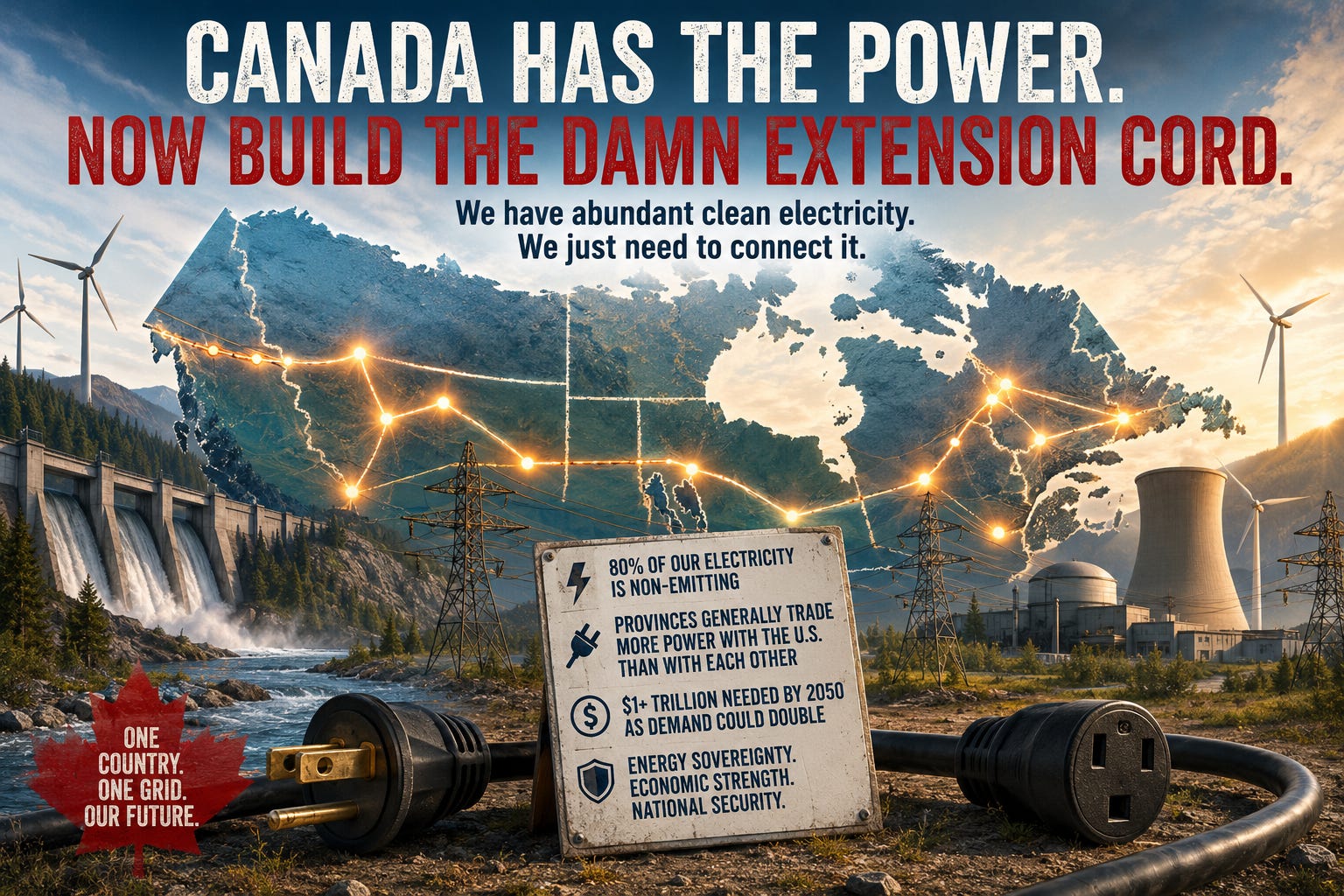
Canada has an energy problem that sounds ridiculous when you first hear it.
We have enormous amounts of electricity.
We just aren’t particularly good at moving it around our own country.
Quebec has a hydroelectric powerhouse.
Ontario has one of the world’s most experienced nuclear industries.
Manitoba has hydro.
British Columbia has hydro.
Newfoundland and Labrador has hydro resources so large that Churchill Falls alone has shaped provincial politics for generations.
Alberta and Saskatchewan have natural gas, rapidly growing wind and solar generation, and huge industrial electricity requirements.
And Canada has the uranium, engineering talent and nuclear know-how to build considerably more nuclear generation if provinces decide they need it.
Put the whole thing together and roughly 80% of Canadian electricity already comes from non-emitting sources.
That’s an extraordinary starting position.
But here’s the Canadian part.
We built most of it province by province.
And then we built some of our strongest transmission connections south.
To the United States.
Not east and west.
Across Canada.
The federal government’s own 2026 electricity strategy now says Canadian provinces and territories operate as multiple, relatively segregated electricity systems and generally trade more electricity with the United States than with one another.
There’s a technical term for this.
I prefer:
We forgot to buy the extension cord.
We Don’t Really Have a Canadian Grid
When Canadians talk about “the grid,” it sounds like one giant electrical machine stretching from Victoria to St. John’s.
It isn’t.
Electricity is primarily provincial jurisdiction.
Different provinces have different utilities.
Different regulators.
Different market structures.
Different generation mixes.
Different planning systems.
Different priorities.
Eight of Canada’s ten provinces still rely primarily on vertically integrated utilities to plan, build and operate their systems.
That isn’t necessarily bad.
It helped provinces develop electricity systems suited to their own resources.
But it also produced a country where moving a large block of electricity across a provincial boundary can be considerably more complicated than looking at a map and drawing a line.
Meanwhile, Canada has built extensive connections with the United States.
The Canada Energy Regulator currently oversees 86 international power lines.
And the CER says the pattern plainly: Canada’s large transmission infrastructure has historically been built predominantly north-south rather than east-west.
That made economic sense.
American markets were nearby.
Canadian hydro producers could sell surplus electricity south and make money doing it.
Those connections also improve reliability on both sides of the border.
I am not arguing Canada should unplug America.
That would be stupid.
I’m arguing that perhaps Canada should become at least as serious about connecting Canada.
Look at the Numbers
In 2025, Canada exported 32.7 terawatt-hours of electricity to the United States, worth about $3.3 billion.
We also imported 22.1 TWh from the United States, worth about $1.4 billion.
Canada supplied more than 81% of all electricity imported by the United States that year.
So let’s dispense with the fantasy that Canada is some energy-poor northern outpost waiting for somebody else to keep the lights on.
We’re a serious electricity producer.
But Mother Nature occasionally reminds us not to get cocky.
Low precipitation hammered hydro generation in several provinces recently.
British Columbia, Quebec and Manitoba all experienced the consequences.
B.C., for example, became a significant electricity importer during the drought years.
That’s actually another argument for stronger connections.
A national grid isn’t about declaring one province the permanent power station for everybody else.
It’s about options.
When one region has excess electricity, move it.
When another has a shortage, move it there.
When hydro reservoirs are low, draw from somewhere else.
When wind generation is booming in one region, use it elsewhere.
When a nuclear fleet is producing steady baseload electricity, connect it to a larger market.
That’s what networks are good at.
Hydro Could Become Canada’s Giant Battery
This is where things get particularly interesting.
Hydroelectric reservoirs don’t behave like coal or gas plants.
Water can be stored.
Generation can be increased when demand rises and reduced when other electricity is plentiful.
That gives hydro-rich provinces something enormously valuable in an electricity system containing increasing amounts of wind and solar:
flexibility.
Imagine Manitoba wind generation is booming overnight.
Instead of wasting cheap electricity, neighbouring hydro systems could potentially reduce generation and preserve water.
Later, when demand rises or wind generation falls, hydro production increases.
The reservoir effectively stores energy without requiring somebody to manufacture a mountain of lithium batteries.
British Columbia already uses versions of this strategy through electricity trading with the Pacific Northwest.
The concept isn’t theoretical.
The question is whether Canada can do more of it inside Canada.
Ottawa Has Finally Started Saying the Quiet Part Out Loud
This isn’t merely GeezerWise sitting on Vancouver Island drawing transmission lines on a napkin.
In May 2026, the federal government released Powering Canada Strong: A National Strategy for an Electrified Canadian Economy.
And some of the language is remarkably direct.
Canada expects electricity demand could double by 2050.
AI data centres alone could require 3 to 5 gigawatts by 2030 and as much as 10 GW by 2050.
Then add critical-mineral mines.
Battery factories.
Advanced manufacturing.
Housing.
Transportation.
Defence infrastructure.
New industrial projects.
And whatever industries haven’t even been invented yet.
The government’s estimate for expanding and modernizing Canada’s electricity system?
More than $1 trillion between now and 2050.
Important distinction:
That isn’t the price of one giant east-west transmission line.
It’s the estimated investment required for the broader electricity-system expansion… generation, transmission and other infrastructure…
needed as Canada heads toward dramatically higher electricity demand.
But interprovincial transmission is clearly part of the plan.
Ottawa says interprovincial transmission capacity could increase by roughly 27% by 2035 and potentially 70% by 2050.
And there’s an economic reason.
The federal strategy cites modelling suggesting that doubling the B.C.-Alberta interconnection could produce about $1.7 billion in net benefits by 2050.
Tripling Manitoba-Saskatchewan capacity could produce about $2.3 billion.
That’s where the extension cord stops being a cute metaphor.
There’s real money involved.
Some Pieces Are Already Moving
And this is where we need to separate political announcements from bulldozers.
There is not currently one coast-to-coast Canadian supergrid under construction.
Nobody should pretend otherwise.
What is happening is a collection of regional projects, agreements, financing programs and proposed interties that could gradually create something much more integrated.
In July, New Brunswick, Nova Scotia and Prince Edward Island signed an agreement to pursue greater Maritime electricity integration and develop a regional roadmap.
Ottawa also announced $5.9 million to advance planning for an expanded P.E.I.–New Brunswick interconnection.
The Nova Scotia-New Brunswick Wasoqonatl Reliability Intertie has received a $285-million Canada Infrastructure Bank equity commitment, including $54 million through its Indigenous Equity Initiative, along with $24.7 million in federal pre-development funding.
Up north, the proposed Taltson Hydro Expansion would add 60 MW of generation and approximately 320 kilometres of transmission, connecting the North and South Slave grids for the first time.
It is being examined not just as an electricity project but as infrastructure supporting mining, communities and potentially Canada’s expanded northern defence presence.
But Taltson is not yet a completed project. It was referred to the federal Major Projects Office in March 2026 and remains in development and regulatory work.
Same story with another monster project in British Columbia.
The North Coast Transmission Line is designed to more than double electricity capacity into northwestern B.C., opening the door to mines, ports, LNG and other major industrial developments.
Ottawa and British Columbia announced $3.9 billion toward the first two phases in July.
Several First Nations represented through the K’uul Power consortium have agreements providing an option for up to 50% ownership.
Pre-construction work has been advancing and governments have been targeting construction in 2026.
Again…
That’s progress.
But let’s not put a ribbon on something before it’s built.
Indigenous Partnership Isn’t a Footnote
There is another lesson hiding inside these projects.
You aren’t going to string thousands of kilometres of new Canadian transmission infrastructure across the country while treating Indigenous nations like people who get invited to the meeting after the decisions have already been made.
That era is over.
And frankly, there is a better model available anyway.
Ownership.
Canada already has examples.
The Wataynikaneyap transmission project in Ontario is Indigenous-led and majority-owned and has connected remote First Nations to Ontario’s electricity grid.
Aamjiwnaang First Nation and the Chippewas of Kettle and Stony Point First Nation are acquiring nearly a 20% interest in Hydro One’s Chatham-to-Lakeshore transmission line with support from the federal Indigenous Loan Guarantee Program.
The North Coast project could go much further.
That’s not consultation as paperwork.
That’s participation in the asset.
If Canada is about to spend hundreds of billions rebuilding its energy infrastructure, Indigenous Canadians shouldn’t merely watch the transmission towers cross their traditional territories.
They should have opportunities to own the damn towers.
Then There’s the Industrial Question
This may ultimately be the biggest reason to build.
Electricity is becoming industrial currency.
Want an AI data centre?
Show me the megawatts.
Want a mine?
Show me the transmission line.
Want an EV battery factory?
Show me reliable electricity.
Want to expand advanced manufacturing?
Same question.
Want to develop Canada’s North?
Electricity.
Want military installations operating in remote regions?
Electricity again.
For most of my lifetime, Canada could afford to think of electricity mainly as a public utility issue.
Keep the lights on.
Keep rates reasonable.
Build another generating station when necessary.
That world is disappearing.
Electricity capacity is increasingly deciding where investment goes.
If a company needs 500 megawatts and Province A says, “Maybe in eight years,” while another jurisdiction says, “We’ve got it,” guess who gets the factory?
Canada’s electricity system is becoming part of our industrial strategy whether politicians like the phrase or not.
This Isn’t Green Versus Oil
And please spare me the usual political food fight.
This isn’t:
GREEN GOOD.
OIL BAD.
Canada can produce oil.
Canada can produce natural gas.
Canada can export LNG.
Canada can build nuclear reactors.
Canada can expand hydro.
Canada can build wind.
Canada can build solar.
Canada can build storage.
And Canada can build transmission lines connecting all of it more intelligently.
Energy abundance is the objective.
Because an energy-rich country fighting internally over which form of Canadian energy we’re allowed to like is one of the dumbest luxuries imaginable.
Build what makes economic sense.
Then build the infrastructure allowing Canadians to use it.
And Yes, This Will Be Expensive
Here’s where the cheerleading stops.
Transmission projects are expensive.
Very expensive.
They can take years to approve and years more to build.
Provinces guard their electricity jurisdiction carefully.
Utilities don’t necessarily want somebody in Ottawa telling them how to operate their systems.
Different provincial electricity markets don’t fit neatly together.
Transmission corridors cross private land, Indigenous territories, forests, waterways and communities.
Environmental assessments matter.
Consultation matters.
Engineering constraints matter.
And every proposed intertie has to survive the most basic test:
Does the damn thing make economic sense?
A national strategy cannot mean Ottawa drawing one enormous line across a map and sending everybody a bill.
Regional integration will probably make far more sense.
Western connections.
Prairie connections.
Ontario-Quebec.
Quebec-Atlantic Canada.
Northern grids.
Then stronger links between those regions where economics justify them.
Think Canadian electrical backbone, not one magical coast-to-coast wire.
Here’s What Changed
For decades, Canada could afford electricity provincialism.
America was stable.
Continental trade was predictable.
Cross-border energy relationships were treated as almost permanent.
Then Canadians received a reminder.
Nothing in geopolitics is permanent.
Canada should continue selling electricity to Americans when it benefits us.
We should continue buying American electricity when it benefits us.
But our domestic energy system shouldn’t depend on the assumption that political relations with the United States will always remain exactly as they were.
That’s not anti-American.
That’s risk management.
Nobody buys fire insurance because they hate their house.
They buy it because houses occasionally catch fire.
A country should think the same way about critical infrastructure.
The Railway Argument
Canada has faced this problem before.
A huge country.
A relatively small population.
Enormous distances.
Regional economies looking in different directions.
And infrastructure that didn’t always make immediate financial sense if you examined every kilometre separately.
So we built railways.
Not because railway construction was easy.
It was brutally difficult.
Not because every section instantly paid for itself.
It didn’t.
We built them because connecting Canada had value beyond the balance sheet for any individual stretch of track.
The railway didn’t simply move freight.
It helped create the economic geography of the country.
Electricity may be our generation’s version of that decision.
Not identical.
Not literally one giant project.
But the principle is remarkably familiar.
Canada possesses extraordinary resources.
What we lack is the infrastructure to combine those resources into their full national advantage.
The Carney government has now put a more integrated electricity system squarely on the national agenda.
There are projects moving.
There is financing available.
The new 15% Clean Electricity Investment Tax Credit specifically includes eligible interprovincial transmission infrastructure.
The Canada Infrastructure Bank has a $20-billion clean-power investment target.
The federal Indigenous Loan Guarantee Program has been expanded to $10 billion.
And the Building Canada Act now gives Ottawa a mechanism for accelerating designated projects considered nationally important — while still requiring consultation and respecting provincial jurisdiction and Indigenous rights.
Those are tools.
They are not transmission lines.
Now comes the difficult part.
Using them.
The Recap…
Canada already generates roughly 80% of its electricity from non-emitting sources.
But our provincial grids remain far better connected north-south with the United States than east-west with each other.
Meanwhile electricity demand could double by 2050 as AI, mining, manufacturing, transportation and new industry pile onto the system.
We don’t need one magical national wire.
We need a much stronger Canadian electrical backbone.
Because this isn’t just an electricity project anymore.
It’s an economic project.
An industrial project.
A national-security project.
And increasingly, a sovereignty project.
The Gut-Punch…
The railway helped connect Canada once.
Electricity may have to do it again.
Canada already has the power.
Now build the damn extension cord.
Sources
Natural Resources Canada — Powering Canada Strong: A National Strategy for an Electrified Canadian Economy — the key 2026 federal strategy covering Canada’s fragmented grids, projected doubling of electricity demand, interprovincial transmission, industrial demand, financing and energy sovereignty.
Canada Energy Regulator — 2025 Canada-U.S. Energy Trade — 2025 electricity exports, imports and Canada’s share of U.S. electricity imports.
Canada Energy Regulator — Who Regulates Electricity Trade? — Canada’s 86 international power lines and the historic north-south orientation of transmission.
Natural Resources Canada — Stronger Maritime Electricity Grid — July 2026 Maritime regional integration agreement.
Government of Canada — North Coast Transmission Line — federal-provincial funding, Indigenous equity opportunities and current project status.
Government of Canada — Taltson Hydro Expansion — 60-MW expansion, 320-km transmission proposal and northern economic/security rationale.
Government of Canada — Clean Electricity Investment Tax Credit — 15% refundable credit covering eligible generation, storage and transmission infrastructure.
Government of Canada — Building Canada Act / Projects of National Interest — current federal framework for accelerating nationally significant infrastructure.
Indigenous Services Canada — Wataynikaneyap Power — Indigenous-led, majority-owned Ontario transmission project.
Department of Finance — Indigenous ownership of Hydro One transmission — federal loan guarantee supporting nearly 20% First Nations equity ownership.
If you enjoy thoughtful conversations, Canadian stories, and the occasional smart-ass observation about the world we’re living in, you’re in the right place.
Subscribe free and get new stories, insights, and observations delivered directly to your inbox.
No paywall.
No spam.
No nonsense.
Leave anytime with a single click.
I promise not to take it personally.
It's now technically possible to send electric energy great distances by underwater cable. Australia and Singapore had an agreement to send solar generated power about 10 years ago, which was subsequently cancelled, and I believe recently revived.....
Labrador to Europe is probably a possibility, Game Changing? All of a sudden our limited US export potential has interesting options....
Build baby Build!
What is missing is a focus on HVDC connections. DC intertie connections do not have the line losses of AC transmission lines, and do not have to be synchronized the way AC connections do. When Premier Ford threatened to flip the switch to the USA I think someone told him it would put the lights out in Ontario as well if not synchronized. Manitoba and Quebec have HVDC lines. They go South. Ask Google about HVDC connectors in China. They move electricity from the North to the population centers in the South. They have done this as a strategic investment to reduce reliance on oil and natural gas. We should too if the federal government can find a way to get the provincial electrical fiefdoms to cooperate.