

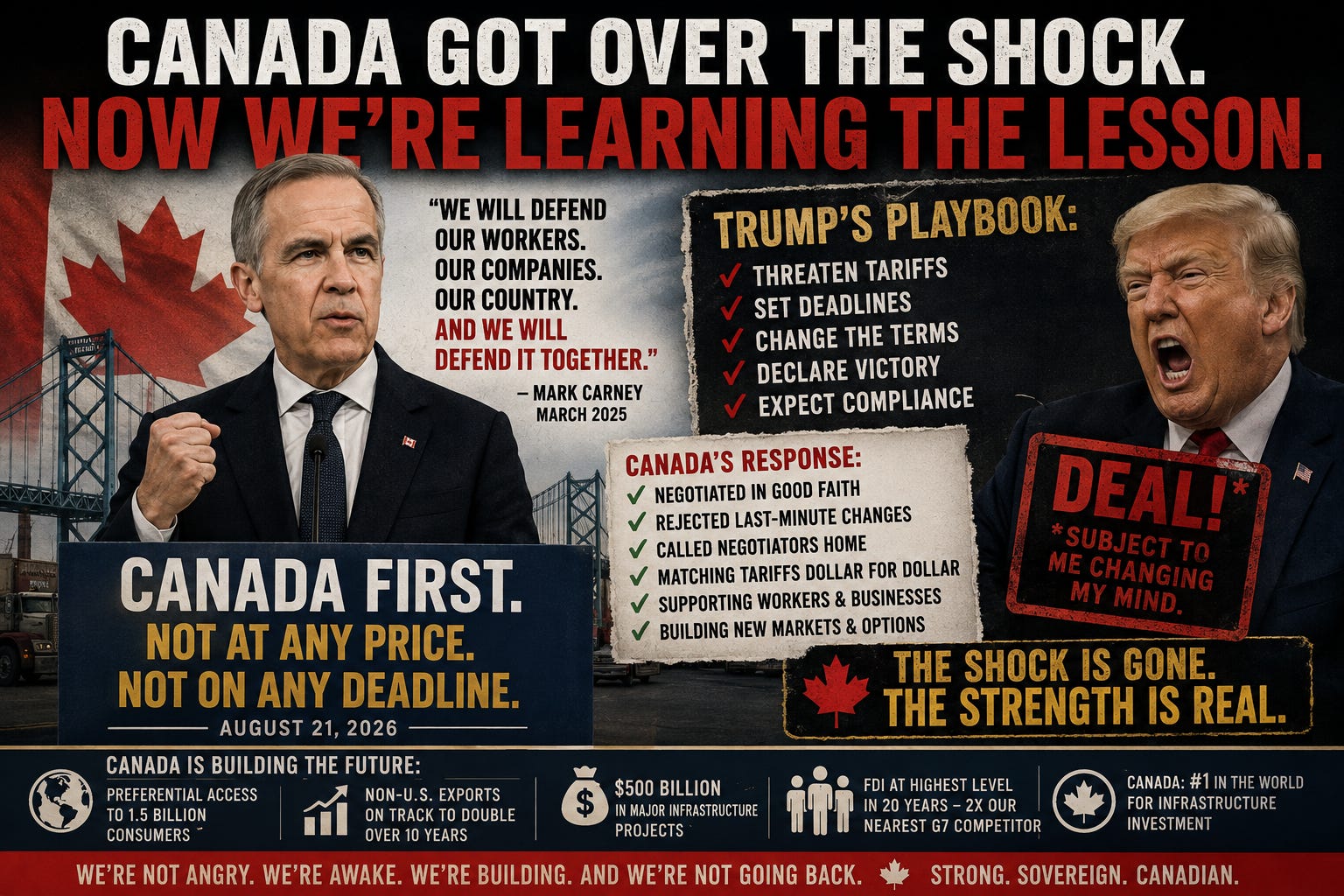
There was one sentence in Prime Minister Mark Carney’s latest statement that stopped me cold…
“Never a deal at any price or on any deadline.”
That may be one of the most important things a Canadian prime minister has said during this entire mess with Donald Trump.
Because for the last 18 months, Trump has operated as though Canada eventually has to give him what he wants.
Set a deadline.
Threaten tariffs.
Move the deadline.
Raise the tariffs.
Announce progress.
Change the terms.
Threaten some more.
And eventually Canada will become frightened enough about losing access to the American market that we’ll sign whatever piece of paper Trump puts in front of us.
Except this time Canada didn’t.
Carney walked.
And I’m perfectly comfortable with that.
We’ve Been Here Before
To understand why this moment matters, go back to the beginning of this fight.
Donald Trump had just announced 25 percent tariffs against the auto industry.
Carney called it what he believed it was…
“A direct attack.”
He was standing near the Ambassador Bridge… one of the greatest physical symbols of the deeply integrated Canadian and American economies.
Cars and parts have crossed that border back and forth for generations.
Canadian and American workers didn’t merely sell cars to each other.
We built the damn things together.
And Carney acknowledged that something fundamental was changing.
He talked about the ties of kinship and commerce between Canada and the United States.
Then he said those ties were “in the process of being broken.”
But another part of that speech matters even more today.
Carney said Canadians had “gotten over the shock of the betrayal and are learning lessons.”
And then came the lesson…
“We have to look out for ourselves and we have to look out for each other.”
That wasn’t chest-thumping.
Carney immediately started explaining what that meant in practical terms.
This Was Never Just About Retaliating
Canada had committed to using the money collected through retaliatory tariffs to support Canadian workers.
The government changed Employment Insurance rules.
It provided companies with ways to delay tax payments.
It established financing and liquidity measures so businesses facing sudden American tariffs wouldn’t have to make disastrous long-term decisions because of short-term political pressure from Washington.
Carney also pointed to the $2-billion Strategic Response Fund.
Government procurement.
Canadian supply chains.
Cooperation with labour.
And then he described the longer-term objective…
Building a “made-in-Canada option so that we are less affected by these.”
Read that again.
So that we are less affected next time.
Because anybody paying attention should have understood there would be a next time.
And now there is.
Fast Forward 18 Months
Canada has spent months negotiating with the Trump administration.
The objectives Carney laid out were reasonable.
Preserve tariff-free access to the United States for the vast majority of Canadian businesses.
Reduce American tariffs on strategic Canadian industries.
Give Canadian businesses greater stability.
Protect small and medium-sized businesses.
And maintain Canada’s flexibility, independence and sovereignty.
That last one matters.
Because Canada wasn’t negotiating merely to obtain a piece of paper with Donald Trump’s signature on it.
We were negotiating for a deal worth having.
According to Carney, considerable progress had been made.
But it wasn’t enough.
Then the American side changed its proposed terms at the last minute.
Carney described those changes as “unfair, uneconomic” and said they called into question something even more important:
The reliability of any deal.
That’s the part Canadians shouldn’t skip over.
Because what good is a trade agreement if you can’t trust the other party to honour it?
So Canada Called the Negotiators Home
That’s what happened.
No dramatic surrender.
No agreement simply so politicians could announce that they had achieved a deal before Trump’s deadline.
Canada suspended the negotiations.
The United States intends to impose 50 percent tariffs on roughly $28 billion worth of Canadian goods.
Canada says it will match those tariffs dollar for dollar.
That will hurt.
Nobody should pretend otherwise.
Tariffs aren’t Monopoly money.
Businesses pay.
Workers can lose hours or jobs.
Consumers eventually feel the consequences.
Carney himself has never pretended otherwise.
During that earlier auto-tariff confrontation he said plainly:
“This will hurt us.”
But then he added something equally important…
“Through this period, by being together, we will emerge stronger.”
Now we’re finding out whether Canada meant it.
Something Has Changed in Canada
I think the most important change isn’t economic.
It’s psychological.
Remember how this started?
Every Trump tariff announcement felt like an emergency.
Every Truth Social post became breaking news.
Every deadline became another countdown clock.
What will Trump do?
What does Trump want?
Will Trump give Canada an exemption?
Can Canada convince Trump?
Will Trump change his mind?
We’ve spent an enormous amount of time asking what Donald Trump will allow Canada to do.
Maybe we’re finally asking the better question…
What does Canada want to do?
That’s a very different country.
Canada Isn’t Pretending America Doesn’t Matter
Let’s not get silly about this.
The United States remains our largest trading partner.
Millions of Canadian jobs are connected directly or indirectly to that relationship.
Our supply chains have been integrated for generations.
You don’t unwind that in 18 months.
You shouldn’t even want to unwind all of it.
Trade between Canada and the United States has created enormous prosperity on both sides of the border.
The problem isn’t America.
The problem is dependence on an increasingly unreliable American government.
There’s a difference.
Canada doesn’t need to stop trading with the United States.
Canada needs to stop being terrified of the possibility that someday we might have to trade less with it.
And that’s exactly why diversification matters.
Canada Has Been Building Other Doors
While Trump has been threatening tariffs, Canada has been working on something considerably less exciting but much more important:
Options.
New markets.
New infrastructure.
New trading relationships.
New domestic supply chains.
More Canadian procurement.
More east-west trade.
More ability to move Canadian resources to customers who aren’t located directly south of us.
Canada’s existing trade agreements already provide preferential access to approximately 1.5 billion consumers.
Carney says Canada is on track to double that market access by the end of this year.
The government says nearly $500 billion in major infrastructure projects are advancing.
Foreign direct investment in Canada is running at levels not seen in two decades.
Canadian exports to markets outside the United States are growing.
Again, none of this makes Trump’s tariffs harmless.
It does something much more important.
It gives Canada choices.
And choices create leverage.
That May Be Trump’s Biggest Miscalculation
Donald Trump’s negotiating power depends heavily on the other guy believing he can’t afford to say no.
That’s why deadlines matter.
That’s why threats matter.
That’s why tariffs matter.
That’s why the constant escalation matters.
The message is always essentially the same:
Give me what I want because what happens if you don’t will be worse.
That’s powerful leverage.
Until somebody discovers they can survive saying…
No.
Canada just said it.
The deadline arrived anyway.
Trump can impose his tariffs.
Canada can retaliate.
Canadian businesses will adapt.
The federal government will have to support workers and industries caught in the crossfire.
And Monday morning will still arrive.
Canada will still be here.
I Don’t Know If We Ever Get a Deal With Trump
And I’m becoming increasingly comfortable with that possibility.
Maybe negotiations restart.
Probably they eventually will.
Maybe a fair agreement can still be reached.
Great.
Take it.
But Canada should never sign a bad deal merely because Donald Trump created another deadline.
And we certainly shouldn’t surrender permanent pieces of Canadian sovereignty in exchange for temporary promises from a president who can change his demands whenever the mood strikes him.
That’s not stability.
That’s dependency.
And dependency is exactly what Canada has spent the last 18 months learning to reduce.
The Shock Is Gone
That’s why I keep coming back to what Carney said during that earlier tariff confrontation.
Canadians had gotten over “the shock of the betrayal.”
I think he was right.
Something changed.
At first, Trump’s attacks produced disbelief.
Then anger.
Then boycotts.
Then Canadians started looking around.
Buy Canadian.
Travel Canadian.
Find different suppliers.
Find different customers.
Build infrastructure.
Strengthen domestic industries.
Trade with Europe.
Trade with Asia.
Trade with anybody who wants what Canada has and is prepared to deal with us fairly.
That’s what getting over the shock looks like.
Not pretending America disappeared.
Not hating Americans.
Not cheering for economic pain.
Just finally understanding that Canada’s future cannot depend upon keeping one American president happy.
The Gut-Punch…
Trump thought tariffs would teach Canada how much we needed America.
He may have accidentally taught us something else.
How much we need to stop needing America quite so much.
And Friday night, when Mark Carney called Canada’s negotiators home rather than accept a deal he didn’t believe served Canadian interests, we saw what that lesson looks like.
Maybe we’ll eventually get a good deal with Donald Trump.
Maybe we won’t.
I’m good with either outcome.
Because the objective was never supposed to be getting a deal.
The objective is building a strong, independent Canada.
And for the first time in a very long time, we’re being forced to find out just how strong we can become.
🇨🇦 Canada first. The deal comes second.
If you enjoy thoughtful conversations, Canadian stories, and the occasional smart-ass observation about the world we’re living in, you’re in the right place.
Subscribe free and get new stories, insights, and observations delivered directly to your inbox.
No paywall.
No spam.
No nonsense.
Leave anytime with a single click.
I promise not to take it personally.
This seems like an excellent time to nail down purchase of 50+ Swedish Gripen fighters and the Canadian manufacturing jobs and maintenance training that go with them.
This is just what we need to help us focus. Thanks, Fred.
A related thought: I got in touch with the small business that CBC featured last Wednesday to see if I could buy something to help out a bit. I m waiting for a polished fossil necklace, made in Calgary, modestly priced, that I will wear and announce it s origins to whoever admires it. Free shipping too. But the owner admits she s terrified because her customers are mostly Americans who will drop her with the added 50%. I suggested that her work is lovely and might do well in the ROC, but she isnt so sure and advertising is a huge investment. She s on Etsy too but doesnt stand out as Canadian.
So I suggested and still believe this could be possible: What if the federal government were to host or support some kind of national marketplace where we could all go to find Canadian goods and maybe services. A counter Amazon, not necessarily for buying but more a directory for finding?
I m not a business person and maybe am missing the obvious. But government has subsidized such things in the past, maybe it s time again? Who do we encourage to advocate this? just our local MP? I m guessing that the country is so big nowadays that people in the west cannot connect us on the Atlantic with a target at all never mind get past Ontario and Quebec. But while we don t have the buying power of the USA. we re also quite possibly big enough to support a small business across the country with the right advertising am awareness.
What do you all think?