

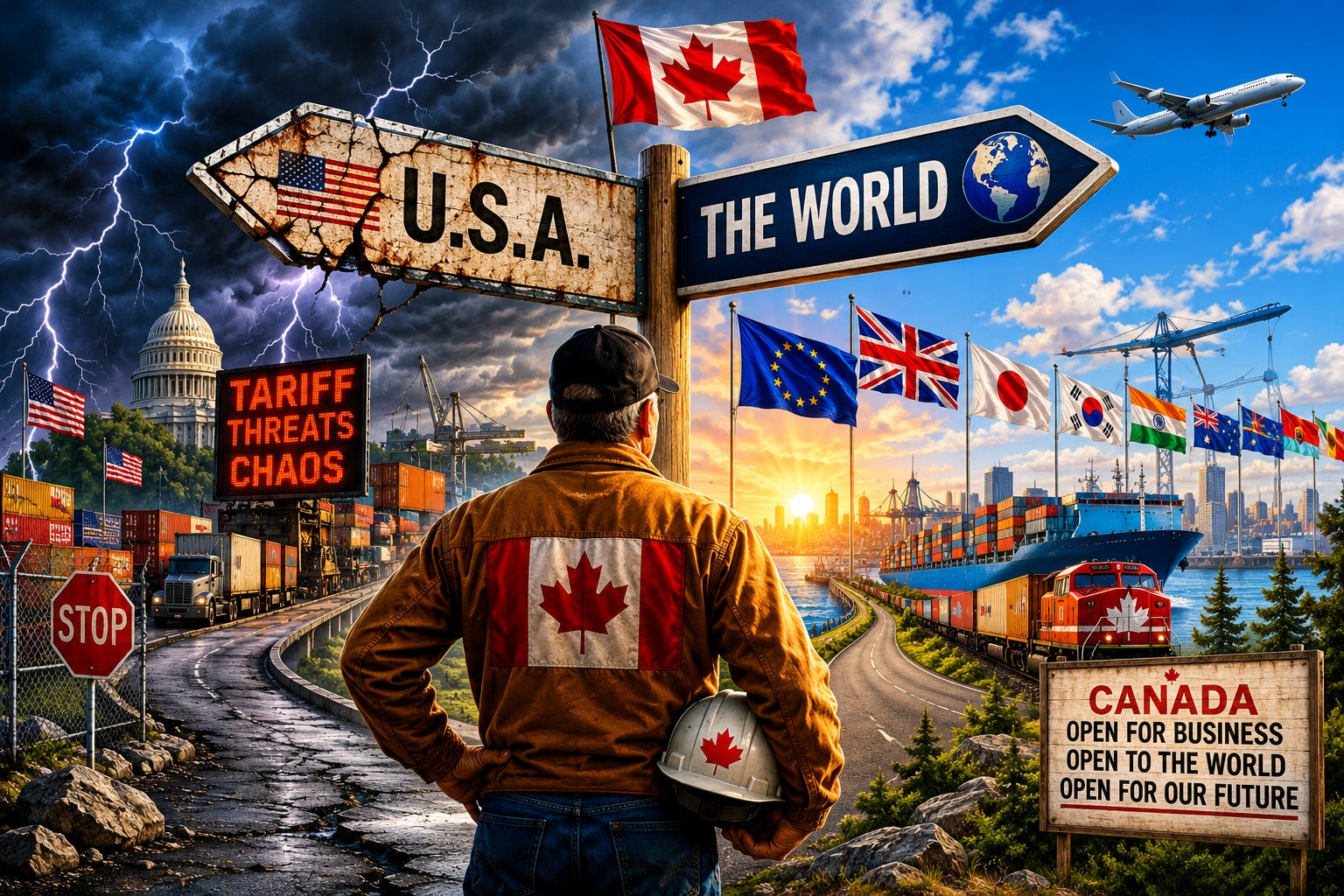
For a country that supposedly got “hurt” by tariffs, Canada seems to be doing something awkward lately…
We keep breaking export records.
Meanwhile, the United States is once again threatening to tear up the trade agreement it negotiated itself.
At some point, you stop calling this strategy and start calling it chaos.
This week, Washington floated fresh threats about not renewing CUSMA/USMCA… the trade deal signed in 2018 and loudly celebrated at the time as one of the greatest agreements ever made.
Now suddenly?
Maybe not so great.
Apparently, the newest sales pitch is: the best part of the deal is being able to kill it later.
Imagine buying a house because you liked the demolition clause.
That seems to be where we are.
Canada’s Position Has Quietly Changed
A few years ago, this kind of threat would have sent Ottawa into a cold sweat.
Today?
Not nearly as much.
Because Canada has been quietly doing something smart… reducing dependence on one customer.
And the numbers tell the story.
According to recent Statistics Canada trade data, Canadian exports climbed to a record $75.2 billion in April, with total exports up 1.6%, helping produce the country’s largest trade surplus since before the tariff battles began.
That matters.
Because diversification is no longer some economist’s PowerPoint fantasy.
It’s survival.
When your biggest trading partner treats agreements like temporary mood swings, eventually you stop betting your future on stability that doesn’t exist.
Canada still wants a renewed trade agreement.
So does Mexico.
Nobody is pretending cross-border trade suddenly stops mattering.
But there’s a growing recognition here that relying too heavily on a single country… especially one that changes direction every second Tuesday… comes with risks.
Big ones.
The Gordie Howe Bridge Fight Says More Than People Think
Then there’s the bridge drama.
The new Gordie Howe International Bridge, linking Ontario and Michigan, is supposed to make trade smoother, faster, and less clogged than the aging crossing it replaces.
Canada paid for it.
All of it.
Roughly $6.4 billion.
The idea was straightforward…
Canada funds construction, collects toll revenue to recover costs, and later shares net revenue with Michigan.
Pretty standard arrangement.
One side fronts the money.
Both sides eventually benefit.
That’s how adults usually handle infrastructure.
Yet somehow, even this has become political theatre.
The latest noise out of Washington suggests the U.S. deserves compensation on a project it didn’t finance.
That’s a bit like your neighbour showing up after you built a fence and demanding rent because he can see it.
Here’s the Bigger Story Nobody Wants to Say Out Loud
The real issue is trust.
Or more accurately…
The erosion of it.
Trade deals only work when both sides believe signatures still matter.
If every agreement becomes negotiable after the ink dries, businesses stop planning long term.
Investors hesitate.
Countries hedge.
And allies quietly start building alternatives.
That’s exactly what Canada is doing.
Europe.
Asia.
New supply chains.
New partnerships.
New customers.
Not because Canada suddenly stopped liking the United States.
Because smart countries plan for uncertainty.
And uncertainty has become America’s biggest export.
Two Countries. Two Different Temperaments.
What makes this contrast sharper is how both countries are handling economic pressure.
Inflation pressures are rising on both sides of the border.
Energy prices are moving.
Global uncertainty remains high.
But the response looks very different.
In Canada, the Bank of Canada held rates at 2.25%, balancing inflation risks against a slowing economy. Independent institution. Separate from government. Boring? Maybe.
But boring central banking is underrated.
In the U.S., political pressure on monetary policy continues to intensify.
And that matters.
Because when interest rates start getting treated like political campaign buttons instead of economic tools, things can go sideways fast.
Canada’s Lesson Has Finally Sunk In
For decades, Canada treated the U.S. market like a permanent guarantee.
Cheap.
Easy.
Reliable.
That era may be ending.
Not because Americans are the enemy.
They’re not.
But because any business owner will tell you the same thing:
If one customer controls too much of your revenue, they eventually control you.
Canada finally seems to understand that.
And frankly?
About time.
The Recap…
America is threatening the trade deal it negotiated again.
Meanwhile, Canada just hit a record $75.2 billion in exports.
Funny thing happens when you stop relying on one customer:
You stop panicking every time they slam the table.
New piece just dropped. 🇨🇦
The Gut-Punch…
Canada spent decades building an economy beside one giant customer.
Now we’re learning a painful business lesson:
When the customer becomes unpredictable, loyalty turns into liability.
Diversify… or get dragged around forever.
Source Credit:
Research based on current trade reporting, Statistics Canada data, public comments on CUSMA/USMCA renewal discussions, Bank of Canada policy updates, and user-provided research transcript.
🔎 The GeezerWise Standard
This space is built on disciplined thinking.
Facts over spin.
Verification before amplification.
Good-faith discussion over tribal noise.
I use AI tools to help shape my spoken drafts into clear writing.
The judgment, conclusions, and final message are mine.
If you’re new here, this explains how I decide what’s worth sharing:
How I Decide What’s Worth Sharing → [link]
💌 Subscribe at GeezerWise.com to receive future letters:
www.geezerwise.com/subscribe
— Fred Ferguson
GeezerWise
#CanadaStrong
Yay Canada. We ARE the adult in the room. DJT is unfit to be president, on so many levels.
Thanks, Fred, for the calm response to the insanity being thrown at us day by day. I’m thankful Canada has chosen a calm and steady hand in Mr Carney. Anyone who has been in a row boat in choppy waters knows slow and steady movements can get the boat righted again, fast and furious sends everyone into the water.