

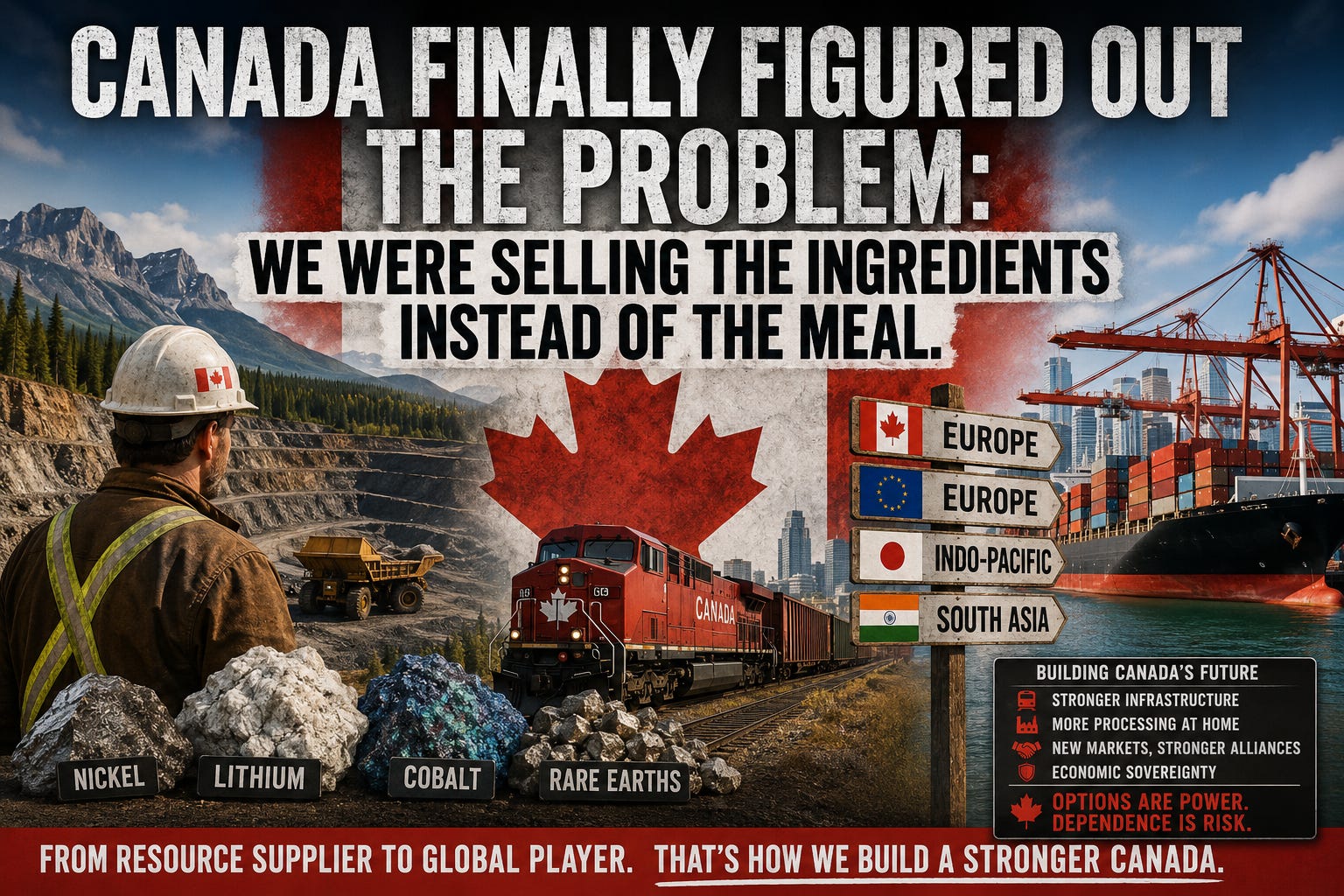
For decades, Canada had one hell of a comfortable business model.
Dig it up.
Pump it out.
Cut it down.
Ship it south.
Then let somebody else turn it into something worth considerably more money.
It worked.
Until having one enormous customer started looking less like convenience and more like dependence.
And that may turn out to be one of the most important economic lessons Canada learns from the Trump years.
Because Canada isn’t suddenly discovering that we have resources.
We’ve always known that.
We’re finally starting to understand that the real money… and the real power… comes from controlling what happens next.
Owning the mine isn’t enough
Canada has nickel.
Lithium.
Cobalt.
Rare earth elements.
Energy.
Timber.
Potash.
Uranium.
And a grocery list of other things modern economies desperately need.
But here’s the part Canadians haven’t talked about nearly enough…
Digging something out of the ground doesn’t give you control of the supply chain.
Processing it does.
Refining it does.
Manufacturing with it does.
Having the railways, ports, highways and energy infrastructure to move it where YOU want to sell it does.
For too long, Canada has been standing beside a pantry full of ingredients while somebody else owned the restaurant.
That’s the part that appears to be changing.
Trump’s unpredictability changed the calculation
The United States isn’t disappearing.
Nor should Canada pretend it is.
America will almost certainly remain our biggest trading partner for a long time.
We have geography, infrastructure and decades of economic integration tying us together.
But there’s a huge difference between having a biggest customer and having an only customer that matters.
That’s where Trump changed things.
Tariffs.
Threats.
Trade fights.
Talk about annexation.
Treating allies like competitors one week and enemies the next.
Eventually businesses and governments start asking a pretty basic question…
What happens if Washington changes the rules again?
Canada had better be able to answer…
“We have other customers.”
That’s economic sovereignty.
Not isolation.
Options.
And Ottawa is putting serious money behind those options
This isn’t just another politician standing behind a podium announcing that Canada should “diversify trade.”
We’ve heard that speech for about fifty years.
Canada’s current strategy includes a goal of doubling non-U.S. exports over the next decade.
But you can’t double exports to countries you can’t efficiently reach.
So the boring stuff suddenly becomes incredibly important.
Ports.
Railways.
Highways.
Airports.
Energy corridors.
Arctic transportation.
Canada has announced a $6-billion Trade Infrastructure Strategy, including a $5-billion Trade Diversification Corridors Fund and $1 billion for Arctic infrastructure.
Then there’s the $51-billion Build Communities Strong Fund over ten years.
The government’s estimate is that investment could contribute roughly $95 billion to Canadian GDP over the decade.
Those aren’t little pilot projects.
They’re pieces of a much bigger idea:
Build Canada so Canadian products don’t have only one direction to travel.
Critical minerals could be where this gets really interesting
The world needs enormous quantities of minerals for batteries, electronics, defence systems, energy infrastructure and advanced manufacturing.
Canada has plenty of them.
But merely shipping raw minerals overseas would repeat the same old mistake.
The bigger opportunity is building more of the processing and refining capacity here.
Mine it here.
Process more of it here.
Refine more of it here.
Manufacture more with it here.
Then sell higher-value products to multiple customers.
Europe needs secure supplies.
Germany needs industrial inputs.
Indo-Pacific economies need resources.
Western countries are also trying to reduce their dependence on Chinese-controlled supply chains.
Canada doesn’t need to replace the United States with Germany, Europe or Asia.
That would simply be changing dance partners while keeping the same bad habit.
We need all of them.
Competition for Canadian products is considerably healthier than Canadian producers begging one customer to buy them.
There’s also something bigger happening
Infrastructure used to be discussed mostly as domestic housekeeping.
Build a bridge.
Fix a highway.
Expand a port.
Today infrastructure is becoming part of foreign policy.
It’s part of national security.
It’s part of Arctic sovereignty.
It’s part of trade policy.
And increasingly, it’s part of Canada’s ability to tell another country…
No.
That’s the bit I think Canadians need to understand.
A country dependent upon one customer has limited bargaining power.
A country with five customers can negotiate.
Now comes the difficult part
None of this is guaranteed.
Canada has an impressive ability to announce a project on Tuesday and still be studying it when everybody involved retires.
Permitting matters.
Construction costs matter.
Indigenous partnerships matter.
Environmental protection matters.
Skilled labour matters.
Canadian ownership matters.
And processing plants don’t magically appear because somebody held a press conference.
We could screw this up.
We could spend billions and build too slowly.
We could export the resources while foreign companies capture most of the value.
We could replace American dependence with dependence on somebody else.
Or we could finally do something Canada should have done decades ago.
Build enough infrastructure, processing capacity and trading relationships that no single foreign government can put its boot on our economic windpipe.
Trump may have accidentally done Canada a favour
Not because American economic trouble automatically means Canadian success.
It doesn’t.
If the United States gets badly hurt, Canada gets hurt too.
Our economies are far too connected for Canadians to cheer an American economic crisis.
But Trump’s behaviour destroyed one assumption that shaped Canadian economic policy for generations:
That America would always be the safe, predictable choice.
That assumption is gone.
And once it’s gone, everything changes.
Ports aren’t just ports anymore.
Mines aren’t just mines.
Railways aren’t just railways.
Trade agreements aren’t just trade agreements.
They’re bargaining power.
They’re insurance.
They’re sovereignty.
Maybe Canada needed a shove before we’d finally start building alternatives.
Well...
We got one.
Now we’d better not waste it.
The Recap…
Canada’s biggest economic problem was never a shortage of resources.
It was what we did with them after we dug them up.
Now Canada is spending billions building new trade routes, infrastructure and processing capacity while chasing customers beyond the United States.
Trump didn’t invent Canada’s diversification strategy.
He made putting it off look dangerous.
The Gut-Punch…
Economic sovereignty isn’t about telling America to get lost.
It’s about making damn sure Canada can survive if America tells us to.
Source credit:
Research notes compiled from Government of Canada infrastructure and trade-diversification announcements, federal budget material, Canada-Alberta infrastructure announcements and supporting industry analysis. Figures and claims should be checked against the underlying government releases before publication.
If you enjoy thoughtful conversations, Canadian stories, and the occasional smart-ass observation about the world we’re living in, you’re in the right place.
Subscribe free and get new stories, insights, and observations delivered directly to your inbox.
No paywall.
No spam.
No nonsense.
Leave anytime with a single click.
I promise not to take it personally.
I remember my social studies teacher in 1965 saying something similar. Wake up Canada, we aren't just a resource exporter
Ireland used to sell most of its livestock “on the hoof”
Then it switched to processing the animals and selling the meat - a mega lift in the country’s profit base!