

Let me put this plain and simple.
Trade negotiations are not a group project.
They’re not a “hey, I was in the neighbourhood” coffee meeting.
And they sure as hell aren’t something an opposition MP gets to freelance on a weekend trip to Washington.
Yet that’s exactly what happened.
Jamil Jivani, a Conservative member of Parliament, travelled to the U.S. on his own, met with American officials, and posted online about it like he was part of the negotiating team.
Problem is…
He isn’t.
He’s not the government.
He’s not the trade minister.
He’s not assigned to negotiations.
But he presented himself like he could “help” shape Canada–U.S. talks.
That’s not diplomacy.
That’s amateur hour.
Here’s how this stuff actually works.
When two countries negotiate trade, there’s one channel.
One message.
One authority.
One table.
Because unity equals leverage.
The second you look divided, the other side smells weakness like blood in the water.
If Washington thinks…
“Hmm… maybe we don’t need Ottawa. Maybe we can deal with this guy instead…”
Congratulations.
You just handed them a bargaining chip against your own country.
That’s not helping Canada.
That’s undercutting Canada.
And let’s be honest about tone.
This wasn’t some quiet, professional outreach.
His messaging included partisan complaints and culture-war theatrics.
It looked less like statecraft…
…and more like social media clout chasing.
That’s influencer behaviour.
Not negotiator behaviour.
There’s a difference.
A big one.
Here’s where it gets serious.
If a foreign government ever says…
“We’ll talk… but only if this MP is involved…”
Now you’re not negotiating trade anymore.
You’re letting a foreign country pick which Canadian politicians get influence inside our own system.
That’s not politics.
That’s interference.
That’s sovereignty territory.
And once you open that door, good luck closing it.
Now zoom out.
Same week?
You’ve got separatist noise in Alberta.
You’ve got provincial leaders cozying up to outside interests.
Danielle Smith playing footsie with anyone who’ll give her a headline.
And now a federal MP running solo meetings in Washington.
Different players.
Same pattern.
Cracks in the wall.
And every crack makes Canada look smaller.
Look… free speech is fine.
Opinions are fine.
Debate is healthy.
But once you hold office, you’re not just some guy with a podcast.
You carry the country with you.
That comes with rules.
We already hold politicians to higher standards for ethics, conflicts of interest, and finances.
Why?
Because their actions have national consequences.
Foreign policy should be no different.
If your behaviour weakens Canada’s negotiating position or gives another country leverage over us…
That’s not “expression.”
That’s misconduct tied to the job.
Here’s the GeezerWise version…
If you’re not on the team…
Don’t grab the jersey and run onto the field pretending you’re the quarterback.
You’re not helping.
You’re fumbling the ball in front of the other side.
The Recap…
Trade talks aren’t a freelance gig.
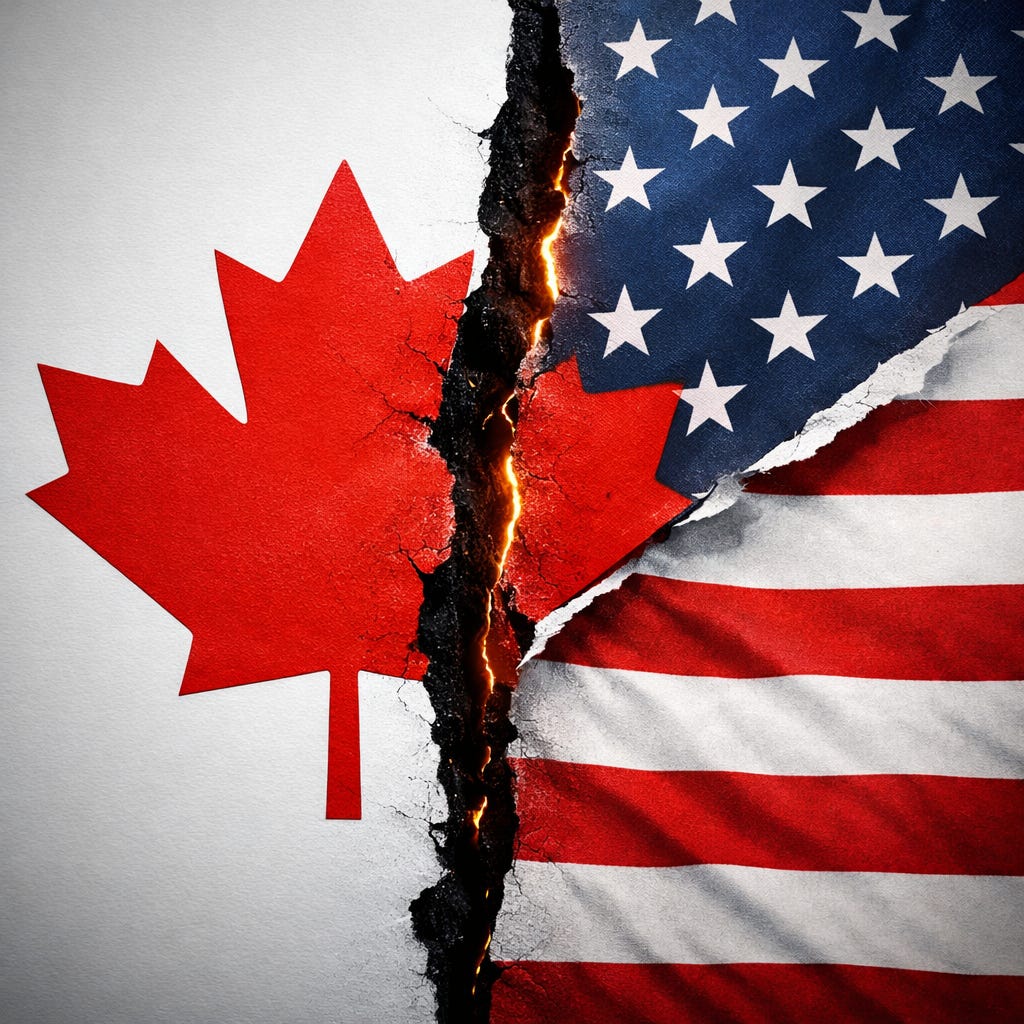
When MPs start running side meetings in Washington, it doesn’t make us look strong… it makes us look split.
Division is leverage.
And foreign governments love leverage.
Punchy Line…
If Ottawa speaks with two voices, Washington only has to negotiate with the weaker one.
Source Credit:
Based on commentary and reporting about recent Canada–U.S. political outreach involving opposition MPs.
Canada Strong Movement… House Rule & Disclosure
Canada Strong exists to defend Canadian sovereignty, democratic norms, and economic independence… without imported talking points or borrowed outrage.
House rule… Facts and good-faith discussion are welcome. I use AI tools to help turn my spoken drafts into clear writing. I’m 73, my hands shake, and I type with two fingers… so I speak first, then edit.
The ideas, positions, and final message are mine.
💌 If you enjoyed this, subscribe at GeezerWise.com to get future Unlearn letters straight to your inbox: www.geezerwise.com/subscribe ✌️
#CanadaStrongMovement #CanadaStrong
He is a spy and he works for washington.
Tinker, tailor, politician or spy...
Mandatory Top-Secret Security Clearance for Federal Party Leaders
🟢ACTION REQUIRED: Petition e-7148 Calls for Mandatory Top-Secret Security Clearance for Federal Party Leaders
Parliamentary petition e-7148, submitted by Bruce Fanjoy, has been formally presented to the House of Commons, calling for a requirement that all federal party leaders obtain and maintain top-secret security clearance.
The petition is grounded in growing concerns about Canada’s national security environment. In recent years, Canadian Security Intelligence Service has repeatedly warned that foreign states actively target political parties, elected officials, and candidates as part of broader foreign interference efforts. These warnings have underscored vulnerabilities not only at the institutional level, but within party leadership structures themselves.
Supporters of the petition argue that party leaders occupy a unique position of responsibility. They shape internal party culture, oversee candidate selection, and are ultimately accountable for how security risks are managed within their organizations. Without top-secret clearance, leaders may lack access to critical intelligence briefings that would allow them to identify threats, respond quickly, and take preventive action.
The petition explicitly points to the leader of the Conservative Party of Canada, who has refused to seek top-secret security clearance. This refusal has been described as a failure of leadership that exposes Canada to avoidable national security risks at a time when foreign interference is a documented and ongoing concern.
At its core, e-7148 is not about partisan advantage. It is about governance standards in a high-risk environment. Petitioners are asking Parliament to treat access to national security intelligence as a basic requirement of federal party leadership, rather than a voluntary choice.
The petition now sits before the House of Commons of Canada, where it will await formal consideration under parliamentary procedures.
The broader question raised by e-7148 is whether national security preparedness should depend on individual discretion, or whether it should be a non-negotiable responsibility attached to political leadership itself.
Please sign and share widely,
https://www.ourcommons.ca/petitions/en/Petition/Details?Petition=e-7148