

For the past few years, Canadians have been told a familiar story.
We’re supposedly the country falling behind.
The overtaxed, overregulated neighbour living beside the world’s economic powerhouse.
The latest numbers tell a more complicated story.
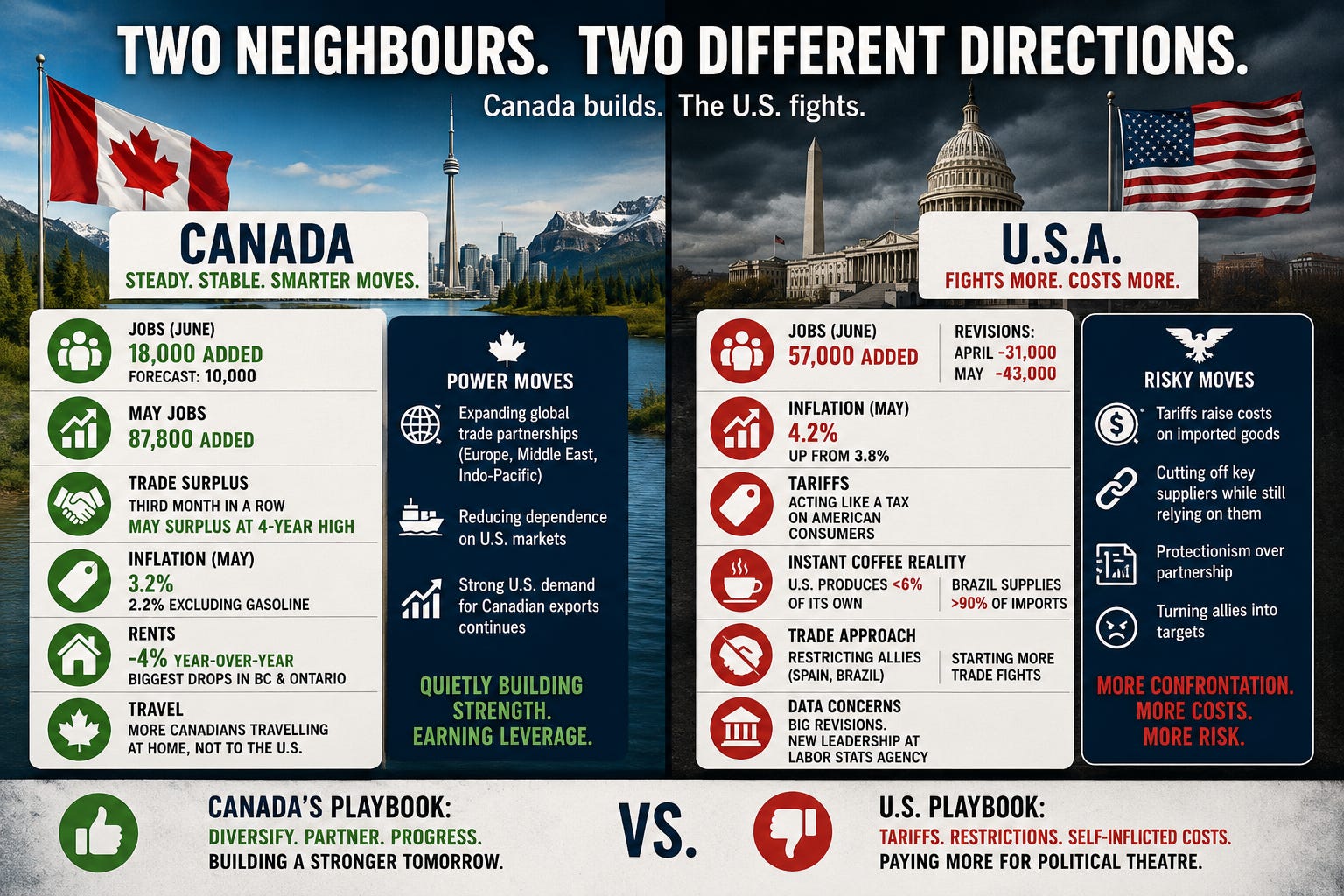
In June, Canada added 18,000 jobs. Economists expected about 10,000. That came after a blockbuster gain of 87,800 jobs in May.
Unemployment edged lower and employment continued moving in the right direction.
South of the border, the picture wasn’t nearly as impressive.
The United States reported 57,000 new jobs in June. Then came the fine print. April’s numbers were revised down by 31,000 jobs. May lost another 43,000.
That’s becoming a pattern. The headline arrives first. The corrections arrive later.
Meanwhile, Canada keeps stacking small wins.
Not dramatic wins.
Not flashy wins.
Just the kind that compound over time.
One of the biggest is trade.
Canada recently posted its third consecutive monthly trade surplus, with May reaching a four-year high.
What’s particularly interesting is that exports to the United States continue rising despite all the political chest-thumping, tariff threats, and endless claims that America doesn’t need Canadian products.
Apparently somebody forgot to tell American buyers.
Because they’re still buying.
A lot.
That matters because trade surpluses aren’t generated by speeches. They’re generated by customers willing to hand over money.
Then there’s inflation.
Nobody in Canada is throwing a parade over grocery bills. Life is still expensive.
But the gap between the two countries is becoming difficult to ignore.
U.S. inflation recently climbed to 4.2%.
Canada’s came in at 3.2%.
Remove gasoline from the equation and Canada’s inflation rate drops to roughly 2.2%.
That’s a meaningful difference when you’re buying food, paying rent, or trying to keep a household budget from exploding.
Speaking of rent, Canadians received a rare piece of good news.
National rents have fallen about 4% year-over-year, with much of the decline concentrated in British Columbia and Ontario.
Again, nobody is claiming housing has become affordable.
But when rents move down instead of up, that’s real money staying in people’s pockets.
Now compare that with what’s happening in the United States.
Washington has increasingly embraced tariffs as an economic weapon.
The theory sounds simple enough.
Tax foreign products. Protect domestic producers. Create jobs at home.
The problem is that reality has a habit of ignoring political slogans.
Tariffs don’t magically disappear after they’re announced.
Someone pays them.
Most often, that’s consumers.
A tariff is simply an extra cost inserted into the supply chain. Businesses pass it along. Shoppers pay more.
The coffee market offers a perfect example.
The United States produces less than 6% of its own instant coffee. Brazil supplies more than 90% of imported instant coffee consumed by Americans.
You can argue with economics.
You can argue with trade policy.
You can’t argue with geography and climate.
Coffee doesn’t care about politics.
It grows where it grows.
The same reality applies across dozens of industries.
Pharmaceutical ingredients.
Consumer goods.
Industrial components.
Food products.
Modern economies are deeply interconnected. Cutting off suppliers while remaining dependent on their products is a costly game.
Canada appears to have noticed this.
Instead of narrowing its options, Ottawa has spent the past several years expanding them.
New trade discussions and agreements continue emerging across Europe, the Middle East, and the Indo-Pacific region.
Canada is actively pursuing deeper relationships with countries such as Saudi Arabia and Qatar while strengthening existing partnerships elsewhere.
It’s not about replacing the United States.
That’s impossible.
It’s about making sure America is no longer the only customer standing at the counter.
That’s a very different strategy.
One concentrates risk.
The other spreads it around.
Even travel patterns are starting to reflect the shift.
Fewer Canadians are heading south for vacations. More are travelling domestically.
Some of that is political.
Some is economic.
Some is simply people deciding they’d rather spend their money at home.
Either way, Canadian tourism operators are seeing the benefit.
The broader lesson here isn’t that Canada has suddenly become an economic superpower.
It hasn’t.
We still have productivity problems.
Housing challenges.
Infrastructure bottlenecks.
And enough political dysfunction to keep columnists employed for generations.
But there is a growing difference between the two countries.
Canada’s approach has largely been based on diversification, stability, and incremental progress.
The American approach increasingly relies on confrontation, tariffs, and economic shock tactics.
One strategy resembles building a larger toolbox.
The other resembles reaching for a bigger hammer.
Sometimes the hammer works.
Sometimes you end up smashing your own thumb.
The numbers increasingly suggest that’s a risk Americans may be discovering in real time.
And while Canada isn’t perfect, it’s quietly benefiting from not making every economic decision feel like a cage match.
The Recap…
Canada added 18,000 jobs in June, beating forecasts. The U.S. added 57,000 but erased 74,000 jobs through revisions to prior months.
Canada’s trade surplus is at a four-year high. Inflation is lower. Rents are falling. Domestic tourism is rising.
Meanwhile, tariffs are pushing costs higher for American consumers while the U.S. remains dependent on many of the imports it’s trying to restrict.
Sometimes the boring strategy wins.
The Gut-Punch…
For years, Canadians were told the future belonged to countries that moved fast, broke things, and picked fights.
Turns out there’s another option.
Keep your allies.
Expand your customer list.
Avoid punching holes in your own supply chain.
And let the numbers do the talking.
Source credit:
Economic and trade data compiled from publicly reported Canadian and U.S. employment, inflation, trade, housing, and tourism statistics referenced in the research material provided.
If you enjoy thoughtful conversations, Canadian stories, and the occasional smart-ass observation about the world we’re living in, you’re in the right place.
Subscribe free and get new stories, insights, and observations delivered directly to your inbox.
No paywall.
No spam.
No nonsense.
Leave anytime with a single click.
I promise not to take it personally.
Fred, you hit a very interesting point in your summary, about inflation. And while not in this particular posting, not that long ago (a day or two) you also commented on interest rates.
In my entire life, it's always been some variant of "US inflation/borrowing rates are considerably lower than Canada."
All of a sudden, Canada is marginally ahead on BOTH!
Whether that trend is just a blip or not, that's still to be seen.
Trump makes Mark Carney look like the second coming of Christ by comparison. Every Trump move is intentionally designed to destroy and collapse the economy so he can install a police state and autocratic rule. He almost makes it easy for Canada to do better on every front that matters.