

There’s an old saying in business.
If you want to know what people really believe, don’t listen to what they say. Watch where they spend their money.
Canadians have spoken with their wallets.
Instead of driving south, we’re booking campgrounds in PEI, hotels in Vancouver, cabins in the Rockies and weekend getaways across the country.
That simple decision is turning into an economic story that few people saw coming.
This isn’t because Canadians suddenly discovered that Banff is beautiful.
We already knew that.
What’s changed is where Canadians believe their money belongs.
The numbers are hard to ignore.
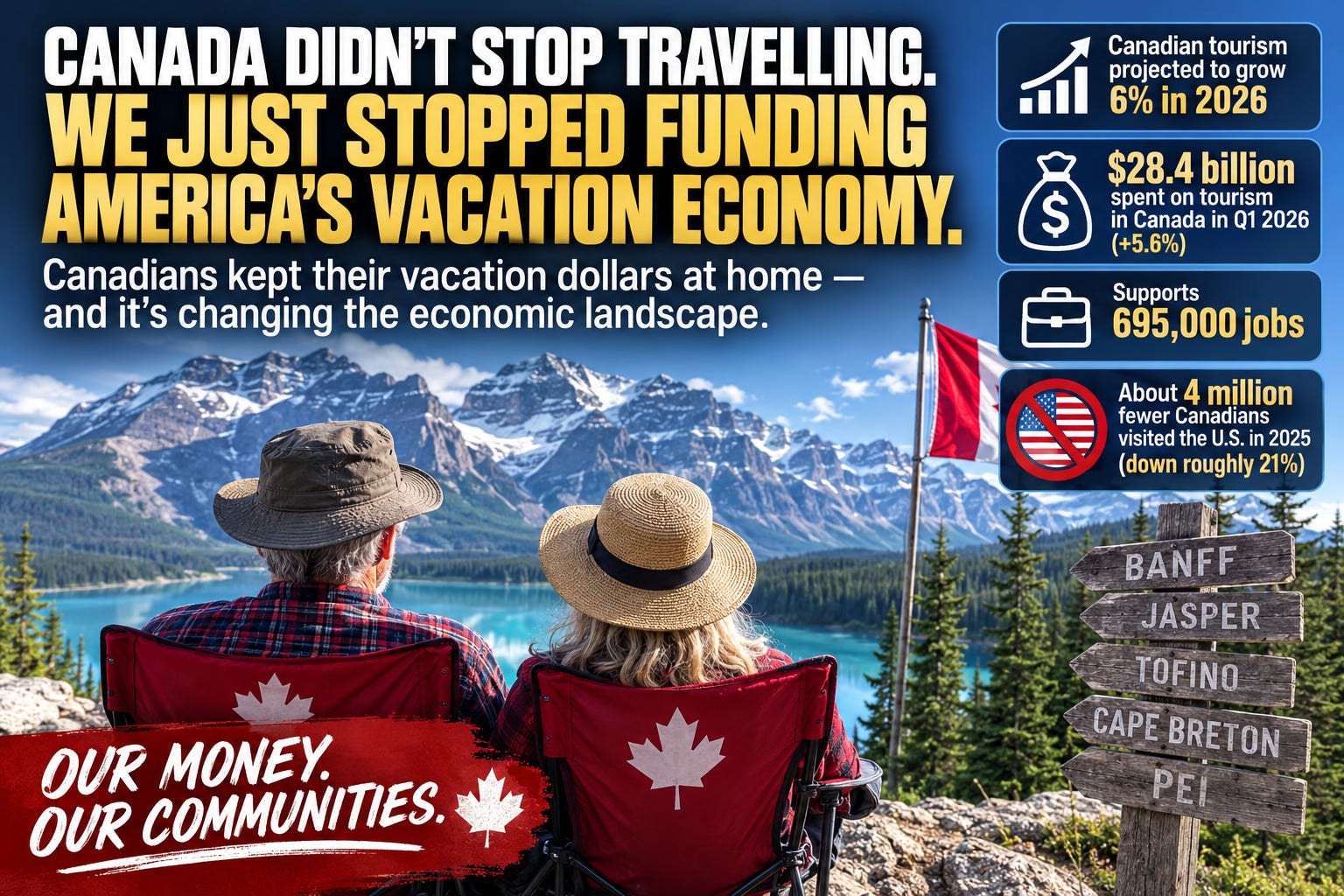
Canada’s tourism industry is expected to grow another 6% in 2026, after already posting a record year.
Tourism spending reached $28.4 billion in just the first quarter of 2026, up 5.6% from a year earlier.
The industry now supports roughly 695,000 Canadian jobs.
That’s not a lucky summer.
That’s an economic trend.
Some provinces are seeing extraordinary gains.
Prince Edward Island nearly doubled domestic visitor spending. British Columbia recorded a huge jump in domestic travel spending.
Alberta’s visitor economy climbed past $15 billion while attracting more international visitors than many expected.
Ontario and Quebec continue to bring in the largest overall visitor numbers.
Meanwhile, the traffic flowing south tells the other half of the story.
About four million fewer Canadians visited the United States in 2025, a decline of roughly 21%. Canadians spent $3.3 billion less travelling in the U.S. than the year before.
That money didn’t disappear.
It stayed here.
Or it went somewhere else.
For decades, vacation dollars quietly crossed the border every summer. Hotels, restaurants, shopping malls and tourist attractions in American border states counted on Canadians showing up.
Now many aren’t.
That matters because tourism isn’t just about beaches and selfies.
It’s payroll.
It’s restaurants hiring staff.
It’s gas stations, guides, ferry operators, campgrounds, museums and family-owned businesses.
When vacation dollars stay inside Canada, they keep circulating through Canadian communities instead of leaving the country.
Think of it like plugging a leak in a bucket.
The water level rises without adding another drop.
The irony is impossible to miss.
Tourism has traditionally been one of America’s strongest export industries because foreign visitors bring money into the country.
Yet hostile political messaging, trade fights and deteriorating relations with close allies have helped drive away one of the United States’ biggest groups of international visitors.
Estimates suggest America lost more than $8 billion in international tourism spending during 2025, with some forecasts putting the eventual losses much higher.
Nobody ordered Canadians to stay home.
Nobody passed a law.
Millions simply made individual decisions.
One family at a time.
One vacation at a time.
One booking at a time.
That’s the fascinating part.
This wasn’t created by government spending.
It wasn’t a stimulus package.
It was consumers voting with their credit cards.
Sometimes the biggest economic shifts don’t happen on Parliament Hill or in Washington.
They happen when ordinary people decide where to spend two weeks of vacation.
And when millions of people make the same choice, it becomes an economic force that governments can’t ignore.
The Recap…
Canadians didn’t cancel their vacations.
We changed destinations.
Billions of tourism dollars are staying inside Canada, strengthening local businesses, supporting hundreds of thousands of jobs and giving communities across the country an unexpected boost.
Sometimes patriotism doesn’t wave a flag.
Sometimes it books a hotel room.
The Gut-Punch…
Politicians talk about defending the economy.
Canadians quietly did it with their vacation plans.
Turns out a family road trip can be more powerful than a political speech.
Source credit:
Research compiled from Canadian tourism data, industry reports, and reporting by CNN and The Guardian, based on the supplied research notes.
If you enjoy thoughtful conversations, Canadian stories, and the occasional smart-ass observation about the world we’re living in, you’re in the right place.
Subscribe free and get new stories, insights, and observations delivered directly to your inbox.
No paywall.
No spam.
No nonsense.
Leave anytime with a single click.
I promise not to take it personally.
Thanks, Fred. Love that this is happening. We need to do more to identify and develop welcoming environments. I live in Nova Scotia, on the coast outside Halifax. Never take it for granted for a second and until say 2020 it was just a fishing village, still has few amenities though it s been discovered and is being built up. But more to thempoint, for us elders, it typically has pretty mild winters. Most days until January light jackets are plenty, and it s easy to walk everywhere. We might have a snow day but it melts fast. Even in january and february, winters along the southwestern shore are much lighter. I worked in Ottawa where winter is serious and would have vacationed here had i known. Sometimes people can golf year round,many beaches are always there,towns are still charming and inns and evenings are delightful.lobsters and vinyards,crafters and antiques, whales and filmmaking, just off the top of my head.
Thanks Fred for continuing such relevant and interesting articles with all the important data included.
We used to take our small campervan south each winter for shorter trips (2–4 weeks). The coast of South Carolina is surprisingly semitropical. In fact, the Vietnam jungle war scene in Forrest Gump was filmed at Hunting Island State Park. It was always pleasant to escape the winter weather here in Southern Ontario for these trips.
However, with the changing political climate in the US with Trump 1.0 and especially now with Trump 2.0, we decided to eliminate these previously enjoyable trips. At a campground, you meet many folks from different places, and some, especially the non-MAGA types from northern states were very pleasant. However, South Carolina is one of the most conservative states in the US, and interacting with an increasing number of MAGA types was not enjoyable.
We were planning to sell our camper anyways, since camping is harder for seniors like us. So we did sell it, and now take short "staycations" closer to home. In fact, as we don't expect to travel outside the country, we let our passports expire. There are so very many beautiful places to visit here in Canada, and our bucket list has grown proportionately. It's of utmost importance for all of us to spend our hard-earned dollars right here at home! Elbows Up!