

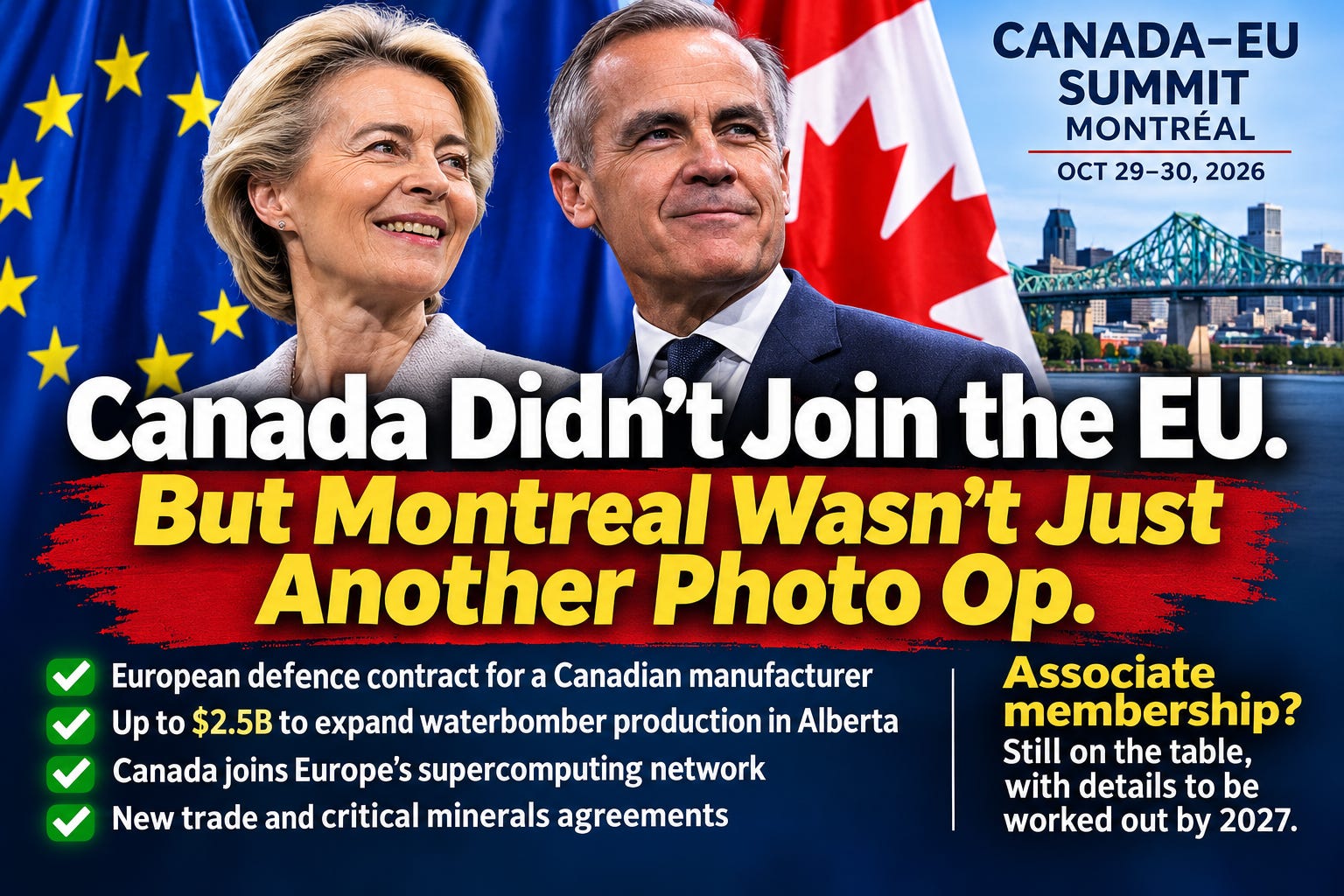
I’ve watched Canadian governments announce enough trade agreements over the years to know
a handshake and a photograph don’t necessarily mean much.
Sometimes they lead somewhere.
Sometimes everybody goes home, congratulates themselves, and nothing much changes.
So when Mark Carney met with European leaders in Montreal on October 29 and 30, I had one question.
What did Canada actually get?
Not what might happen five years from now.
Not what politicians hope will happen.
What happened?
Turns out, quite a bit.
And some of it is already putting Canadian businesses to work.
Let’s start with the helmets.
A Montreal company called Galvion has secured a contract worth more than $44 million to supply military helmets to Latvia.
That might not sound like the sort of announcement that changes Canada’s economic future.
But look a little closer.
The contract comes through the European Union’s Security Action for Europe program, known as SAFE.
Canada became the first non-European country to join that initiative earlier this year.
And Galvion isn’t the first Canadian company to benefit.
Another Montreal company, Marconi Technologies, previously secured a contract to supply Canadian-made tactical radios to Poland’s Cyber Command.
Two Canadian companies. Two European defence customers.
That’s not a politician promising that jobs might appear someday.
That’s Canadian manufacturing winning business in Europe.
And considering how much time we’ve spent worrying about Canadian factories losing access to the American market, I find that rather encouraging.
Then there’s Alberta.
The federal government announced plans for up to $2.5 billion in financing to help De Havilland expand production of Canadian-made Water Bombers in Wheatland County, Alberta.
The aircraft would help meet firefighting needs in Canada and Europe.
Now, that financing is an announced commitment, not $2.5 billion already spent.
But consider what we’re talking about.
Canadian aircraft. Canadian manufacturing. Canadian jobs.
And a market that extends well beyond our southern border.
We have the engineering talent. We have the manufacturing experience.
What we need are customers and the investment to build what they want.
Europe has a growing need for firefighting aircraft.
Canada knows how to make them.
Funny how that works when countries start looking for opportunities instead of picking fights.
Canada also got a seat at another table.
One of the less flashy announcements could turn out to be particularly important.
Canada has joined the European High Performance Computing Joint Undertaking.
That’s a mouthful, isn’t it?
Here’s what it means.
Canadian researchers and businesses will gain access to some of Europe’s most powerful supercomputing resources, including JUPITER.
We’re talking about the kind of computing power used in advanced scientific research, artificial intelligence and complex simulations.
Canada has talented researchers and technology companies.
But building every piece of expensive research infrastructure ourselves makes little sense when we can cooperate with trusted partners.
This gives Canadian researchers access to capabilities that can help them compete internationally.
And unlike a promise to discuss cooperation someday, Canada’s participation has actually been confirmed.
That’s worth something.
The minerals beneath our feet are getting attention, too.
Canada and the European Investment Bank have advanced an agreement designed to make it easier for the bank to finance Canadian critical-mineral projects.
That’s important.
Canada has minerals that Europe needs for batteries, defence equipment, electronics and advanced manufacturing.
But having minerals underground doesn’t automatically create an industry.
You need financing.
You need processing facilities.
You need customers willing to make long-term commitments.
And you need to do more than dig things out of the ground and ship them somewhere else.
The European Investment Bank arrangement could help Canadian projects attract financing.
It doesn’t mean the bank has suddenly written cheques to every mining company in the country.
Those investments still have to happen.
But opening another source of potential financing is a meaningful step.
Especially if it helps Canada build more of the processing and manufacturing here.
We’ve spent enough decades exporting raw materials and buying back finished products.
I’d like to see us keep more of that work.
And what about that historic European invitation?
Here’s where things get interesting.
Back in September, European Commission President Ursula von der Leyen proposed making Canada the European Union’s first associate member.
Nobody had been offered that particular relationship before.
It was an extraordinary proposal.
But Canada didn’t become an associate member in Montreal.
In fact, the exact meaning of that status still hasn’t been settled.
The leaders launched what they’re calling the Canada–EU Alliance for the Future and agreed to work toward a much closer relationship.
The official goal is to define that relationship by the 2027 summit.
That’s not the same as joining the European Union.
And it isn’t a completed associate-membership agreement.
There’s still a lot to negotiate.
What rights would Canada have?
What obligations would come with the arrangement?
How would Canadian businesses benefit?
And what would it cost?
Those questions matter.
I don’t particularly care what fancy name politicians give a partnership.
I care what Canadians get out of it.
So far, Montreal has produced some real results.
But the biggest proposal remains unfinished.
There’s another number Canadians should know.
According to the Prime Minister’s Office, trade in goods and services between Canada and the European Union reached approximately $178 billion in 2025.
That’s not pocket change.
The EU is already Canada’s second-largest trading partner for goods and services.
And that relationship existed before anyone started talking about associate membership.
Canada and Europe also concluded substantive negotiations on a new digital trade agreement in Montreal.
That could make it easier for Canadian businesses to sell software, digital products and services into European markets.
The agreement still has to move through the necessary steps before it is fully in force.
But the negotiations have reached an important milestone.
Compare that with the announcement about increasing Canadian liquefied natural gas exports to Europe.
There, the governments agreed to study the possibilities.
That’s useful, but it’s not a new supply contract.
See the difference?
One negotiation has been substantially completed.
Another opportunity is being examined.
Neither should be confused with a shipment leaving a Canadian port tomorrow.
And I think Canadians deserve to know which is which.
Here’s what I find most encouraging.
For decades, we’ve built an economy that depends heavily on the United States.
There’s nothing inherently wrong with trading with our closest neighbour.
It’s a massive market, and Canadian businesses have benefited enormously from that relationship.
But we’ve also learned what happens when the country buying so much of what we produce starts using tariffs and threats as political weapons.
Suddenly, being dependent on one customer doesn’t look quite so comfortable.
And finding alternatives becomes more than a nice idea.
It becomes a matter of economic independence.
That’s why Montreal matters.
Not because Canada is about to become part of Europe.
Not because the European market can replace the United States overnight.
It can’t.
But because Canada is starting to build more relationships that give us choices.
A defence manufacturer in Montreal selling equipment to Latvia.
Canadian researchers gaining access to European supercomputers.
A potential new source of investment for our critical-mineral industry.
An opportunity to expand aircraft manufacturing in Alberta.
And a larger economic partnership that could create opportunities we haven’t even negotiated yet.
Some of those things are happening.
Others still need work.
That’s the difference between progress and promises.
And we should be watching both.
I’ve spent much of this year arguing that Canada needs to stop waiting for Washington to become reasonable again.
We need to build more here.
Sell more elsewhere.
And make ourselves less vulnerable to the next threat from the White House.
Montreal didn’t solve all of that.
But it showed what moving in that direction can look like.
Canada doesn’t have to stop doing business with America.
We just have to stop acting as though America is the only place we can do business.
And for the first time in a while, I’m seeing more than speeches about making that happen.
I’m seeing Canadian companies getting some of the business.
That’s a start worth paying attention to.
The Recap…
Europe offered Canada a historic new relationship in September.
At the Montreal summit, Canada didn’t become an EU associate member. That part is still being negotiated.
But Canadian companies secured European defence business, researchers gained access to powerful computing resources, and new agreements advanced trade and investment opportunities.
Some of this is already real. Some remains on the drawing board.
The important part? Canada is building options beyond the United States.
And those options are starting to produce results.
The Gut-Punch…
Canada doesn’t need Europe’s permission to be independent of American pressure.
It needs customers, investment, manufacturing capacity and the confidence to build something beyond the American market.
Montreal didn’t deliver all of that.
But it gave us a few more reasons to stop pretending Washington holds all the cards.
Source Credit:
Primary sources… October 30, 2026
Prime Minister of Canada… Canada and the European Union announce new Alliance for the Future… Official summit announcement covering defence contracts, De Havilland financing, computing, critical minerals, LNG and trade figures.
Prime Minister of Canada… Joint Statement: Canada and the European Union building together an Alliance for the Future… The jointly agreed commitments, completed negotiations and plans for future cooperation.
The article distinguishes announced financing from disbursed funds, completed negotiations from agreements in force, and proposed associate membership from an established legal arrangement.
If you enjoy thoughtful conversations, Canadian stories, and the occasional smart-ass observation about the world we’re living in, you’re in the right place.
Subscribe free and get new stories, insights, and observations delivered directly to your inbox.
No paywall.
No spam.
No nonsense.
Leave anytime with a single click.
I promise not to take it personally.
Thank you Fred another in-depth and well researched article. It is very encouraging that circumstances are forming so that Canada can move forward away from stalled and stagnant trading practices and move closer to improved opportunities for economic growth with a variety of potential partners.