

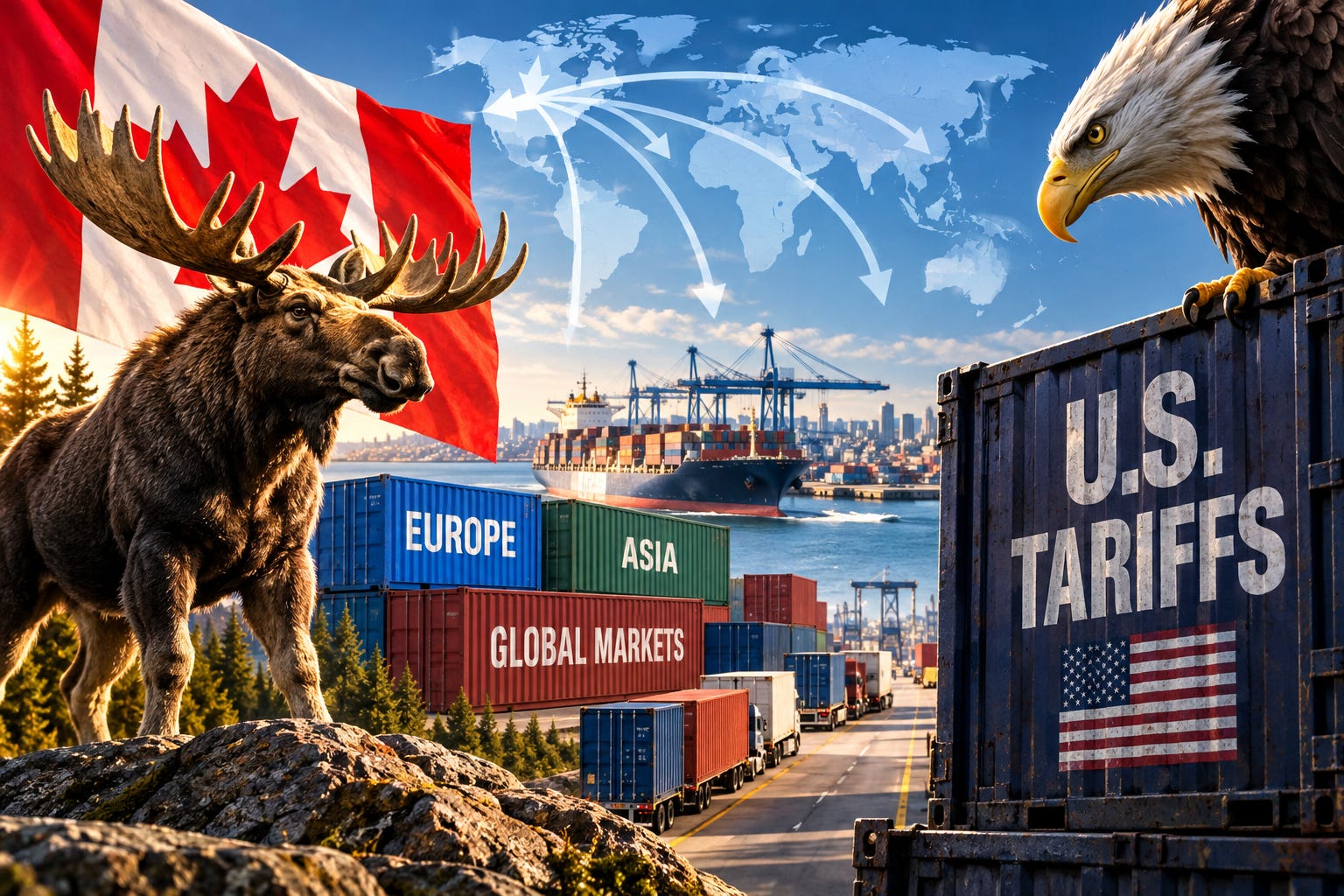
I think we’ve been looking at Canadian leverage the wrong way.
For years, whenever Canada and the United States got into a trade scrap, somebody would eventually point out the obvious:
America is ten times our size.
Case closed.
Except economies aren’t bar fights.
And something rather interesting has happened while Washington has been busy reminding Canada how dependent we are on the American market.
Canada started doing something about it.
Not talking about it.
Doing it.
In July, Canadian exports to countries other than the United States hit a record $25.6 billion.
They jumped 7.4% in a single month.
Even more interesting, non-U.S. markets accounted for 33.7% of Canadian exports that month.
At the same time, exports to the United States fell 6.6%.
Those aren’t projections from some government strategy document.
Those are Statistics Canada numbers.
Statistics Canada… July 2026 merchandise trade
That doesn’t mean Canada has replaced the American market.
Not even close.
But it does mean something I think is much more important…
Canada is beginning to create options.
And options are leverage.
Then Washington pushed again.
On August 21, Prime Minister Mark Carney suspended the latest trade negotiations with the United States.
According to the Prime Minister’s statement, Canada had been seeking continued tariff-free access for most Canadian businesses, lower U.S. tariffs on strategic industries, protection for smaller businesses and preservation of Canada’s economic and policy independence.
Carney said last-minute changes to the American proposal didn’t meet those objectives.
So Canada walked away.
Prime Minister’s August 21 statement on Canada-U.S. negotiations
Then came the tariffs.
The United States imposed a 50% tariff on about $28 billion worth of Canadian goods.
Canada answered.
Effective September 8, Ottawa imposed matching counter-tariffs on $27.6 billion worth of American imports, with rates of 15%, 25% and 50% depending on the product.
Steel. Aluminum. Dairy. Appliances. Agricultural equipment. Pulp and paper. Electronics.
And the existing Canadian counter-tariffs on U.S. automobiles remained in place.
Department of Finance… Canada’s September 8 counter-tariffs
Now, I’m not going to pretend tariffs are painless simply because Canada is the one imposing them.
They’re not.
Canadian importers can pay them too. Canadian businesses can get hurt. Ottawa has exemptions and remission programs precisely because governments know retaliatory tariffs can whack their own companies along with the intended target.
That’s the ugly reality of a trade war.
But there’s a pretty large difference between absorbing a punch and refusing to throw one back because you’re afraid the other fellow is bigger.
Canada chose retaliation.
More importantly, it is simultaneously trying to reduce the vulnerability that made retaliation so dangerous in the first place.
Here’s the part I find most interesting.
Canada’s leverage isn’t really the tariff.
It’s the customer list.
In 2025, Canadian exports to the United States fell by $29.4 billion.
Exports to the rest of the world increased by $27.6 billion.
Some of that increase came from precious metals, particularly gold, so let’s not dress the number up as something it isn’t.
Take those metals out and Canadian exports outside the United States still increased by $14 billion.
Statistics Canada… Recent developments in the Canadian economy
Then July 2026 produced that record $25.6 billion month outside the U.S.
That’s starting to look less like a blip.
Canada is still enormously connected to the United States, particularly in energy.
Here’s a number that should prevent anybody from getting carried away…
In 2025, 90.1% of Canadian crude oil exports still went to the United States.
Canada supplied 63.4% of American crude-oil imports and nearly all of its imported natural gas.
The two countries are still joined at the economic hip.
Canada Energy Regulator… 2025 Canada-U.S. energy trade
But read those numbers again.
They describe mutual dependence, not Canada sitting helplessly outside America’s kitchen door waiting for scraps.
The United States matters enormously to Canada.
Canada matters to the United States too.
And now Canada is working on the part of that equation it can actually control.
Finding more customers.
That’s what has changed.
Earlier this month, Carney went to Europe proposing a substantially deeper Canada-EU relationship.
Canada and the European Union are discussing expanded cooperation in critical minerals, defence manufacturing, energy, AI, space and financial services.
The EU is already Canada’s second-largest trading partner in goods and services, with about $178 billion in trade in 2025.
Prime Minister’s Office… Canada and Europe deepen ties
That’s the strategy I think matters far more than whatever tariff number appears in tomorrow’s headline.
Don’t replace America.
That’s ridiculous.
Replace dependence on America.
There is a difference.
Keep selling to Americans.
Keep buying from Americans when it makes sense.
Keep the border moving.
But build ports. Build pipelines to tidewater. Process more of our resources here. Knock down provincial trade barriers.
Sell more to Europe and Asia. Give Canadian companies enough customers that losing access to one market doesn’t put a gun to the country’s head.
Because leverage isn’t telling your biggest customer to get lost.
Leverage is being able to tell your biggest customer:
We’d like your business.
But we don’t need your permission.
That’s the Canada-U.S. trade story that looks very different today than it did when this fight started.
Canada hasn’t become independent of the United States.
It has finally started understanding the cost of being too dependent on it.
And judging by where Canadian exports are beginning to go, somebody appears to be doing something about it.
The Recap…
Canada didn’t suddenly become bigger than the United States.
It did something smarter.
Non-U.S. exports hit a record $25.6 billion in July while Canada matched Washington’s latest tariffs dollar for dollar.
The goal isn’t to stop trading with America.
It’s to make sure America is never again our only serious option.
The Gut-Punch…
You don’t gain leverage by yelling louder at your biggest customer.
You gain leverage by finding more customers.
Canada finally seems to have figured that out.
Source credit
Statistics Canada, Canadian International Merchandise Trade, July 2026; Statistics Canada, Recent Developments in the Canadian Economy: Spring 2026; Department of Finance Canada tariff measures and countermeasures; Canada Energy Regulator 2025 Canada-U.S. Energy Trade data; Prime Minister of Canada statements on the August 2026 Canada-U.S. negotiations and September 2026 Canada-EU discussions. All figures checked against primary government sources as of September 29, 2026.
If you enjoy thoughtful conversations, Canadian stories, and the occasional smart-ass observation about the world we’re living in, you’re in the right place.
Subscribe free and get new stories, insights, and observations delivered directly to your inbox.
No paywall.
No spam.
No nonsense.
Leave anytime with a single click.
I promise not to take it personally.
I find it strange that Donald Trump is so upset by Canada saying no. By taking cheap shots like “nasty” and “mean”, he sounds like a high school student describing his ex.
Canada’s PMMC (respected and very well known around the world) has successfully forged partnerships and a brighter direction for global economic growth, trade and investment 🇨🇦🇪🇺🇨🇼🌎