

The loudest guy in the room isn’t always winning.
Sometimes he’s just the guy breaking furniture while everyone else quietly leaves and signs deals somewhere else.
That’s the part a lot of people are missing right now.
While the United States ramped up tariffs and tried to strong-arm countries into better trade terms, Canada did something far less dramatic… and far more effective.
We adapted.
And the newest trade numbers show it’s working.
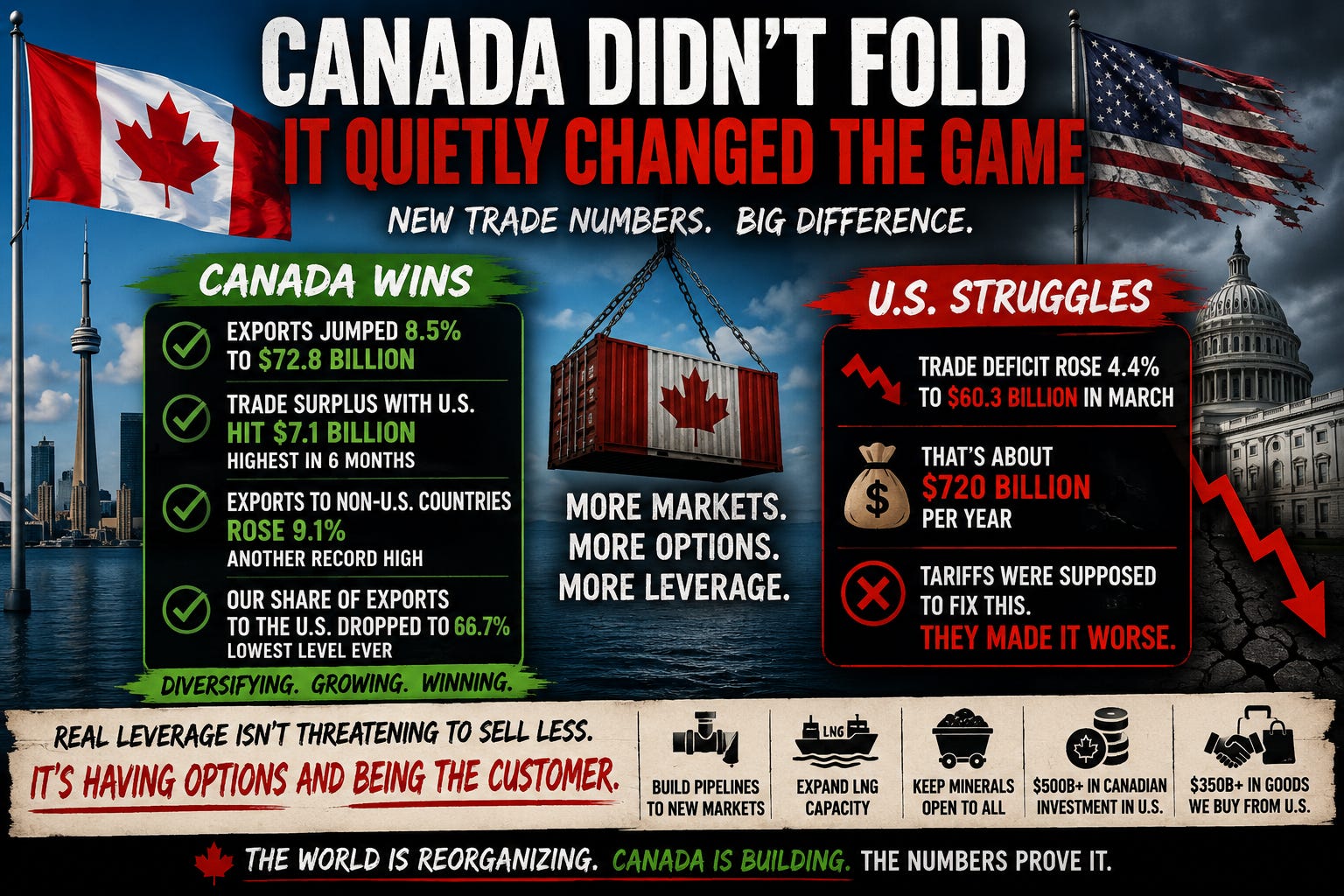
In March, Canadian exports jumped 8.5%, hitting $72.8 billion. Energy exports surged. Gold exports exploded.
Trade with countries outside the United States climbed to another record high.
Meanwhile, our trade surplus with the U.S. hit $7.1 billion… the strongest in six months… even while our dependence on the American market dropped to its lowest level ever.
That’s the important part.
Canada is selling more…
while relying less on a single customer.
That’s not weakness.
That’s leverage.
And unlike the political theatre flooding social media every day, leverage doesn’t need to scream to work.
It just quietly changes who has options.
The United States, meanwhile, posted a monthly trade deficit of more than $60 billion.
That’s the opposite of what tariffs were supposed to accomplish.
Think about that for a second.
The entire sales pitch behind the tariff war was…
“America will buy less foreign stuff and bring production home.”
Instead?
Countries started building trade relationships with each other while reducing dependence on the U.S.
That’s what happens when your negotiating strategy feels less like diplomacy and more like a guy flipping over tables at Costco because the free samples ran out.
Businesses don’t like instability.
Markets don’t like instability.
Investors definitely don’t like instability.
So capital starts looking for calmer water.
And lately?
Canada’s starting to look a whole lot calmer.
Now here’s where the conversation gets really dumb online.
You’ll hear politicians demanding Canada “use oil and minerals as leverage.”
Sounds tough.
Gets applause.
Fits on a bumper sticker.
But most people never stop to ask the obvious question…
What exactly does that mean?
Because if you “use oil as leverage,” the implication is threatening to cut exports off.
Which would be economically suicidal.
Canada sells enormous amounts of energy to the United States because they buy enormous amounts of energy from Canada.
You don’t strengthen your economy by shutting down your own wells, pipelines, electricity exports, and jobs just to look aggressive on television.
That’s not strategy.
That’s setting your own garage on fire to scare the neighbour.
Real leverage looks different.
Real leverage is diversification.
Real leverage is building the Trans Mountain expansion so Canadian oil can reach Asian markets instead of being trapped with one buyer.
Real leverage is expanding LNG capacity on the west coast.
Real leverage is keeping critical minerals open for global buyers instead of locking Canada into one arrangement before negotiations even begin.
Real leverage is Canadian pension funds having hundreds of billions invested in the United States… and Washington knowing that investment flows can shift.
Real leverage is consumers.
And this is the part Americans should probably be paying closer attention to.
Canada buys roughly $350 billion in American goods every year, plus tens of billions more in services.
That matters.
A lot.
Because businesses in the United States don’t want to lose access to wealthy Canadian consumers sitting right next door.
That’s leverage.
Not threatening to stop selling things.
Threatening to stop buying them.
Big difference.
One hurts you.
The other hurts the other guy.
And while all this noise keeps bouncing around social media, something even bigger is happening underneath it all:
The world is reorganizing itself.
Countries are building alternate supply chains.
Alternate trade routes.
Alternate investment partnerships.
Alternate energy systems.
Quietly.
Without the dramatic headlines.
Canada’s role in that shift is growing because we have what the world needs:
energy,
food,
minerals,
water,
stability,
and functioning institutions.
That combination suddenly looks a lot more valuable than it did a few years ago.
And the market numbers are beginning to reflect it.
Money moves before headlines catch up.
Always.
That doesn’t mean Canada is invincible.
It doesn’t mean there won’t be rough patches.
And it definitely doesn’t mean the United States is collapsing.
But it does mean the old assumption…
that Canada had no cards to play…
is looking more ridiculous by the month.
The biggest mistake people make during moments like this is confusing volume with strength.
Washington still dominates the headlines.
But Canada?
Canada’s quietly building options.
And options are power.
The Recap…
Canada’s trade numbers just sent a message most people missed.
We’re exporting more.
Depending less on the U.S.
And building trade ties everywhere else.
Meanwhile, America’s trade deficit keeps growing despite the tariff war.
The loudest guy in the room isn’t always winning.
Sometimes he’s just making everyone else look for another table.
The Gut-Punch…
The real shift isn’t that Canada suddenly became powerful.
It’s that the world stopped believing America was the only customer that mattered.
Source credit:
Trade statistics, export figures, investment references, and policy discussion adapted from the provided transcript research notes.
🔎 The GeezerWise Standard
This space is built on disciplined thinking.
Facts over spin.
Verification before amplification.
Good-faith discussion over tribal noise.
I use AI tools to help shape my spoken drafts into clear writing.
The judgment, conclusions, and final message are mine.
If you’re new here, this explains how I decide what’s worth sharing:
How I Decide What’s Worth Sharing → [link]
💌 Subscribe at GeezerWise.com to receive future letters:
www.geezerwise.com/subscribe
— Fred Ferguson
GeezerWise
#CanadaStrong
Great update Fred. A little over a year ago when Trump held his Liberation Day tariff announcements, all the economists predicted that this was a suicidal move on the part of the USA and that the tariffs would have the opposite effect of what Trump was spouting. I'm so happy to see that they were right. The tariffs have really hurt US businesses and their economy. We've had a lot of pain in Canada as a result too, but I think in the long run it woke us up and in large parts thanks to Mark Carney, we are moving on in a very positive direction.
One irony I don't see mentioned much is that the claim was that the tariffs would move manufacturing back to the US. Biden had started projects to do that, but 1 of the first steps Orange Fulius took was to cancel all of them--without taking any steps to replace them or otherwise spur manufacturing. I guess he assumed they would just spring forth like those delicate little lilies after a rain.