

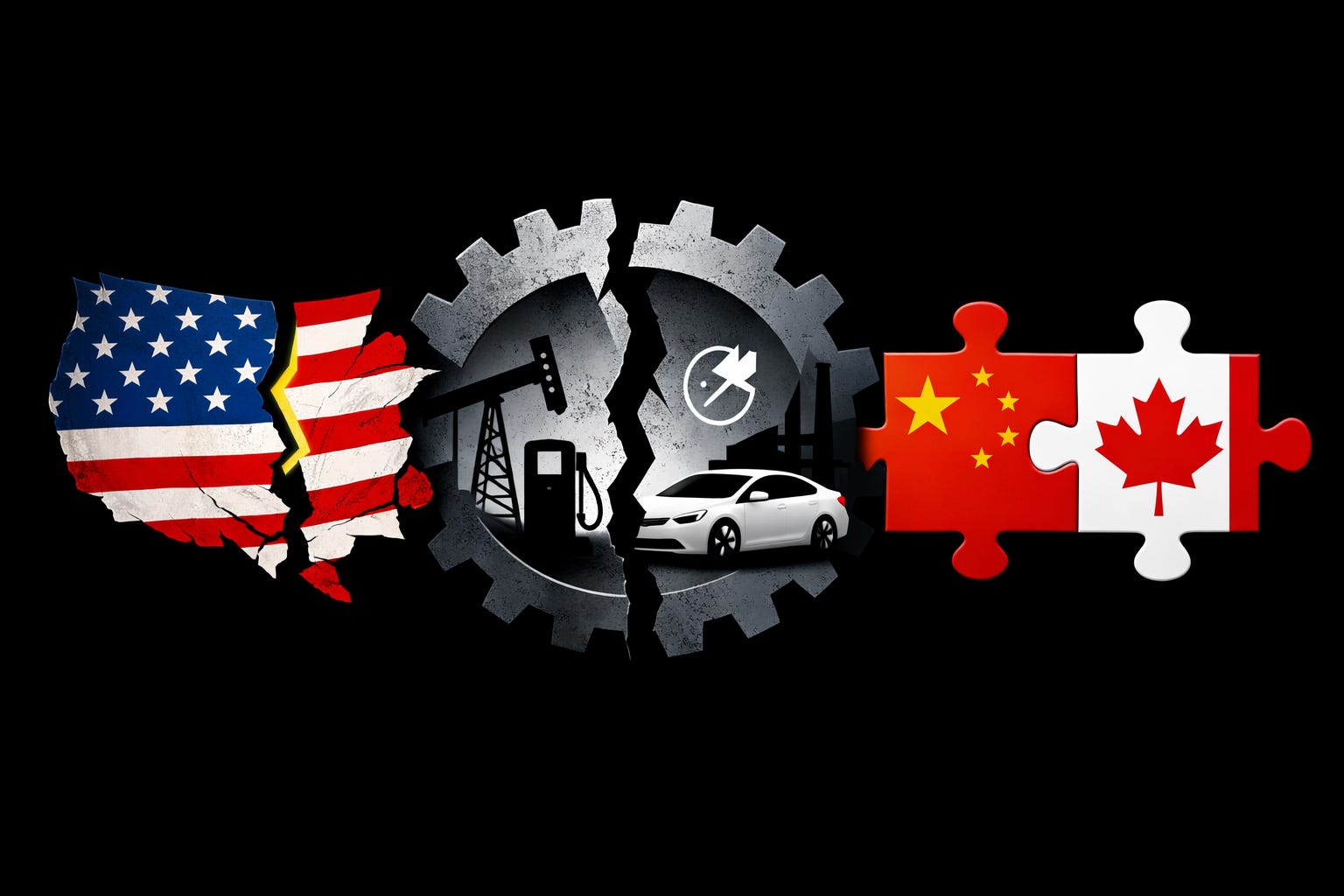
This wasn’t supposed to happen.
For decades, the Canada–U.S. relationship ran like a well-oiled machine.
Parts crossed the border like it didn’t exist. Cars were built in pieces on both sides. Energy flowed south. Money flowed both ways.
It worked because both sides understood one simple rule…
Don’t break what makes you both rich.
Then someone broke it.
What started as a tariff fight turned into something much bigger… a slow-motion unraveling of a system that took over half a century to build.
And here’s the part most people still haven’t fully clocked:
Canada didn’t just push back…
It pivoted.
The Move Nobody Expected
Early 2026… Canada cuts a deal with China.
Not a small one. A strategic one.
• Chinese electric vehicles get access to Canada (with limits)
• China slashes tariffs on Canadian canola
• Canada signals it’s open to deeper economic cooperation
That’s not just trade.
That’s repositioning.
For years, Canada followed Washington’s lead on China… especially on EV tariffs. Then suddenly… it didn’t.
That shift matters more than the headlines.
Because when your closest ally starts calling someone else “more predictable”… that’s not diplomacy.
That’s a warning shot.
The Thing About Tariffs Nobody Talks About
Tariffs sound tough.
They play great in speeches.
But in the real world?
They’re like putting a toll booth in the middle of your own factory.
The U.S. and Canadian auto industries weren’t separate systems… they were one machine split by a line on a map.
Parts cross that border multiple times before a car is finished.
So when you tax that flow…
You don’t punish “them.”
You slow down yourself.
And that’s exactly what happened.
• Billions wiped from major automakers
• EV investment pulling back hard
• Supply chains getting messy, expensive, inefficient
At the exact moment the rest of the world is sprinting into electric.
Timing matters.
And this was bad timing.
The Illusion of “Jobs Coming Back”
On the surface, it looks like a win.
A factory shifts south. Jobs move into the U.S.
Great headline.
But dig one layer deeper…
These aren’t the old middle-class jobs people remember.
They’re leaner. Less secure. Lower leverage for workers.
And worse… they’re tied to an industry that’s losing ground globally in the EV race.
So you’re not rebuilding the past.
You’re relocating a shrinking future.
Meanwhile… Canada Changed Directions
While all this noise was happening, Canada made a quieter… much bigger… decision.
Energy.
Instead of relying heavily on the U.S. market, Canada is building capacity to ship LNG to Asia.
Not a tweak.
A long-term shift.
We’re talking…
• Massive expansion of export infrastructure
• Tens of millions of tons of LNG headed overseas
• New relationships forming in Asia-Pacific
That’s decades of dependency starting to unwind.
And once those routes are built?
They don’t just “snap back.”
The Numbers Are Already Whispering
Exports tell the story before politicians do.
• U.S. share of Canadian exports is dropping
• Non-U.S. trade is rising fast
• The trend is moving in one direction
Not a collapse.
But a drift.
And drift becomes distance… if you leave it long enough.
Here’s the Bigger Game
This isn’t really about cars.
Or oil.
Or even tariffs.
It’s about alignment.
When you pressure allies hard enough… they start looking for options.
China knows that.
They don’t need to win a fight.
They just need to wait for cracks… and step into them.
That’s exactly what this looks like.
The Part That Should Make You Pause
None of this hits all at once.
That’s the dangerous part.
Right now, most of the impact is still… hidden.
Delayed.
Spread out across supply chains, investments, decisions not made yet.
Then one day…
It shows up all at once.
Markets don’t warn you politely.
They just… adjust.
End of an Era (Whether Anyone Admits It or Not)
For about 40 years, the trend was simple…
Closer integration. More trade. Shared systems.
That trend just broke.
Not completely.
Not overnight.
But direction matters more than speed.
And the direction has changed.
Bottom Line
You can’t rip apart a system built over 60 years and expect everything to land neatly.
You can’t push allies without consequences.
And you definitely can’t pause the future while everyone else keeps moving.
Canada didn’t start this shift.
But it adapted to it… fast.
And now the board looks very different.
The Recap…
This didn’t look like a big story…
But it is.
Canada didn’t just push back… it changed direction.
And once that happens… things don’t go back to “normal.”
The Gut-Punch…
You don’t lose an advantage in one move…
You lose it by pushing your allies until they stop needing you.
Source Credit:
Based on a Scott Ritter analysis of Canada USA geopolitical and economic developments
🔎 The GeezerWise Standard
This space is built on disciplined thinking.
Facts over spin.
Verification before amplification.
Good-faith discussion over tribal noise.
I use AI tools to help shape my spoken drafts into clear writing.
The judgment, conclusions, and final message are mine.
If you’re new here, this explains how I decide what’s worth sharing:
How I Decide What’s Worth Sharing → [link]
💌 Subscribe at GeezerWise.com to receive future letters:
www.geezerwise.com/subscribe
— Fred Ferguson
GeezerWise
#CanadaStrong
Canada Didn’t Blink... It Rewired the Game
While Washington played tariffs, Carney rewrote the map... and the fallout is just getting started.
Response to Fred Ferguson (Geezerwise)
Fred—
There’s something quietly precise in what you’re describing here… and it’s easy to miss because
it doesn’t look dramatic enough.
It doesn’t feel like a rupture. It feels like adjustment.
But systems don’t announce when they break. They just stop behaving the way they used to.
What you’re really pointing at isn’t a tariff dispute. It’s the moment an integrated system begins to lose its internal trust.
For decades, the Canada–U.S. relationship worked because it wasn’t just trade—it was assumption.
Assumption of continuity. Assumption of alignment. Assumption that friction would never be introduced at scale.
Tariffs don’t just tax goods. They tax that assumption.
And once that happens, the system starts doing something very specific: It begins to search for redundancy.
That’s why Canada’s move doesn’t read, to me, as opportunistic or even strategic in the classic sense.
It reads as systemic self-preservation.
Not “choosing China.” Not “pivoting away from the U.S.” But reducing exposure to a partner that has become… less predictable.
And in tightly coupled systems, predictability is everything.
Because the real vulnerability isn’t dependence. It’s asymmetric uncertainty.
Your point about tariffs acting like a toll booth inside a shared factory is exactly right— but I would take it one step further:
It’s not just slowing the machine. It’s forcing every participant in that machine to quietly ask:
“What happens if this toll becomes permanent?”
That’s the moment behaviour changes.
Not in headlines. In boardrooms. In investment committees. In long-term infrastructure decisions.
Which is exactly where your energy point becomes decisive.
Energy infrastructure is not reactive. It’s declarative.
When Canada builds LNG capacity toward Asia, it’s not responding to a quarter… it’s committing to a decade-scale flow realignment.
And flows, once rerouted, develop their own gravity.
They don’t “snap back.” They accumulate.
What makes this particularly interesting is that nothing you describe requires conflict.
No confrontation. No formal break. No political drama.
Just a series of rational decisions made under slightly altered assumptions.
And that’s how systems actually shift.
Not through shocks— but through quiet re-weighting of trust.
I also think your line about “relocating a shrinking future” is sharper than it looks.
Because it captures something uncomfortable:
Industrial policy is being applied to stabilise legacy structures… at the exact moment the underlying technological and economic centre of gravity is moving elsewhere.
So the system is doing two things at once:
• Trying to protect the past • While quietly repositioning for a different future
That tension rarely resolves cleanly.
If there’s one place I would sharpen your argument even further, it’s here:
This isn’t just Canada adapting.
It’s the North American system losing its automatic coherence.
And once coherence is no longer automatic, it has to be actively maintained.
Which is harder. Slower. And politically fragile.
So yes—this doesn’t look like a big story.
Because nothing has “collapsed.”
But the direction has changed. And in systems like this, direction is the signal.
Everything else is lag.
And your final line lands exactly where it should:
You don’t lose an advantage in a single move.
You lose it the moment others start building a world where they no longer need you to function.
That’s the shift.
This is such valuable analysis, thanks Fred, and Hans too