

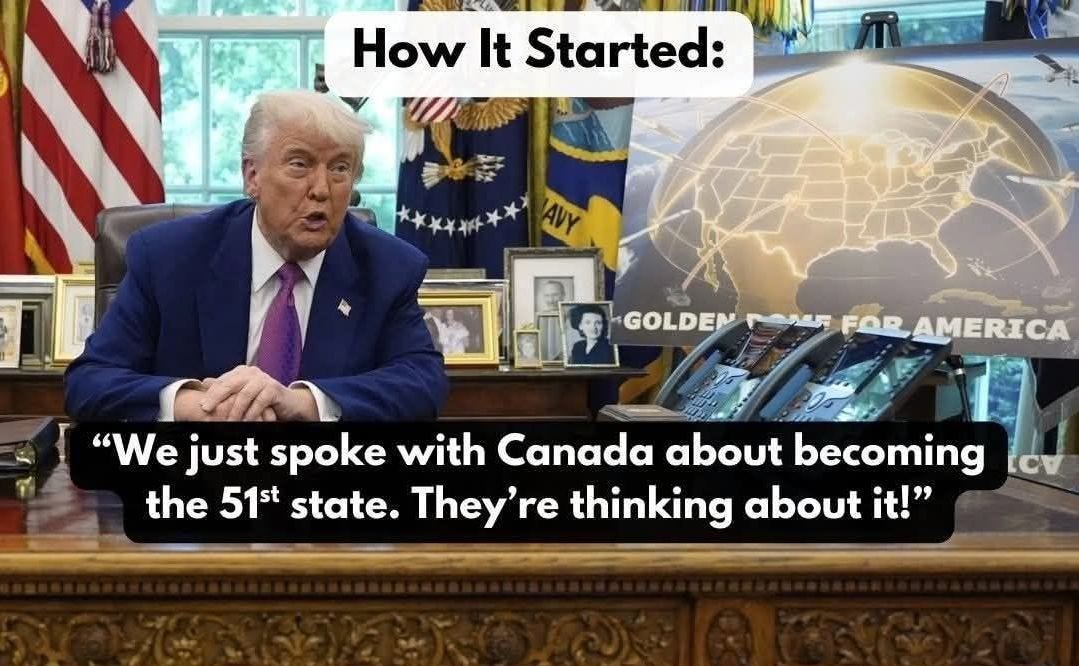
For years, we’ve been trained to expect a pattern…
Washington stomps its foot.
Everyone else scrambles.
So when Donald Trump dusts off the old tariff threats and economic chest-thumping, the pundit reflex kicks in. Who’s panicking? Who’s pivoting? Who’s folding?
This time, Canada did something far more unsettling to bullies.
Nothing.
No counter-threats.
No grandstanding.
No theatrical pivot toward Beijing to “balance” American noise.
Just calm, deliberate refusal to play the game.
And that’s exactly why this moment matters.
Strength Doesn’t Always Make Noise
Under Mark Carney, Canada’s response hasn’t been flashy — and that’s driving some commentators absolutely nuts.
They want drama.
They want a crisis narrative.
They want Canada to be either obedient to Washington or secretly running into China’s arms.
Reality, inconveniently, lives in the middle.
Carney’s message has been consistent:
Canada will diversify its economic relationships without becoming dependent on anyone.
That’s not rebellion.
That’s risk management.
Trade Isn’t a Scoreboard
Here’s where the bad economics creeps in.
Trump’s worldview treats trade like a hockey game…
Exports = goals
Imports = losses
Deficits = humiliation
Tariffs = toughness
But economies don’t work that way… and they never have.
As economists like Paul Krugman have been pointing out for decades, trade is a system, not a scoreboard. You don’t “win” trade by threatening your own supply chains and daring others to flinch.
Canada understands this because our economy is deeply integrated with the U.S. by geography, infrastructure, and decades of shared standards… not ideology.
You don’t unwind that with a press conference.
Diversification Is Not Substitution
One of the laziest takes floating around right now is that if Canada doesn’t jump when Washington snaps its fingers, we must be pivoting to China.
That’s nonsense.
Canada has been broadening trade ties for years — with Europe, Japan, South Korea, Australia, and other rule-based economies — not to replace the U.S., but to avoid single-point failure.
Think of it like building a house.
Diversification is adding more exits and better wiring.
Substitution is tearing down the foundation and hoping the new one sets faster.
Carney isn’t doing the second. And thank God.
China Isn’t a Neutral “Plan B”
Yes, China is a large market.
It’s also a market with:
Political conditionality
Opaque regulation
State intervention
Sudden rule changes
That’s not ideology. That’s lived experience for firms operating there.
Market access that can be withdrawn on political whim carries a hidden tax. Businesses know this. Investors price it in. Workers eventually pay for it.
Canada’s refusal to swap American volatility for Chinese opacity isn’t naïveté — it’s competence.
The Real Power Move: Not Reacting
Here’s the part most hot-take culture misses.
Trade intimidation only works if the target panics.
When Canada stays boring, predictable, and rules-based, it reduces the payoff of coercion. The threat loses force when it doesn’t produce concessions.
That’s not weakness.
That’s denying your opponent the script.
In economic terms, it stabilizes expectations.
In human terms, it keeps the lights on and people working.
Why This Is Quietly Uniting Canadians
Something else is happening under the noise — and it’s worth noticing.
Canadians across political lines are getting tired of imported chaos.
They don’t want policy driven by tantrums, midnight posts, or loyalty tests.
They want steadiness.
Carney’s approach signals something deeply Canadian right now:
We don’t confuse yelling with leadership
We don’t mistake volatility for strength
We don’t burn down functioning systems for applause
That shared instinct — protect stability, don’t escalate stupidity — is a form of unity you won’t see trending on cable news.
But it’s real.
The Bigger Lesson
This isn’t about personalities.
It’s about two economic worldviews colliding.
One says power comes from shock and submission.
The other says power comes from credibility, institutions, and patience.
The first generates headlines.
The second shapes outcomes.
Canada’s refusal to flinch isn’t dramatic — and that’s precisely why it works.
Sometimes the strongest move is declining to let someone else turn your economy into their performance art.
Source notes: Analysis informed by a long-form political-economy video discussing Trump’s trade threats, Canada’s response under Mark Carney, and standard international trade economics. Facts retained; structure and wording rebuilt entirely in my own voice.
Canada Strong Movement… House Rule & Disclosure
Canada Strong exists to defend Canadian sovereignty, democratic norms, and economic independence… without imported talking points or borrowed outrage.
House rule… Facts and good-faith discussion are welcome. I use AI tools to help turn my spoken drafts into clear writing. I’m 73, my hands shake, and I type with two fingers… so I speak first, then edit.
The ideas, positions, and final message are mine.
💌 If you enjoyed this, subscribe at GeezerWise.com to get future Unlearn letters straight to your inbox: www.geezerwise.com/subscribe ✌️
#CanadaStrongMovement #CanadaStrong
But without 2 more seats it seems like we may have a spring election. It will be interesting to see what happens with the conservatives. They seem like a time bomb but maybe so many of them are married to PP"s rants that they will stay the course. That will likely give the Liberals another win but likely not a majority. If only 2 more would walk so we could save all this cost and drama.