

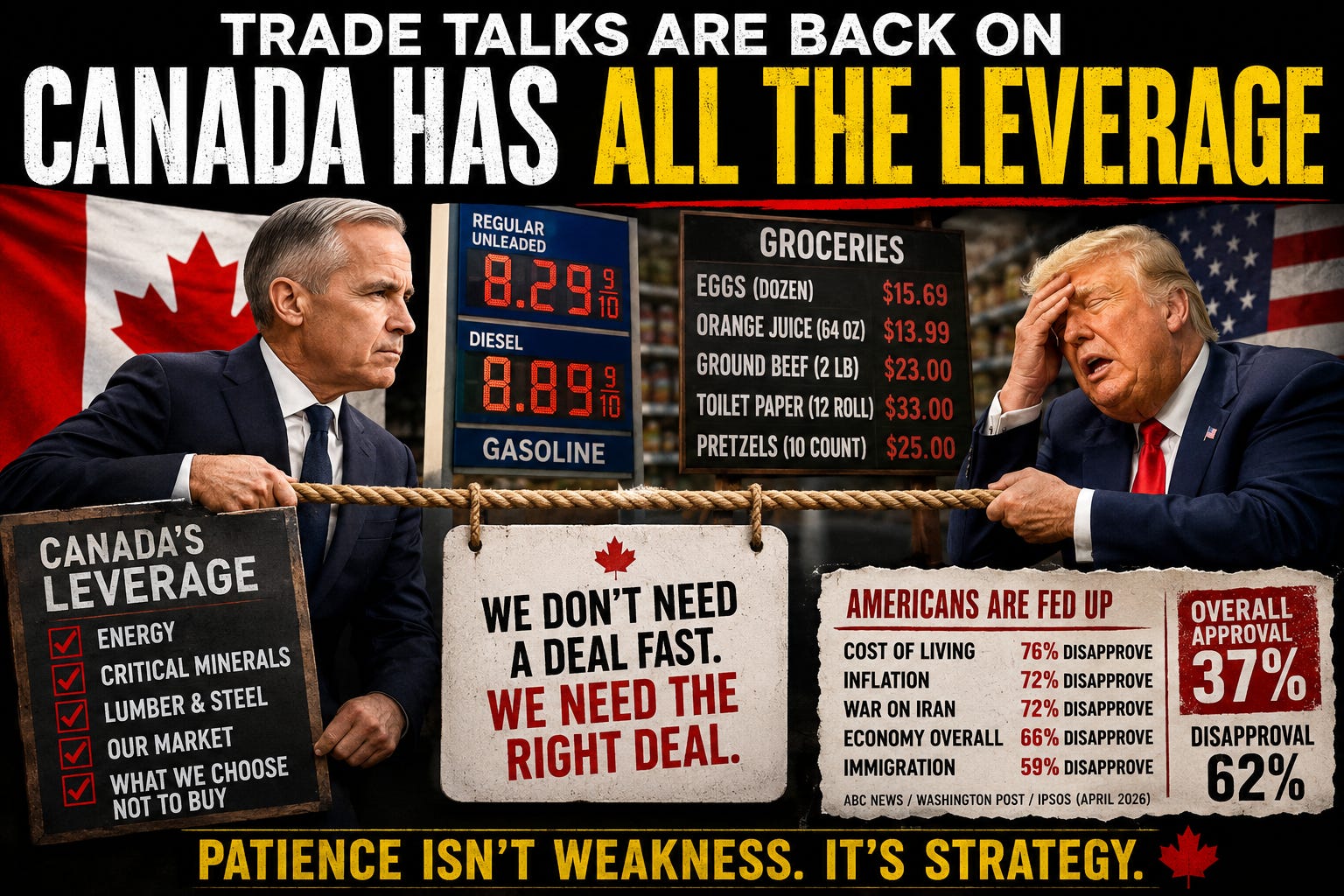
The funny thing about leverage is this…
Most people don’t recognize it until the other guy starts sweating.
For the past year, Canadians have been told we were the weak side in this trade fight with the United States.
That we needed a deal fast.
That we couldn’t survive pressure from Washington.
That we should cave early before things got worse.
Meanwhile, prices in the United States have been climbing like somebody replaced the economy with a gas-powered leaf blower pointed straight at people’s wallets.
Eggs. Gas. Food. Household basics.
Americans are getting hit from every direction at once.
And now… quietly… face-to-face Canada-U.S. trade negotiations are back on again after being stalled for months.
That timing matters.
Because the political environment inside the United States today is completely different than it was when the tariff chest-thumping started.
Back then, Washington thought pressure tactics would force countries like Canada into fast concessions.
Now?
The pressure is boomeranging back onto American consumers.
And voters notice when a grocery bill starts looking like a car payment.
Poll numbers coming out of the U.S. are ugly. Approval ratings tied to inflation, cost of living, and the broader economy have deteriorated badly.
That changes the negotiating table.
A government under economic pressure doesn’t have unlimited room to escalate another trade war… especially one that risks making prices even worse for its own population.
That’s where Canada’s position quietly strengthened.
Not because we screamed louder.
Not because we panicked harder.
Because we waited.
That’s the part a lot of people still don’t understand.
Sometimes the strongest negotiating move is refusing to sprint into a bad deal just because the other side is yelling.
Mark Carney’s approach appears built around exactly that idea… don’t rush into cosmetic side deals that can disappear with the next political mood swing in Washington.
And honestly?
That’s common sense.
Canada already learned the hard way that temporary “good vibes” agreements mean absolutely nothing if they aren’t backed by enforceable legal frameworks.
One Truth Social post is not a trade agreement.
One handshake photo-op is not economic security.
One politician saying “trust me” is not policy.
What actually matters is durable law, signed agreements, and enforceable rules.
That’s where the real fight sits.
Now here’s the part Canadians often underestimate…
We actually do have leverage.
A lot of it.
Not fantasy leverage.
Not chest-beating leverage.
Real-world leverage tied to supply chains, resources, and consumer markets.
The United States buys enormous amounts from Canada because they need enormous amounts from Canada.
Oil.
Aluminum.
Steel.
Potash.
Lumber.
Critical minerals.
Electricity in some regions.
Industrial inputs tied directly into American manufacturing.
That relationship cuts both ways.
And leverage isn’t only about what you sell.
It’s also about what you choose not to buy.
That’s the piece many politicians still struggle to explain properly.
When Canadians shift purchasing habits away from American products, services, tourism, alcohol, digital services, or other imports, that creates pressure too.
Consumers are economic actors whether governments acknowledge it or not.
That doesn’t mean Canada “wins” by trying to destroy the American economy.
That would be stupid.
Our economies are deeply tied together.
But it does mean the fantasy that Canada has “no cards” was never true.
The United States is discovering something uncomfortable right now…
Economic intimidation gets harder when your own voters are already angry about prices.
And politically?
That matters a lot heading toward midterms.
Because inflation changes voter behaviour faster than ideology does.
People will tolerate political drama for a while.
They will not tolerate paying insane prices forever.
That’s when governments suddenly become interested in compromise.
And here’s the bigger lesson hiding underneath all this…
Canada’s strongest move may not have been fighting harder.
It may have been refusing to panic.
That restraint bought time.
And time changed the battlefield.
The Recap…
For months Canadians were told we had no leverage against the U.S.
Now inflation is hammering American consumers, trade talks are back on, and suddenly Washington needs economic stability more than another tariff circus.
Funny how patience starts looking a lot like strategy once the pressure flips directions.
The Gut-Punch…
The loudest person in a negotiation usually isn’t the one holding the power.
It’s usually the one starting to feel it slip away.
Source credit:
Based on trade commentary, polling discussion, and Canada-U.S. negotiation analysis from the supplied transcript research notes.
🔎 The GeezerWise Standard
This space is built on disciplined thinking.
Facts over spin.
Verification before amplification.
Good-faith discussion over tribal noise.
I use AI tools to help shape my spoken drafts into clear writing.
The judgment, conclusions, and final message are mine.
If you’re new here, this explains how I decide what’s worth sharing:
How I Decide What’s Worth Sharing → [link]
💌 Subscribe at GeezerWise.com to receive future letters:
www.geezerwise.com/subscribe
— Fred Ferguson
GeezerWise
#CanadaStrong
Thank you once again, Fred. When Howard Lutnick said that Canada’s strategy to wait for a deal was “stupid”, I suspected we were on to something. You just confirmed it.
The Shakespearean phrase "hoist by his own petard" comes to mind. (or at least to my mind, haha) The many things the U.S. has done to harm itself, starting with tariffs, which are paid by the buyer, not the seller, (surprise!) and ending with a war which resulted in the closing of the Straits of Hormuz has put the American economy on the ropes and the population poorer than when they started, before electing their golden haired savior. Add to that the alienation of the country's allies and trading partners who turned elsewhere to buy and sell their goods, resulting in the worsening of the U.S. trade deficit and we have the makings of the perfect storm.
There are many in Canada, as elsewhere, who are reactive and respond with noise and ill thought-out rhetoric to display their angst, their need to defend against perceived enemies and above all to decry the quiet discipline of those governed by logic and patience. We know who they are and where they can be found, whether in MAGA meetings in Toronto or at freedom rallies in Alberta. Apparently there is a part of the brain, the amygdala, that renders these poor souls unable to respond in any other way.
Then there are those who are patient and thoughtful, who see the big picture, the macro of events, and refuse to be goaded by infantile mania. Often these people have become well educated and able to deduce the impact of the many inputs that drive a society and thus formulate a reasonable response. I am so happy that we have elected such a person in these trying times.
Many years ago, when I was involved in day trading futures, I spoke to my mentor of my indecision regarding a particular trade, resulting in me doing nothing. He replied that not taking a position is, in itself, a position. I've remembered that ever since.