

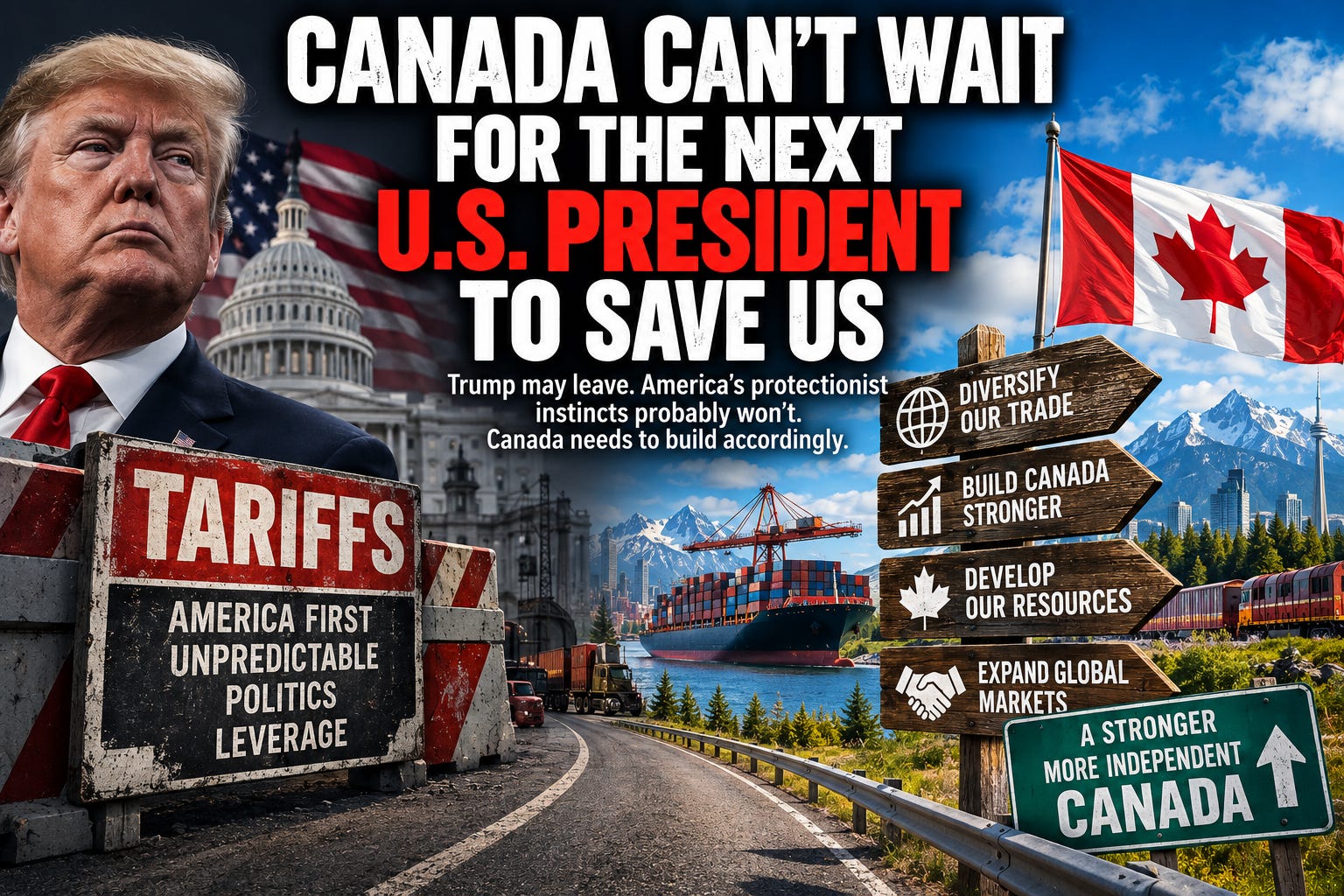
There’s a comforting story Canadians could tell ourselves about this whole mess.
Donald Trump is the problem.
Wait him out.
Eventually Americans elect somebody more reasonable, the insults stop, the tariff war winds down and Canada and the United States go back to being the friendly neighbours we remember.
I wouldn’t bet the country on it.
Not because every future American president will behave like Donald Trump. They won’t.
Not because Democrats and Republicans are identical on trade. They aren’t.
But because underneath all the Trump noise, threats and economic bullying is something much less dramatic and much more permanent:
The United States has national interests that don’t disappear when presidents change.
That doesn’t make America our enemy.
It makes America a country.
Canada needs to remember that we’re one too.
Gavin Newsom Gave Us the Right Answer… Even If It Wasn’t the Comfortable One
Back in August, California Governor Gavin Newsom was making the Canadian media rounds.
He sounded very different from Donald Trump.
He spoke warmly about Canada, condemned Trump’s treatment of us and described California as a stable partner.
I welcomed it.
I’d much rather deal with an American president who respects Canada than one who talks about us like a piece of real estate he’d like to pick up at a bankruptcy auction.
But during a CBC interview, Newsom was asked an important question.
If a future Democratic president took office, should Canadians expect the tariffs to disappear and the old free-trade relationship to return?
He didn’t promise that.
His answer was: “I don’t know.”
That may have been the most useful answer he gave us.
Because Newsom wasn’t saying Democrats would continue Trump’s trade war.
He was acknowledging something Canadians need to understand.
Nobody can promise that changing the occupant of the White House puts the old Canada-U.S. relationship back together.
And increasingly, Canada isn’t behaving as though it will.
We Already Know Protectionism Can Survive a Change of President
Softwood lumber is the perfect example.
The dispute didn’t begin with Trump.
While Joe Biden was president, the U.S. Department of Commerce increased combined duties applying to most Canadian softwood lumber exports from 8.05% to 14.54% in 2024.
Canada called the duties unfair and unwarranted.
Then Trump returned.
And things got considerably worse.
Today, the current combined anti-dumping and countervailing cash-deposit rate for the “all others” category of Canadian softwood lumber exporters is 35.16%.
Canfor’s combined rate is 47.59%.
And since October 2025, certain Canadian softwood lumber has also faced an additional 10% U.S. Section 232 tariff.
That’s worth absorbing for a moment.
The dispute existed under a Democratic president.
It continued under a Republican one.
The severity changed enormously.
The underlying American protectionist pressure didn’t disappear.
That doesn’t prove every future U.S. president will keep every Trump tariff.
It proves Canada would be foolish to build its economic strategy around the assumption that they won’t.
And Then August Happened
When I first wrote about this, Canada and the United States had just walked away from another attempt at a trade agreement.
The numbers are clearer now.
On August 22, the United States imposed 50% tariffs on C$27.6 billion worth of Canadian goods under Section 338 of the Tariff Act of 1930.
And these weren’t limited to some obscure corner of the economy.
They hit products including plastics, furniture, electronics, paper products, industrial machinery, wood products, textiles, apparel and sporting equipment.
Worse, these particular tariffs do not provide an exemption simply because the goods comply with CUSMA.
Canada decided not to swallow the deal Washington was offering.
Prime Minister Mark Carney said the proposed terms did not sufficiently protect Canadian workers, businesses, strategic industries and Canadian sovereignty.
Then Canada retaliated.
Not threatened to.
Not announced that maybe someday we would.
Did.
Since September 8, Canada has imposed counter-tariffs of 15%, 25% or 50% on C$27.6 billion worth of American products.
Steel and aluminum.
Dairy.
Appliances.
Agricultural equipment.
Pulp and paper.
Plastics.
Electronics.
Furniture.
Other existing Canadian counter-tariffs, including those affecting U.S. automobiles, remain in place.
This isn’t a hypothetical trade war anymore.
We’re living in it.
Something Else Has Happened While Everybody Was Watching Washington
Canada started selling more stuff somewhere else.
And now we have numbers.
In 2025, Canadian merchandise exports to the United States fell 5.8%.
Meanwhile, exports to countries other than the United States rose 17.2%.
Total merchandise trade with non-U.S. countries reached $553 billion, up 14.3% in a single year.
The U.S. remained overwhelmingly our largest export market… and nobody should pretend otherwise… but its share of Canadian merchandise exports fell from 75.9% in 2024 to 71.7% in 2025 on Statistics Canada’s balance-of-payments measure.
That is not economic independence.
It isn’t even close.
But it is movement.
And Ottawa has now made the objective explicit…
Double Canadian exports to non-U.S. markets over the next decade.
That requires more than diplomatic speeches and trade missions.
It means ports.
Rail.
Roads.
Energy infrastructure.
Critical minerals.
New trade agreements.
New customers.
New investment.
And the physical capacity to get Canadian products to markets that aren’t conveniently sitting on the other side of the 49th parallel.
That work has started too.
The federal government, for example, has committed support for major expansion at Roberts Bank in British Columbia as part of a plan it says could unlock more than $100 billion in additional trade capacity.
That’s what diversification looks like when it stops being a slogan and starts involving concrete.
Today’s Numbers Give Us a Useful Reality Check
Statistics Canada released the latest merchandise trade numbers today.
In August, Canadian exports rose 2.5% to $77.9 billion while imports fell 2%.
Canada recorded a $4.2-billion merchandise trade surplus with the world, our sixth consecutive monthly surplus.
Our surplus with the United States reached $11.2 billion.
Sounds terrific.
But there’s an important catch.
Exports to the United States surged 8.1% partly because American importers were rushing Canadian goods across the border before the new 50% tariffs took effect.
Meanwhile, Canadian exports to countries other than the United States fell 8.5% in August after rising the previous month.
That matters.
Because I’m not interested in replacing one fairy tale with another.
Canada hasn’t suddenly diversified itself out of dependence on the United States.
Not remotely.
What we’ve done is start.
And starting is very different from finishing.
This Was Never About Abandoning America
I keep seeing this argument reduced to some version of…
“So you want Canada to stop trading with the United States?”
No.
That would be economic lunacy.
The United States is a gigantic market sitting beside us. Our economies have been integrated for generations. Millions of Canadian and American jobs depend on that relationship.
We should trade with them.
A lot.
If relations improve, we should trade even more.
But there is a hell of a difference between having your best customer and having one customer with enough leverage to frighten your entire economy every time somebody in Washington changes the rules.
That’s the lesson.
Diversification isn’t divorce.
It’s insurance.
What Happens When Trump Is Gone?
Eventually Donald Trump will leave office.
Maybe the next president is a Democrat.
Maybe it’s Gavin Newsom.
Maybe it’s somebody we aren’t talking about yet.
Suppose the insults stop.
Suppose the annexation garbage disappears.
Suppose Washington once again treats the Canadian prime minister as the leader of a sovereign ally rather than the manager of some northern property America ought to own.
Wonderful.
I’ll take it.
Repair everything we reasonably can.
Shake hands.
Negotiate.
Trade like hell with them.
But don’t stop building ports.
Don’t stop expanding trade with Europe.
Don’t stop building relationships across Asia.
Don’t stop developing critical minerals.
Don’t stop expanding energy infrastructure.
Don’t stop strengthening east-west trade inside Canada.
And for God’s sake, don’t dismantle the new relationships we’re building because somebody in Washington starts smiling at us again.
Because the objective was never simply to survive Donald Trump.
The objective is to make sure no American president ever has this much economic leverage over Canada again.
That project lasts longer than one presidency.
Nobody Is Coming to Rescue Canada
I don’t mean that pessimistically.
Quite the opposite.
Canada doesn’t need rescuing.
We have energy.
Uranium.
Critical minerals.
Agriculture.
Forests.
Advanced manufacturing.
Technology.
An educated workforce.
Access to three oceans.
Free-trade agreements giving Canadian businesses preferential access to enormous international markets.
And countries around the world looking for many of the things we produce.
Our problem was never that Canada couldn’t trade beyond the United States.
Our problem was that for decades we had very little incentive to try hard enough.
The richest consumer market on Earth was sitting next door.
Of course we sold there.
It made perfect sense.
Until efficiency became dependency.
And dependency became leverage.
Trump didn’t create that vulnerability.
He exposed it.
That may turn out to be one of the most consequential things he ever did to Canada.
Because once Canadians saw the vulnerability, we started doing something about it.
Don’t Pay for the Same Lesson Twice
Canada is nowhere near economically independent of the United States.
Anyone telling you otherwise is selling something.
But we are moving.
Exports outside the United States grew sharply last year.
New trade relationships are being pursued.
Infrastructure is being expanded.
Canada has set a goal of doubling non-U.S. exports over the coming decade.
And perhaps most importantly, the old assumption that Washington will always provide a predictable, rules-based economic relationship has been broken.
Prime Minister Carney said it plainly after the August negotiations failed:
“America has changed, and we will not return to our old relationship.”
That doesn’t mean permanent hostility.
It doesn’t mean anti-Americanism.
And it certainly doesn’t mean we should stop trading with the United States.
It means something much simpler.
Canada’s economic security cannot depend on Americans electing the president we hope they elect.
So when Trump eventually leaves, welcome the improvement if improvement comes.
Repair the relationship.
Rebuild trust where trust can be rebuilt.
But keep building Canada.
Keep finding customers.
Keep opening markets.
Keep strengthening ourselves.
Because we learned something expensive.
Let’s not pay for the same lesson twice.
Trump isn’t the reason Canada needs greater economic independence.
He’s the reason we finally understood why it matters.
The Recap…
Trump will eventually leave the White House.
Canada’s economic vulnerability won’t automatically leave with him.
The United States will continue defending American interests, regardless of which party controls Washington.
Canada needs to permanently learn to defend ours.
And this time, we actually appear to be doing something about it.
The Gut-Punch…
The goal isn’t to survive Donald Trump.
It’s to build a Canada that never again has to worry this much about who Americans elect.
Source Credit
Statistics Canada… Canadian international merchandise trade, August 2026, released October 6, 2026.
Statistics Canada… Canadian international merchandise trade, 2025 annual results.
Global Affairs Canada… Current U.S. tariffs and duties affecting Canadian softwood lumber.
Government of Canada, Department of Finance… Canadian countermeasures responding to U.S. tariffs, effective September 8, 2026.
Trade Commissioner Service… Current U.S. Section 338 tariffs affecting Canadian exports.
Prime Minister of Canada… August 21–22 statements on Canada-U.S. trade negotiations and Canada’s trade-diversification strategy.
Prime Minister of Canada… Canada’s objective to double non-U.S. exports over the next decade and expansion of trade infrastructure at Roberts Bank.
If you enjoy thoughtful conversations, Canadian stories, and the occasional smart-ass observation about the world we’re living in, you’re in the right place.
Subscribe free and get new stories, insights, and observations delivered directly to your inbox.
No paywall.
No spam.
No nonsense.
Leave anytime with a single click.
I promise not to take it personally.