

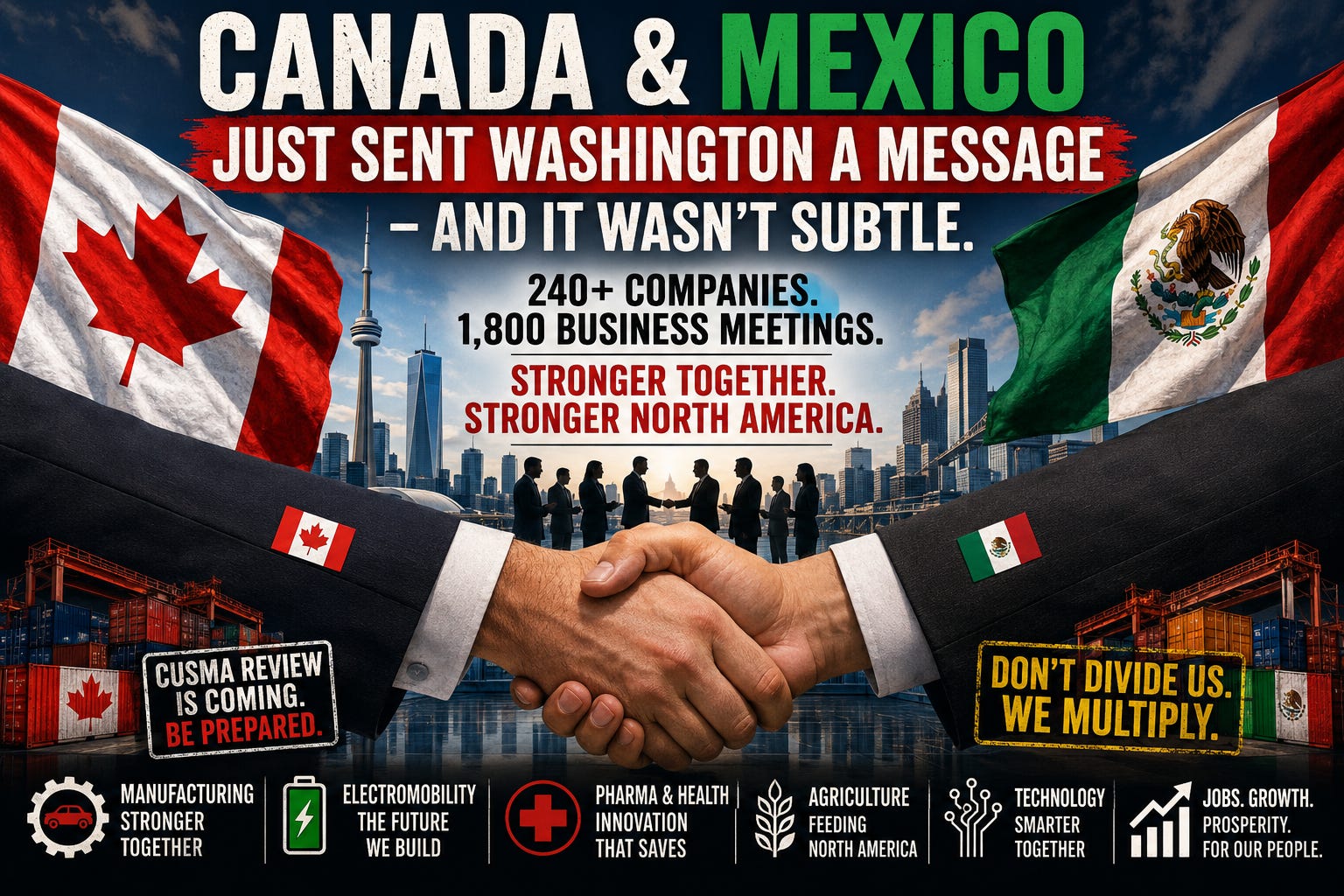
For years, Canada treated the United States like that one giant customer you’re terrified to lose.
Didn’t matter how rude they got.
Didn’t matter how unstable things became.
Didn’t matter how many times tariffs got slapped on Canadian industries like a drunken parking ticket.
We kept showing up with coffee and a smile anyway.
But something changed this week.
Quietly.
Strategically.
And Washington definitely noticed.
More than 240 Mexican companies arrived in Canada for one of the biggest Mexico-Canada trade missions in recent memory.
Roughly 1,800 business meetings. CEOs. Ministers. Manufacturers. Tech firms. Pharma executives. Investors. Aerospace players. Transportation companies. Agriculture. Advanced manufacturing. Electromobility. The whole works.
That’s not a networking event.
That’s two countries comparing notes before a very ugly negotiation.
And the timing isn’t accidental.
The CUSMA review is approaching.
Trump’s administration is again floating pressure tactics, tariff threats, “America First” leverage plays, and renewed attempts to weaken parts of the existing trade structure.
Canada and Mexico remember exactly how this movie played out during the NAFTA renegotiations.
Washington tried separating the herd.
Charm Mexico.
Pressure Canada.
Control the table.
This time?
Ottawa and Mexico City appear to be showing up together before the game even starts.
That’s the real story here.
Not the handshakes.
Not the press photos.
Not the diplomatic fluff.
This is about leverage.
Because both countries have now learned something the hard way…
You cannot build long-term economic security around political mood swings.
One week there’s a tariff.
Next week there’s an exemption.
One day allies are praised.
The next day they’re mocked at rallies for applause.
That’s not stability.
That’s economic whiplash.
And serious countries eventually get tired of planning their future around somebody else’s tantrums.
So Canada and Mexico are adapting.
Frankly?
About damn time.
Here’s what most Canadians still don’t realize…
Canada-Mexico trade remains surprisingly underdeveloped compared to its potential.
That means there’s enormous room to grow.
Mexico brings industrial muscle…
manufacturing, labour capacity, automotive infrastructure, logistics, and rapidly expanding technology sectors.
Canada brings critical minerals, aerospace expertise, energy, agriculture, AI development, finance, and access to European markets through agreements like CETA.
Those economies fit together better than many people think.
For decades, the United States sat in the middle collecting most of the advantage simply because geography made it easy.
Now Canada and Mexico are starting to ask a dangerous question…
“What happens if we build more direct economic lanes ourselves?”
That question matters.
A lot.
Because this isn’t really about “replacing” the American market.
That’s the lazy argument people always jump to.
Nobody serious thinks Canada stops trading with the U.S.
Geography alone makes that impossible.
The United States will remain Canada’s largest trading partner for years.
But there’s a massive difference between partnership and dependency.
And Canadians are finally beginning to understand it.
A smart country diversifies.
A smart country reduces exposure.
A smart country doesn’t keep all its eggs in one increasingly unpredictable basket while pretending everything’s fine because “that’s how we’ve always done it.”
That era is ending.
You can feel it.
Even emotionally.
The trust between Canadians and Americans has taken visible damage over the past several years.
Not hatred.
Not war.
Just erosion.
The kind that happens slowly when one side becomes less reliable, more hostile, and harder to predict.
Countries can still do business professionally without pretending they’re best friends anymore.
That’s adulthood.
And honestly, Europe has been moving this direction too.
The EU has spent years learning how vulnerable open economies become when larger powers start weaponizing trade, tariffs, sanctions, and economic pressure.
Canada is finally catching up to that reality.
Diversify.
Build resilient alliances.
Protect supply chains.
Reduce exposure to instability.
Stay open… but stop being naïve.
That’s where this is heading.
And Washington sees it.
That’s why this Canada-Mexico coordination matters politically.
If Canada negotiates alone, Washington gains leverage.
If Mexico negotiates alone, Washington gains leverage.
If both coordinate?
The balance shifts.
Not completely.
But enough to matter.
Enough to change the conversation.
Enough to remind Washington that allies aren’t furniture.
And maybe that’s the real shift happening underneath all this.
For decades, North American trade operated like gravity…
everything pulled toward the United States automatically.
Now countries are beginning to build side roads.
Quietly.
Carefully.
Strategically.
Not because they hate America.
But because instability changes behaviour.
Always has.
Always will.
And right now, Canada looks less interested in asking permission…
and more interested in finally growing up economically.
That may end up being the biggest story of all.
The Recap…
Canada and Mexico just held one of the biggest trade coordination meetings in years.
240+ companies.
1,800 business meetings.
And one very clear message to Washington:
“You’re not dividing us this time.”
This isn’t anti-American.
It’s anti-dependency.
And honestly?
Canada should’ve started diversifying years ago.
The Gut-Punch…
Canada spent decades acting like America was the only grocery store in town.
Now the shelves are getting unreliable…
and suddenly we’re remembering there’s an entire world outside the parking lot.
Source credit:
Research based on commentary and trade discussion sourced from Europe Curious / Wilford Lemkeuller analysis and related public discussion surrounding upcoming CUSMA negotiations.
🔎 The GeezerWise Standard
This space is built on disciplined thinking.
Facts over spin.
Verification before amplification.
Good-faith discussion over tribal noise.
I use AI tools to help shape my spoken drafts into clear writing.
The judgment, conclusions, and final message are mine.
If you’re new here, this explains how I decide what’s worth sharing:
How I Decide What’s Worth Sharing → [link]
💌 Subscribe at GeezerWise.com to receive future letters:
www.geezerwise.com/subscribe
— Fred Ferguson
GeezerWise
#CanadaStrong
An entire world outside the parking lot, and thank God we have PM Mark Carney with us.
I love this post Fred! I see Mexico as the new lover that Canada took on, & now the jealous lover in the whitehouse is fuming. Canada got tired of placating & started looking around. Good move! We won the checker game! haha