

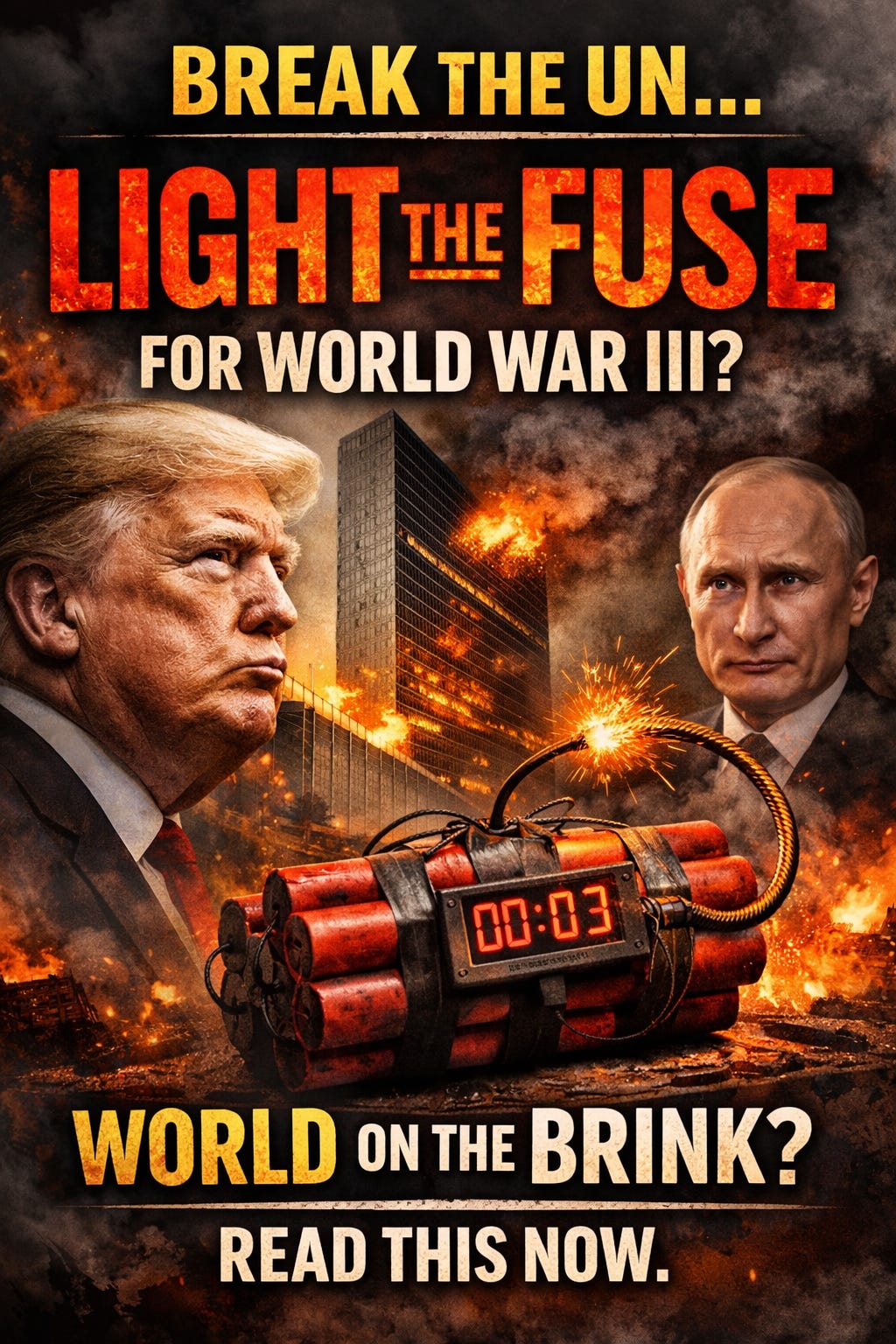
When You Start Wrecking the UN, You’re Not “Putting America First”… You’re Lighting Matches in a Gas Station
Here’s what a lot of people don’t want to say out loud…
If Trump keeps pushing to cripple the United Nations, this isn’t some harmless “globalist paperwork drama.”
It’s the kind of move that makes the world more unstable, more chaotic, and more likely to stumble into a major war.
Not because the UN is perfect.
It isn’t.
But because when the grown-ups stop running the building… the lunatics start running the street.
1) The US is behind on UN dues… and it’s not pocket change
The United States owes the UN around $4 billion in unpaid dues.
And here’s the part that should make your eyebrows climb up your forehead…
That unpaid amount makes up about 80% of the UN’s total regular-budget arrears worldwide.
Meaning: out of all the countries dragging their feet on UN dues… the US is basically carrying the championship belt for non-payment.
And the UN doesn’t run on some bottomless vault of cash. It runs on a tight budget. So when the biggest player stops paying, the whole machine starts grinding.
2) There’s a rule for this… and the US has already crossed the line
The UN Charter has a threshold where a country that doesn’t pay can lose its voting rights.
According to this analysis, the US has already crossed that line.
Now imagine how convenient that becomes for someone who wants to blow the place up politically.
Because if the UN ever said, “Alright, no vote for you,” it becomes instant fuel for the exit ramp:
“See? They’re unfair. We’re done. Scrap the whole thing.”
That’s not diplomacy. That’s manufactured justification.
3) This isn’t random… it’s part of a bigger pattern of pulling out
There’s a claim here that Trump signed a memorandum pulling the US out of 66 international organizations, many tied to the UN system.
And the UN’s response was basically…
“We’re continuing our work anyway.”
Which sounds brave… but it also sounds like what you say when the guy holding the steering wheel just started unbolting it.
4) When the UN gets weakened, regular people get hit first… not politicians
Let’s talk about what this actually changes on the ground.
If the US backs away from UN-linked coordination and systems, the fallout isn’t abstract.
It’s practical, ugly, and expensive.
You get…
Less early warning on disease outbreaks that can turn into pandemics
Less intelligence sharing on terrorism, trafficking, and transnational crime
Less influence over trade standards that affect billions in exports
More regional conflicts spiraling into crises that may require military intervention
Faster climate damage because coordinated responses fall apart… and that hits agriculture, coastal cities, and disaster costs
And yes, we’re already seeing the price tag of chaos.
Wildfires. Hurricanes. Extreme weather. Massive rebuild costs.
When systems fail, it’s not the rich and connected who suffer first.
It’s the people who can’t afford the surprise bill.
5) The quiet disaster… America’s brain drain
This part is sneaky but important.
When a country pulls back from international bodies, it doesn’t just lose “influence.”
It starts pushing its own experts out of the room.
Scientists and professionals lose access, standing, and opportunity.
So they do what smart people do when the building catches fire…
They leave.
The transcript even gives examples of where they might go… Denmark, the UK, Canada.
And as a Canadian, I’ll say it plainly…
If the US starts bleeding talent, other countries will happily catch it like a free-agent draft.
6) When the US steps back, authoritarians step forward
Power vacuums don’t stay empty.
If the US withdraws from the rules-based international system, other players move in fast… especially authoritarian regimes that love chaos and weak institutions.
The argument here is that the current global order has helped prevent major-power war for around 80 years.
You weaken the structure long enough… you don’t get “freedom.”
You get a fight over who runs the world next.
7) There’s a serious legal angle too… and it’s not just “policy preference”
One of the strongest points here is legal…
Under Article VI of the US Constitution, treaties ratified by the Senate are considered the supreme law of the land.
And the UN Charter was ratified in 1945.
So the claim is: a president can’t just casually tear that up like a gym membership.
There’s also mention of Article 60 of the Vienna Convention on the Law of Treaties… basically the kind of thing that can kick off serious international consequences if treaty obligations are being violated.
8) And the Venezuela / Ukraine angle is the kind of thing that should make your skin crawl
This transcript points to something that sounds like a geopolitical hostage trade…
A claim that Putin proposed a deal during Trump’s presidency…
“We’ll give you Venezuela if you give us Ukraine.”
And it says Fiona Hill testified under oath that her national security team received this offer through Russian counterparts.
Whether you’re left, right, or allergic to politics altogether… that kind of “swap countries like trading cards” thinking is how wars get cooked up behind closed doors.
9) The UN headquarters is in the US… but it’s not “US property”
Another detail: the UN headquarters sits on 17 acres in the US, but it’s considered extraterritorial under the 1947 Headquarters Agreement.
So it’s physically in the US… but not fully under US jurisdiction in the usual way.
And historically, international institutions don’t survive when major powers walk away.
The transcript compares it to the League of Nations, which collapsed after key nations withdrew.
And when that fell apart, history didn’t exactly improve.
✅ My new analogy (not in the source)
Breaking the UN isn’t like “quitting a club you don’t like.”
It’s like ripping the smoke detectors out of an apartment building because you’re tired of hearing alarms.
Sure… it’s quieter for a while.
Right up until the whole place goes up and everyone starts screaming anyway.
10) Bottom line: this is a dangerous moment
This isn’t a “hot take.”
It’s a warning flare.
If global coordination collapses, the world doesn’t become freer.
It becomes more volatile, more armed, more paranoid, and more likely to slide into conflict.
And when the adults leave the room, history doesn’t take a nap.
History starts sharpening knives.
Note: I use AI tools to clean up drafts and occasionally create images. The ideas and opinions are mine.
#GeezerWiseSays
💌 If you enjoyed this, subscribe at www.GeezerWise.com to get future letters straight to your inbox.