

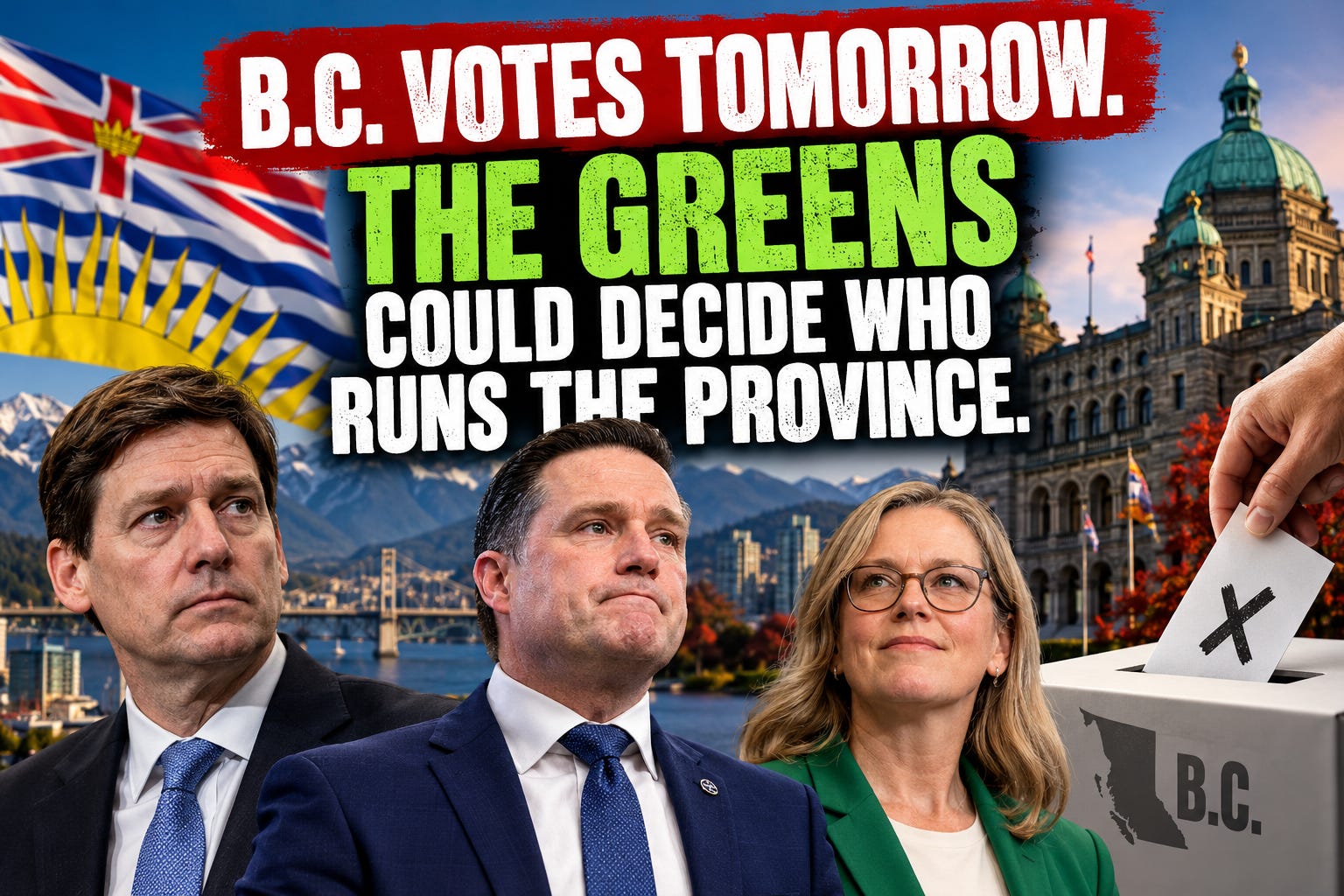
I live in British Columbia, and I’ve been watching this election get more interesting by the day.
Tomorrow, October 24, we vote for a new provincial government.
Except we weren’t supposed to be doing this for another two years.
Premier David Eby decided to call an early election on September 22. I imagine he thought it was a good opportunity to strengthen his government’s position.
Well, that calculation isn’t looking quite so clever anymore.
The latest polls have the B.C. Conservatives ahead, the NDP trailing, and the Greens attracting enough support to make life uncomfortable for both parties.
And something happened in Vancouver last weekend that deserves attention.
The city elected a Green mayor.
Pete Fry defeated incumbent Ken Sim, receiving 98,748 votes according to the city’s official results.
That’s not some encouraging little breakthrough for a fringe candidate. That’s a significant municipal election victory in Canada’s third-largest metropolitan area.
Now, municipal politics and provincial politics aren’t the same thing. Fry’s victory doesn’t mean everyone who voted Green in Vancouver will vote Green provincially.
But it does tell us something.
People are willing to vote Green when they believe the candidate can win.
And that brings us to tomorrow.
The numbers David Eby probably wishes looked different
On October 23, Ipsos released its final provincial election poll.
The Conservatives, led by Lorne Doerkson, stood at 44%.
David Eby’s NDP had 39%.
And Emily Lowan’s Greens had 13%.
Other pollsters are finding much the same thing.
Research Co. puts the Conservatives at 44%, the NDP at 40%, and the Greens at 10%.
Pallas Data has the Conservatives at 45%, the NDP at 39%, and the Greens at 12%.
Different surveys. Different methods. But the same general picture.
The Conservatives are ahead, and the Greens are drawing a meaningful share of the vote.
Now here’s where things get interesting.
British Columbia doesn’t elect governments by adding up all the votes across the province and handing the winner the keys.
We elect 93 MLAs in individual ridings.
A party can win plenty of votes and relatively few seats if those votes are spread around.
That’s the problem the Greens have faced for years.
In 2024, they won roughly 8% of the popular vote but secured only two seats.
This time, some polls have them considerably higher.
Whether that translates into more MLAs is another matter.
But even a small number of Green MLAs could become very important if neither major party wins a majority.
And there is another possibility.
In ridings where the NDP and Conservatives are closely matched, Green support could influence which candidate finishes first.
That’s not a prediction. It’s how our electoral system works.
The part nobody can know for certain is where those Green votes would go if the Greens weren’t on the ballot.
Some might vote NDP. Some might vote Conservative. Some might stay home.
And some might tell anyone asking them to vote strategically to mind their own damn business.
Fair enough.
Their votes belong to them.
But there’s another election question I think deserves more attention
Money.
Not the money political parties spend trying to get elected.
The money ordinary British Columbians have left after paying their bills.
Because while everyone is arguing about who might win, the parties are offering very different approaches to taxes and public services.
The Conservatives are promising income-tax relief, including savings of up to approximately $1,000 a year for many working British Columbians.
The NDP wants to raise income taxes on higher earners to help fund public services.
Those are legitimate political choices.
But I have a question whenever a politician promises to save me money.
What happens to the other bills?
Take automobile insurance.
British Columbia has ICBC, a publicly owned insurance corporation. Our current basic system uses no-fault insurance.
The Conservatives want to introduce more competition while retaining ICBC as a public option.
Supporters argue competition could improve choice and service.
Critics warn that changing the system could drive up costs.
And some political advertising has suggested premiums could double.
That’s a serious claim. But it isn’t an established fact, and I wouldn’t tell readers their premiums will double without evidence demonstrating that outcome.
What I would tell them is this.
If a government promises to save you $1,000 in taxes, you’d better pay attention to what happens to your insurance, electricity, health services and every other expense that government policy can affect.
A tax cut isn’t automatically a bad idea.
Neither is public ownership automatically the cheapest solution.
But a politician showing me one side of the household ledger while ignoring the other isn’t giving me the whole picture.
And I’m old enough to have seen that trick more than once.
There’s something else about this election that bothers me
David Eby didn’t have to call it.
British Columbians had already elected a legislature in October 2024.
There were still two years left in the normal election cycle.
Eby made the decision to ask voters for another mandate early.
That’s his right under our parliamentary system.
But voters also have the right to ask why.
And if they decide they don’t appreciate being dragged back to the polls, that’s their right too.
The Conservatives have spent this campaign trying to convince people it’s time for a change.
The NDP is asking voters to trust it with another term.
And the Greens are offering an alternative to people who don’t believe either major party represents them.
I don’t think Green supporters owe their votes to David Eby.
I don’t think Conservative supporters owe anyone an apology for wanting a different government.
And I certainly don’t think an election should be reduced to telling people which party they must support to stop another party from winning.
That’s a good way to make voters cynical about the whole business.
What I do think is that people deserve to understand the consequences of their choices.
The polls suggest the Conservatives have the advantage.
They don’t guarantee a Conservative government.
A few close ridings could change the seat count considerably.
And if the Greens win enough seats to hold the balance of power, tomorrow’s election could produce a result that none of the three parties can control on its own.
Wouldn’t that be something?
David Eby called an election hoping to settle who should govern British Columbia.
He may have succeeded in making that question a whole lot more complicated.
And tomorrow, the politicians finally stop telling us what British Columbians think.
British Columbians get to tell them.
The Recap…
B.C. votes tomorrow, and the Conservatives are leading in the final polls.
The Greens are polling strongly enough to influence close races and potentially the balance of power.
But this election isn’t just about who wins. It’s about what happens to our taxes, insurance and household bills after the campaign promises are forgotten.
The Gut-Punch…
A politician can promise to leave more money in your pocket. Just make sure you check which pocket they’re taking it out of.
Sources
Ipsos… BC Conservatives Knocking on Door of Majority Government
Research Co. … Conservatives Extend Lead Over NDP in British Columbia
If you enjoy thoughtful conversations, Canadian stories, and the occasional smart-ass observation about the world we’re living in, you’re in the right place.
Subscribe free and get new stories, insights, and observations delivered directly to your inbox.
No paywall.
No spam.
No nonsense.
Leave anytime with a single click.
I promise not to take it personally.
This one’s nice and complicated !!