

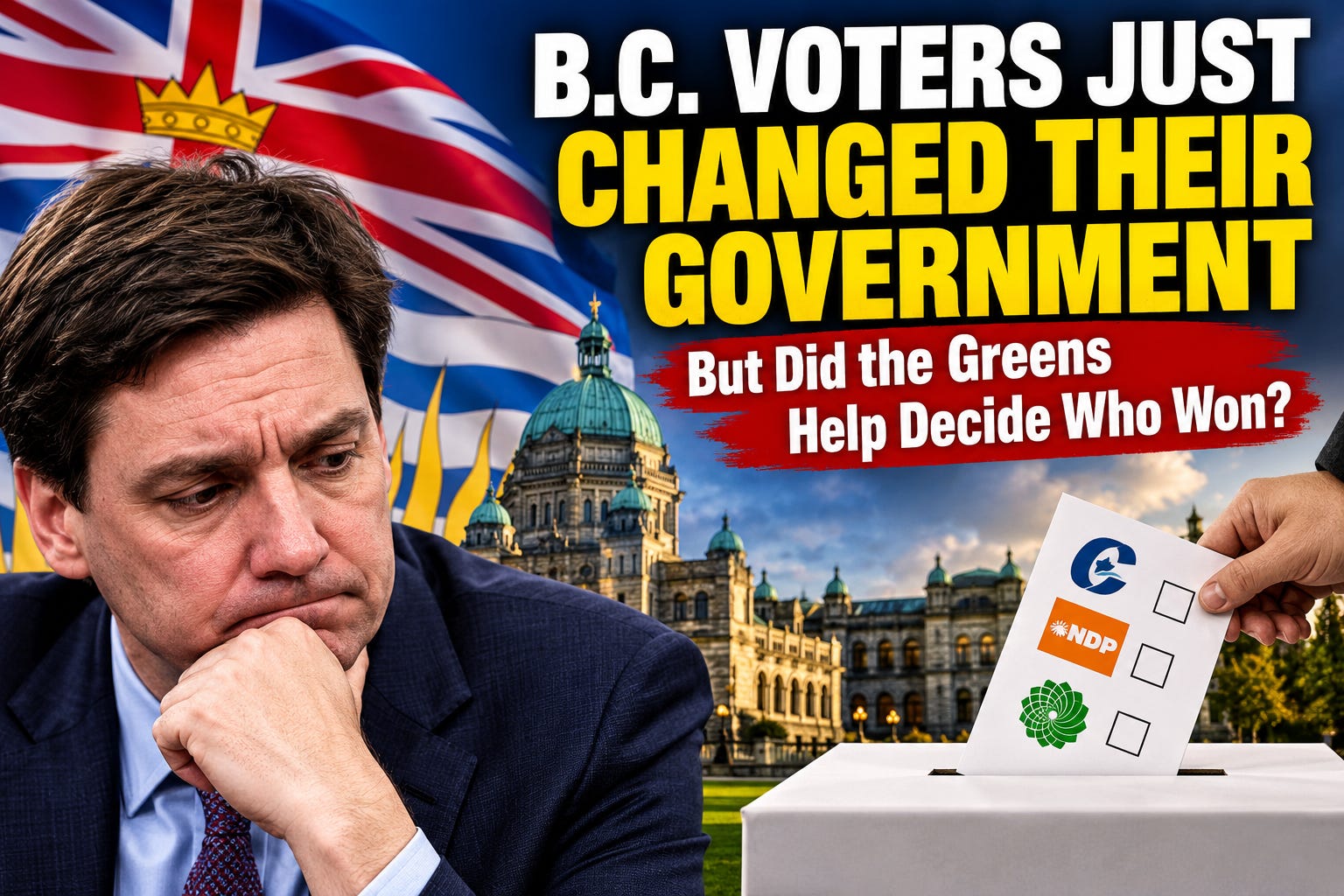
Well, that didn’t go quite the way David Eby planned.
On September 22, the B.C. premier called an election almost two years ahead of schedule.
The Conservatives were fighting among themselves. Their leader had resigned. Their caucus had been fractured. And Eby apparently saw an opportunity to secure another mandate.
Thirty-two days later, he was announcing his resignation as NDP leader.
And British Columbia was preparing for its first Conservative government in nearly a century.
That’s not just losing an election.
That’s taking a political gamble and watching the entire casino change ownership.
The numbers tell quite a story
Saturday’s election gave Lorne Doerkson’s Conservatives a commanding majority.
As of October 25, preliminary results showed the Conservatives leading in 63 of B.C.’s 93 ridings, the NDP in 28, and the Greens in two.
The Conservatives received roughly 48% of the popular vote. The NDP received about 37%, and the Greens nearly 11%.
The final count is scheduled for November 6–10, so some close ridings could still change hands.
But the government isn’t in doubt.
The Conservatives have won.
And here’s where things get interesting.
Nearly 52% of voters supported somebody other than the Conservatives. Yet the Conservatives will control roughly two-thirds of the legislature.
That’s perfectly possible under our electoral system.
But it’s worth understanding how it happens.
The problem isn’t necessarily how people voted
Canada uses what’s called first-past-the-post voting.
It’s simple.
Whoever receives the most votes in a riding wins the seat.
Not necessarily a majority.
Just more than anybody else.
Imagine a riding where the Conservatives receive 43% of the vote, the NDP gets 42%, and the Greens take 15%.
The Conservative wins.
Now, someone will immediately point out that 42 plus 15 equals 57.
And they’re right.
But here’s something else we need to remember.
A Green vote isn’t automatically an NDP vote that wandered into the wrong ballot box.
Some Green voters would support the NDP if their preferred candidate weren’t running. Others might vote Conservative. Some might stay home.
We don’t know without asking them.
Still, when two parties compete for voters with overlapping priorities, the way those votes are divided can change who wins a seat.
And in a close election, a handful of seats can change who governs.
That’s not an opinion.
That’s how the system works.
One Vancouver Island riding tells the story
Look at Ladysmith-Oceanside.
On Sunday, updated results put NDP candidate Stephanie Higginson just 13 votes ahead of Conservative Kris McNichol.
Thirteen votes.
You could fit the margin of victory around a decent-sized dinner table.
The riding had previously shown a Conservative lead, and additional ballots still need to be counted.
That’s how close this election became in some communities.
The Green Party also attracted thousands of votes in the riding.
Does that mean Green voters cost the NDP the seat?
No.
Especially when the NDP was actually leading in the latest preliminary count.
But it does show why people are asking questions about strategic voting.
When the margin between the two leading candidates is measured in dozens of votes, the choices made by supporters of every other candidate can become enormously important.
And voters deserve to understand that before they cast their ballots, not after the results come in.
But let’s not blame the Greens for everything
Here’s where I part company with people who want to pin this entire Conservative victory on the Green Party.
The Conservatives didn’t merely sneak through a handful of close ridings.
They won a substantial lead in the popular vote.
They gained support during the campaign.
And they convinced enough British Columbians that they deserved a change in government.
We can disagree with that decision. We can question their promises. We can worry about what comes next.
But we shouldn’t pretend those voters didn’t exist.
The Conservatives earned approximately 48% of the vote. That’s a substantial electoral achievement.
The NDP lost support where it needed to hold on.
And David Eby called an election he didn’t have to call.
Those facts matter every bit as much as vote splitting.
Perhaps more.
Eby made the gamble. Voters made the decision.
Think about the situation when this election was called.
The Conservatives had just gone through another leadership crisis.
Kerry-Lynne Findlay had resigned, and Lorne Doerkson had stepped in as interim leader.
The party looked vulnerable.
Eby had the option of continuing to govern.
Instead, he called an election.
He argued that British Columbia needed a stronger mandate to confront the economic uncertainty created by Donald Trump’s trade threats.
That’s a legitimate issue.
But British Columbians were also worried about housing, affordability, health care and the cost of living.
And apparently, enough of them decided that changing the government was more important than giving Eby another mandate.
Politicians sometimes forget something rather important.
An election belongs to the voters, not the politician who calls it.
You can choose the date.
You don’t get to choose the result.
Now British Columbians get to see what they voted for
Lorne Doerkson has promised lower taxes, fewer regulations and a major expansion of B.C.’s energy sector.
His party has also pledged to repeal the Declaration on the Rights of Indigenous Peoples Act.
Those are significant policy changes.
They deserve scrutiny, not automatic applause or automatic condemnation.
The Conservatives now have the numbers to govern.
That means they also own the responsibility for what happens next.
Housing doesn’t become affordable because a new premier gives a victory speech.
Health-care wait times don’t disappear because somebody promises to cut red tape.
And expanding energy production comes with real questions about infrastructure, Indigenous rights, environmental protection and who actually benefits.
The campaign is over.
Now comes the hard part.
There’s a bigger Canadian lesson here
I keep coming back to those Green votes.
Not because I think Green voters did anything wrong.
They didn’t.
People have every right to vote for the candidate and party that best represent their values.
But I wonder how many Canadians understand the difference between voting for the party they prefer and voting to influence which party forms government.
Those aren’t always the same decision under first-past-the-post.
And that creates a problem.
A voter can support a party that reflects their beliefs while helping produce an electoral outcome they personally dislike.
Not because their vote was wasted.
Not because they were foolish.
But because our system rewards concentrated support and punishes divided support.
We can argue about whether that’s fair.
We can debate electoral reform.
We can discuss ranked ballots, proportional representation or strategic voting.
But we can’t pretend the mathematics don’t exist.
And we shouldn’t pretend the mathematics tell us what every individual voter wanted, either.
British Columbians have just handed the Conservatives a powerful mandate.
David Eby has paid the political price for calling an election early.
The Greens have kept two seats.
And thousands of voters are probably looking at their local results wondering whether a different choice might have changed something.
Maybe it would have.
Maybe it wouldn’t.
But here’s what I know.
The Conservatives understood they needed to come together to win.
Their opponents went into the election competing for some of the same voters.
And the Conservatives walked away with the government.
That’s a lesson worth remembering well beyond British Columbia.
Because under our voting system, winning the argument and winning the election aren’t necessarily the same thing.
And sometimes the difference determines who runs your province for the next four years.
The Recap…
David Eby called an election two years early. The Conservatives won a commanding majority, and Eby is stepping down as NDP leader.
Now the Green vote is raising questions about whether divided support helped determine the outcome in close ridings.
But vote splitting alone doesn’t explain a province-wide Conservative victory.
The bigger lesson? Under first-past-the-post, how votes are distributed can matter almost as much as how many votes a party receives.
The Gut-Punch…
The Conservatives didn’t need most British Columbians to vote for them. They needed more votes than anyone else in enough ridings.
That’s the system we have.
Whether it’s the system we should keep is another question entirely.
Sources
Election results cited are preliminary as of October 25, 2026. Final counting is scheduled for November 6–10.
If you enjoy thoughtful conversations, Canadian stories, and the occasional smart-ass observation about the world we’re living in, you’re in the right place.
Subscribe free and get new stories, insights, and observations delivered directly to your inbox.
No paywall.
No spam.
No nonsense.
Leave anytime with a single click.
I promise not to take it personally.
Eby made the gamble. Voters made the decision. Something to ponder Eby !