

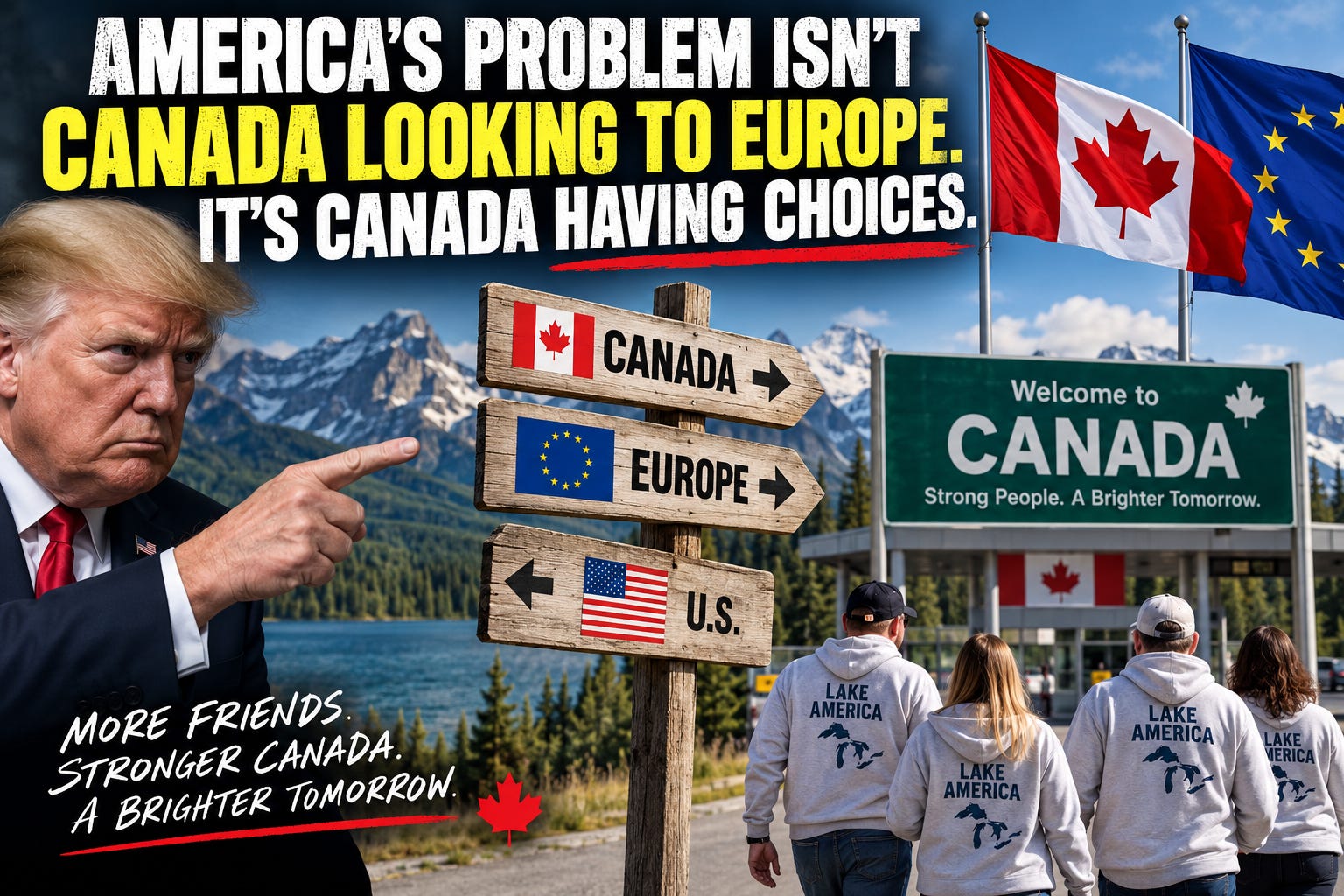
Something happened this week that Canadians should pay attention to.
Not because Donald Trump threatened another tariff.
We’ve heard that song enough times to know the chorus.
The interesting part was what triggered him.
Canada got closer to Europe.
That’s it.
European Commission President Ursula von der Leyen floated the idea of Canada becoming some form of EU “associate member.”
The details are still fuzzy… in fact, no such formal membership category currently exists… but the political message was obvious…
Europe wants a deeper relationship with Canada. (AP News)
Canada said it was interested.
And Donald Trump immediately reached for the tariff gun.
He called the idea “laughable” and said that if he considered it a hostile act, he could impose serious tariffs or even stop trading with Europe on some products. (Investing.com)
Think about that for a minute.
Canada is an independent country.
Europe consists of independent countries.
Canada and Europe decide they might like to work more closely together.
And the President of the United States suggests that could be considered hostile toward America.
That tells me something important about where this relationship has gone.
Canada isn’t asking permission anymore
For decades, Canada built its economy around one enormous advantage…
We lived next door to the richest consumer market on Earth.
It worked.
Maybe a little too well.
Even today, roughly 70% of Canadian exports head south. (AP News)
That was manageable when the relationship was predictable.
Then tariffs became political weapons.
Trade negotiations became threats.
And Trump began publicly talking about Canadian sovereignty while repeatedly suggesting Canada should become part of the United States.
The relationship became something Canada could no longer treat as guaranteed. (Reuters)
So Canada started doing what any sensible business owner would do when one customer represents most of the revenue and suddenly starts threatening him.
Find more customers.
That’s not anti-American.
That’s Risk Management 101.
If Walmart suddenly accounted for 70% of your business and its CEO kept threatening to dump you unless you accepted worse terms, you wouldn’t burn down Walmart.
You’d start calling Costco.
That’s essentially what Canada is doing.
Europe.
Asia.
Mexico.
New defence relationships.
New investment partnerships.
New markets.
Not replacing America.
Reducing the amount of power America has over us.
And apparently that distinction matters.
We’ve heard this attitude before
There’s another reason Trump’s reaction caught my attention.
We’ve seen versions of it coming from American media.
Back in January 2025, Ontario Premier Doug Ford appeared on Fox News with Jesse Watters.
Ford said Canadians were proud Canadians and that our country wasn’t for sale.
Watters responded that if he lived beside the United States, he would consider it a “privilege” to be taken over because everybody supposedly wants American citizenship.
He even told Ford that Canada’s rejection of the idea was personally offensive to him. (Mediaite)
Stop and think about the assumption buried inside that.
Why wouldn’t Canada want to become America?
Why wouldn’t Canadians consider absorption an upgrade?
Why would we object?
Because we’re Canadian, Jesse.
That’s why.
There’s nothing anti-American about wanting your own country to remain your own country.
Just as there’s nothing anti-American about Canada trading with Europe.
Or building ships with Europeans.
Or buying European defence equipment.
Or selling Canadian energy somewhere besides the United States.
That’s called sovereignty.
And then there are the tourists
The video that got me thinking about all this shows four American visitors apparently arriving in Canada wearing shirts referring to “Lake America.”
The source video presents this as another example of the increasingly provocative tone around Canada, although I have not independently verified the circumstances or intentions of those four people.
Maybe they thought it was funny.
Maybe they were trolling.
Maybe they never thought much about it at all.
And that’s actually what interests me.
Because political rhetoric doesn’t stay in Washington.
It leaks.
Politicians repeat something.
Television hosts repeat it.
Social media turns it into memes.
People laugh.
Then somebody puts it on a sweatshirt.
Eventually something that once would have sounded outrageous becomes just another joke.
That’s how political language gets normalized.
It doesn’t require every American to believe Canada should become the 51st state.
Obviously they don’t.
It only requires enough repetition that talking about another country’s sovereignty becomes entertainment.
And Canadians have every right to say…
No thanks.
This isn’t about hating Americans
That’s where I part company with some of the rhetoric in the original video.
I don’t believe four tourists tell us what 340 million Americans think.
I don’t believe Jesse Watters speaks for every American.
And I certainly don’t believe Canadians should start treating ordinary Americans as enemies because their president has turned our relationship into a political punching bag.
Millions of Americans probably think this whole damn thing is ridiculous too.
But something has changed.
Behaviour that Canadians once might have dismissed as political theatre lands differently after months of tariff threats, sovereignty talk and economic pressure.
Context matters.
If your neighbour jokes about stealing your lawnmower once, you laugh.
If he spends eight months standing at the fence explaining why the lawnmower actually belongs to him, the joke starts wearing thin.
Which brings me back to Europe
This may be the most important part.
Canada doesn’t need to choose between America and Europe.
That’s the wrong frame entirely.
We should trade with America.
We should trade with Europe.
We should trade with Asia.
We should trade with Mexico.
We should sell Canadian products wherever somebody wants to buy the bloody things.
That’s what sovereign countries do.
Prime Minister Mark Carney has been pursuing exactly that diversification strategy as relations with Washington deteriorated.
Canada’s exports to non-U.S. markets rose significantly in 2025, although America remains by far our largest trading partner. (Le Monde.fr)
And Europe isn’t exactly dragging Canada kicking and screaming toward the door.
Von der Leyen publicly proposed exploring a new relationship.
Canada welcomed the conversation.
There are plenty of details to negotiate, and European governments themselves aren’t yet united on exactly what an “associate” arrangement should mean. (AP News)
Good.
Negotiate them.
That’s what grown-up countries do.
The strange part is Washington’s reaction
If the United States wants Canada to remain its closest economic partner, there’s a remarkably simple way to accomplish that.
Be a reliable partner.
Offer good deals.
Respect Canadian sovereignty.
Make American markets attractive.
Compete for Canadian business.
That’s how friendships work too.
You don’t keep a friend by threatening him every time he talks to somebody else.
And you certainly don’t strengthen a relationship by telling him he’s lucky you haven’t swallowed his house.
Canada didn’t suddenly wake up one morning and decide America was irrelevant.
America remains enormously important to us.
Probably always will.
But Canada has learned something valuable over the last couple of years.
There’s a difference between having a partner and having a dependency.
Partners give you choices.
Dependency takes them away.
Canada is building choices.
And judging by the reaction from Washington...
that may be exactly why we need them.
The Recap…
Canada gets closer to Europe.
Trump threatens Europe with tariffs.
Apparently Canada having other friends is now potentially a “hostile act.”
That might be the best argument yet for Canada making damn sure it has other friends.
The Gut-Punch…
If somebody gets angry when you become less dependent on them, maybe your dependence was the part they liked.
Source Credit:
The source transcript was “SHOCKING: American Tourists Mock Canada At The Border.” I used it as research material for the incidents and quotations discussed here, then independently checked several of the central public claims. The transcript itself argues that disrespectful political leadership and public behaviour reinforce one another; this article deliberately takes a narrower route, focusing on sovereignty, diversification and Canada’s right to build relationships beyond the United States.
If you enjoy thoughtful conversations, Canadian stories, and the occasional smart-ass observation about the world we’re living in, you’re in the right place.
Subscribe free and get new stories, insights, and observations delivered directly to your inbox.
No paywall.
No spam.
No nonsense.
Leave anytime with a single click.
I promise not to take it personally.
Your last sentence, Fred, just said it all! It’s really easy to be, and to become, dependent. And we seriously got lulled into a somnambulant state. So thankful Mark Carney saw the danger and came forward to serve! 🇨🇦 I suspect he’d been watching it building for quite some time. For me, it explains the speed with which we experienced the paradigm shift he’s enacted, and the speed with which he’s been putting it together, carving out our new path forward. As I said, I think not here. If so, I apologise for being repetitive. It just occurred to me listening, seeing and reading over the last week or so, that what our Prime Minister is doing is reaching way over and beyond partisan politics. He said that the goal is a just society for everyone. And that’s exactly what he’s working toward. That’s pretty nonpartisan in my opinion.
Patsy is spot on - have read your last 2 post tonight, both full of clear fact and as usual feel I have positive thoughts to mull around before bed time.