

There’s a number most people never look at.
No headlines. No screaming politicians. No cable-news fistfights.
Just a number.
And right now, that number is waving a giant red flag over the American economy.
I’m talking about long-term bond yields.
Yeah, I know. Sounds boring enough to cure insomnia.
But stay with me for a minute because this matters more to your future than half the political theatre people spend their days rage-sharing online.
Here’s the plain-English version…
When governments need money, they borrow it.
A lot of it.
And when investors start getting nervous, they charge more to lend.
That’s exactly what appears to be happening in the United States.
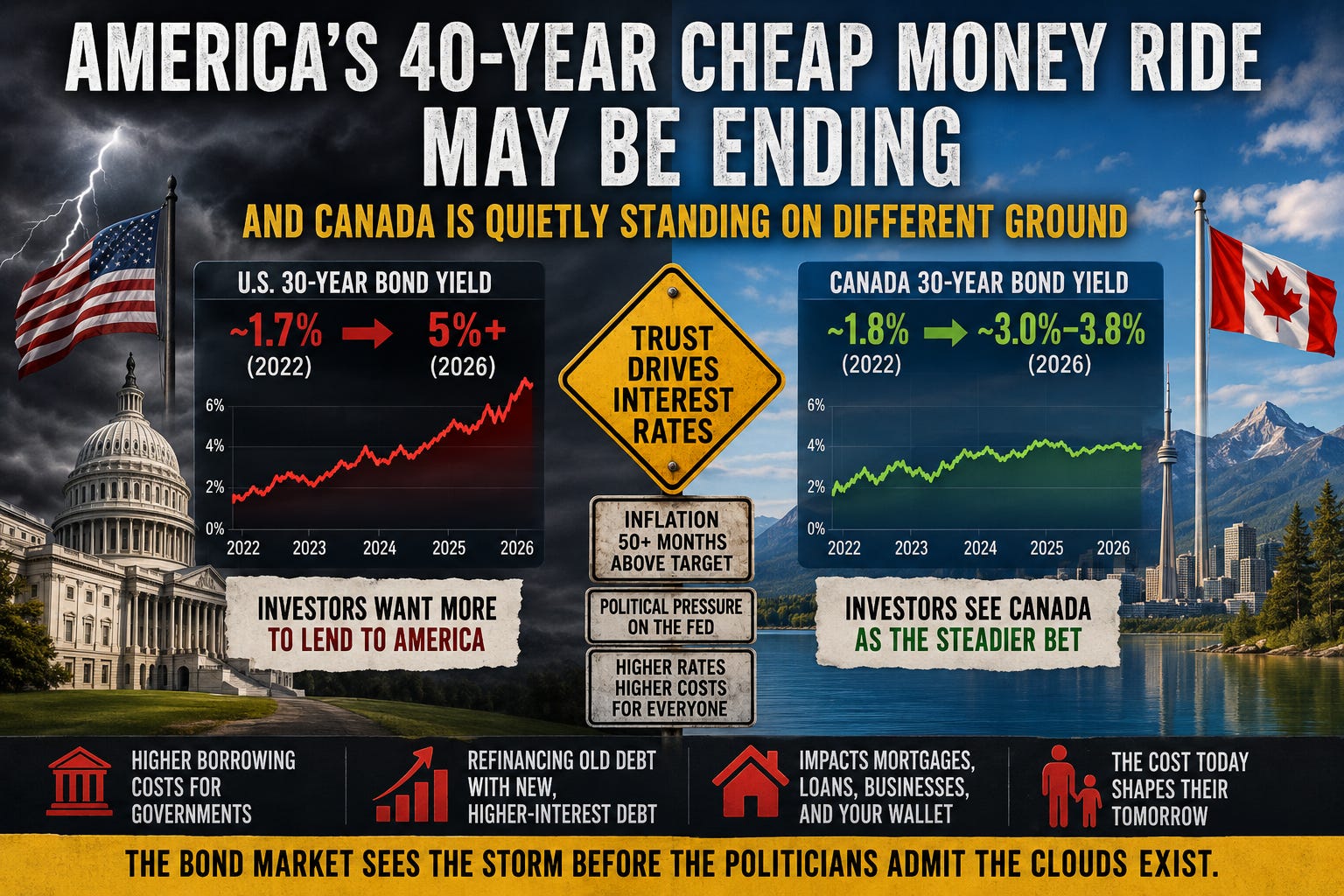
Back in 2022, America could borrow for 30 years at roughly 1.7%.
Today?
That number has pushed above 5%.
That’s not a bump.
That’s a warning shot.
Meanwhile, Canada?
Our long-term borrowing costs climbed too… because nobody lives in an economic bubble… but Canada stabilized closer to the mid-3% range instead of continuing the climb.
And that gap matters.
A lot.
Because bond markets don’t care about campaign slogans.
They don’t clap at rallies.
They don’t wear hats.
They don’t argue online.
They look at math.
Cold, unforgiving math.
And the math says investors increasingly want a bigger reward for lending money to Washington.
That usually means one thing…
Risk.
The Quiet Problem Nobody Wants to Talk About
Most people think inflation is the problem.
It isn’t.
Inflation is the symptom.
The real problem is trust.
Or more accurately…
the slow erosion of it.
For over four years now, U.S. inflation has stayed stubbornly above the Federal Reserve’s 2% target.
Wholesale inflation has remained elevated, consumer prices still sit well above where policymakers want them, and investors are starting to wonder if America has become addicted to spending money it can’t easily control.
That’s where bond yields come in.
Think of it like this…
If your cousin keeps borrowing money and never really gets his act together, eventually you stop lending for cheap.
You still lend…
But suddenly you want protection.
Maybe higher interest.
Maybe collateral.
Maybe both.
Countries work the same way.
Investors aren’t saying America is broke.
They’re saying…
“We trust you less than we used to.”
That’s a very different sentence.
And a far more dangerous one.
The 40-Year Party May Be Over
For roughly four decades, governments got used to falling interest rates.
From the early 1980s onward, borrowing got cheaper and cheaper.
Debt piled up because, frankly, cheap debt feels painless.
Why not spend more if borrowing barely costs anything?
Politicians loved it.
Markets loved it.
Consumers loved it.
Everyone got used to cheap mortgages, cheap financing, cheap everything.
Then came the post-2020 world.
Inflation returned.
Hard.
And suddenly the old rules stopped working.
What worries economists isn’t just higher rates.
It’s the possibility that we’ve entered an entirely new era… one where borrowing stays structurally expensive for years.
If that happens?
Governments everywhere have a problem.
Because old debt eventually comes due.
And when it does, you refinance it at today’s rate, not yesterday’s.
That means replacing cheap debt with expensive debt.
Over.
And over.
And over again.
Like paying off a low-interest credit card using a much uglier one.
Eventually the interest bill becomes the story.
Why Politics Could Make This Worse
Now here’s the part that should make people uncomfortable.
Central banks are supposed to stay independent.
Their job is to make unpopular decisions when needed.
Raise rates.
Slow inflation.
Protect the currency.
Sometimes that means making politicians angry.
Too bad.
That’s the point.
But political pressure is growing in the U.S. to lower rates…
even while inflation risks remain elevated.
And whenever politics starts leaning too heavily on central banking, markets tend to notice.
Because if investors believe interest-rate decisions are becoming political instead of economic?
Trust erodes faster.
And trust, in finance, is everything.
Lose enough of it and lenders start charging insurance premiums.
That’s essentially what higher bond yields are.
A price for uncertainty.
Canada’s Quiet Advantage
This is where Canada quietly enters the picture.
We’ve got our own problems.
Housing affordability.
Debt.
Weak productivity.
Pick your headache.
But investors still appear more comfortable lending to Canada at lower long-term rates than the U.S. right now.
That doesn’t make us smarter.
It doesn’t make us invincible.
It simply suggests markets currently see Canada as a steadier bet.
And in a nervous world, steady suddenly becomes attractive.
Especially when the neighbour next door looks like they’re arguing with the steering wheel while driving.
The Bigger Question
This story isn’t really about bond traders.
Or inflation charts.
Or central bankers.
It’s about what happens when confidence starts slipping.
Because confidence is invisible…
Right up until it isn’t.
Cheap money built much of the modern economy.
Governments borrowed freely.
Businesses expanded.
Consumers financed homes, cars, and lives around low interest rates.
If that era is ending?
The adjustment will touch everything.
Mortgages.
Prices.
Government spending.
Taxes.
Retirement plans.
Even what future generations can realistically afford.
And here’s the uncomfortable truth…
Bond markets usually see the storm before politicians admit the clouds exist.
The Recap…
There’s a number quietly flashing warning lights over the U.S. economy… and most people have never heard of it.
America’s borrowing costs are climbing.
Canada’s are steadier.
And the real story isn’t inflation.
It’s trust.
The Gut-Punch…
Cheap money made a lot of bad decisions look smart.
But when lenders stop trusting the math, the bill eventually arrives.
And bond markets?
They don’t care who wins elections.
They care who can still pay.
Source Credit:
Research notes compiled from economic reporting, bond market data, inflation trends, and central banking analysis provided in source materials. Figures referenced include long-term U.S. and Canadian bond yield movements, inflation persistence, and monetary policy developments.
🔎 The GeezerWise Standard
This space is built on disciplined thinking.
Facts over spin.
Verification before amplification.
Good-faith discussion over tribal noise.
I use AI tools to help shape my spoken drafts into clear writing.
The judgment, conclusions, and final message are mine.
If you’re new here, this explains how I decide what’s worth sharing:
How I Decide What’s Worth Sharing → [link]
💌 Subscribe at GeezerWise.com to receive future letters:
www.geezerwise.com/subscribe
— Fred Ferguson
GeezerWise
#CanadaStrong
I remember a post when I pointed out that. The markets long for stability and relaiability, excactly that destroyed Trump by his erratic and incomperent policy on all fields. The US influence is already vanishing and it gets harder every day they let that mental heavy sick grandpa in office.
This is a very significant statistic and your statement is clear. It would be even more if you inserted your statistical source. Did not this international lack of trust also have a related effect on the worth of the AMERICAN Dollar?