

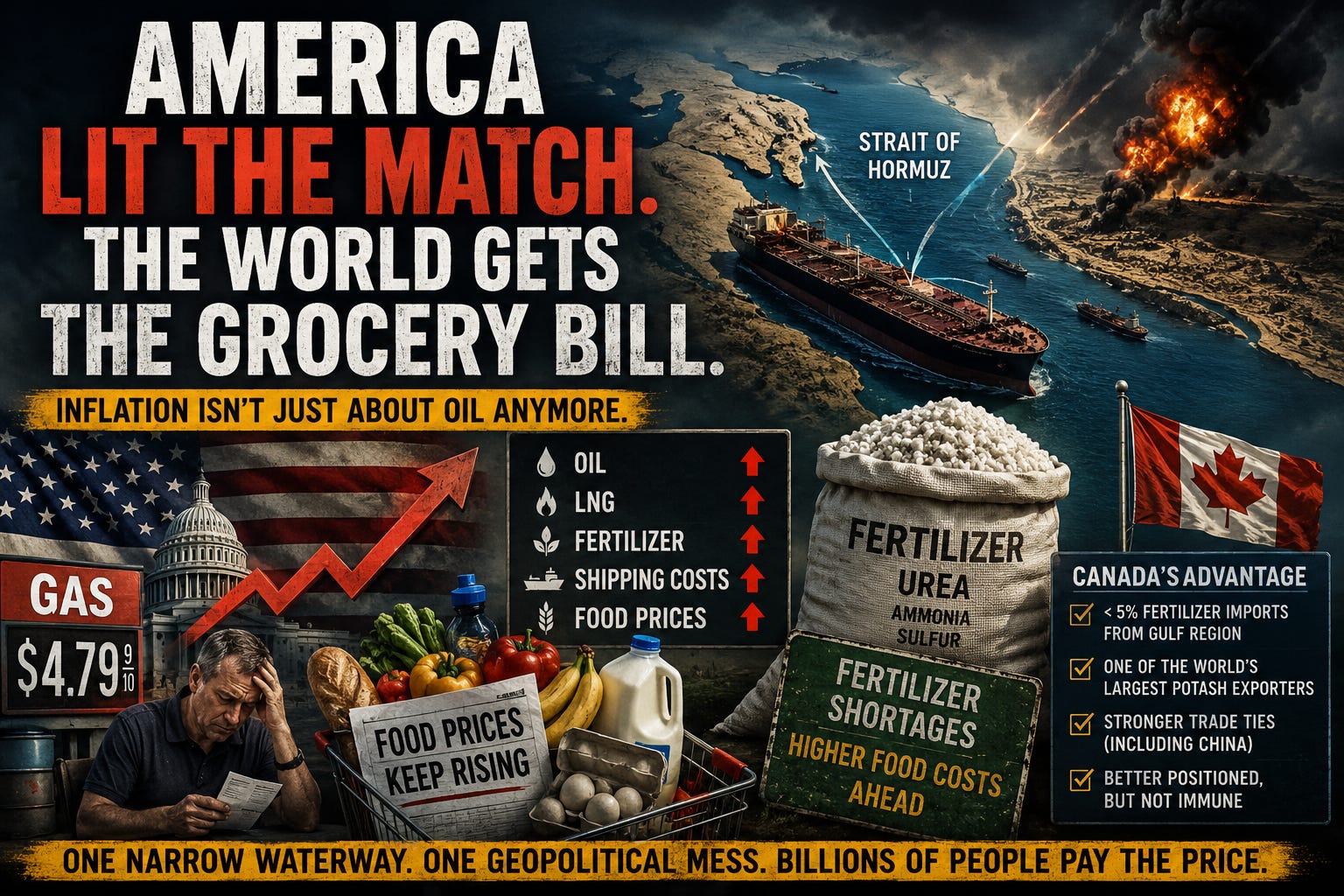
The average person still thinks inflation is mostly about gas prices.
It isn’t.
Gas is just the thing people notice first because the numbers are glowing at them from a giant sign beside the highway.
But the real damage starts deeper in the system — fertilizer, shipping routes, supply chains, interest rates, food production, transport costs. The plumbing underneath modern life.
And right now, one narrow strip of water beside Iran is quietly reminding the planet how fragile the whole machine really is.
The Strait of Hormuz handles roughly 20% of the world’s oil supply, about 20% of liquefied natural gas, and massive amounts of fertilizer components moving into global agriculture markets. Around a third of global sulfur, ammonia, and urea shipments move through that corridor.
That matters because fertilizer isn’t optional.
You can delay buying a new car.
You can skip a vacation.
You can cut Netflix.
You cannot negotiate with crops.
Food either grows or it doesn’t.
And suddenly the world is realizing how many critical products move through one geopolitical choke point sitting right beside a country that just got bombed.
That tends to complicate shipping schedules.
The United States is already feeling it.
American inflation reportedly surged again in April, driven heavily by energy costs and broader supply pressures. The middle class there was already getting squeezed by tariffs and rising import costs before this latest mess even started.
Now add war-risk shipping premiums, disrupted transport routes, fuel spikes, fertilizer uncertainty, and the possibility of longer-term inflation sticking around far longer than central banks hoped.
That’s where this starts turning ugly.
Because once inflation gets embedded again, central banks get trapped.
If prices keep climbing, interest rates may have to stay higher longer — or even rise again.
Which is exactly the scenario people thought they escaped after the 2022 inflation shock.
Higher borrowing costs.
Higher mortgage pressure.
Higher food costs.
Higher transport costs.
Same movie. Different season.
And here’s the part almost nobody is talking about properly:
Canada is exposed…
but not equally exposed.
That distinction matters.
Canada imports less fertilizer from the Gulf region than the United States or Mexico.
Reports suggest Canada gets under 5% of its fertilizer exposure from that region, while the United States and Mexico rely far more heavily on imports moving through Hormuz-linked supply chains.
Canada also happens to be one of the world’s largest potash exporters.
Meaning the very thing becoming more scarce globally is something Canada already produces in massive quantities.
That doesn’t magically protect ordinary Canadians from inflation. We still import plenty of food and consumer products tied to U.S. pricing pressure.
But structurally?
Canada is standing on slightly firmer ground than some other countries right now.
That’s a very different thing than “everything is fine.”
It isn’t fine.
If inflation starts accelerating globally again, Canadians will absolutely feel it.
Groceries.
Fuel.
Shipping costs.
Construction.
Interest-sensitive industries.
Nobody escapes completely when the global system starts coughing blood.
But Canada does have a few cushions the Americans currently don’t.
And one of them came from trade strategy.
While Washington was busy tariffing half the planet like an angry casino owner banning winners from the blackjack table, Canada quietly stabilized parts of its agricultural export relationship with China.
That matters more than people realize.
Because when global instability rises, countries that maintain diversified trade relationships tend to absorb shocks better than countries trying to economically fistfight everyone at once.
The Americans are now discovering something painful…
You can’t simultaneously launch trade wars, pressure allies, destabilize shipping lanes, and demand lower inflation.
Reality eventually sends an invoice.
And now the geopolitical side gets even messier.
Before this conflict escalated, the Strait of Hormuz stayed open largely because everyone understood the consequences of disrupting it.
Iran depended on it too.
The deterrent worked both ways…
“Don’t shut this down or the world retaliates.”
Now the logic has flipped.
Iran has already absorbed attacks.
The retaliation phase already happened.
Which means the old deterrent structure doesn’t operate the same way anymore.
Now the threat is aimed outward:
“Cross here at your own risk.”
And that alone changes global shipping behaviour.
You don’t need every tanker attacked.
You just need enough uncertainty to make insurers panic, shipping costs spike, and captains rethink routes.
Fear itself becomes economic pressure.
That’s how modern instability works.
Not always through explosions.
Sometimes through hesitation.
A delayed shipment here.
An insurance spike there.
A fertilizer shortage six weeks later.
Food inflation three months after that.
The average citizen only notices the final price tag at Walmart.
But the dominoes started falling long before that.
And politically?
This is going to become a giant blame game.
If prices rise in Canada, opposition politicians will scream that Ottawa broke the economy.
If prices rise in the United States, politicians there will blame oil producers, foreign governments, central banks, immigrants, weather, or whichever scapegoat polls best that week.
Meanwhile the actual problem is much bigger…
The global economic system was already overstretched before geopolitical instability got poured on top of it like gasoline on a campfire.
Now everybody’s pretending they’re surprised the flames got taller.
The really uncomfortable truth?
The modern world built itself around ultra-efficient global supply chains that only work when adults are running the room.
And lately…
that assumption feels increasingly optimistic.
The Recap…
Most people think inflation starts at the gas pump.
It doesn’t.
It starts deep inside shipping lanes, fertilizer markets, supply chains, and geopolitical stupidity.
One narrow waterway beside Iran now affects oil, food, fertilizer, and the price of everyday life across the planet.
And once inflation starts spreading through the system again?
Everybody gets poorer slower… then suddenly.
The Gut-Punch…
The world economy isn’t breaking because one thing failed.
It’s breaking because too many powerful people treated global stability like a casino game… and forgot ordinary families are the ones forced to pay the tab afterward.
Source credit: Transcript provided by user and treated as research material only.
Source Credit…
Research and factual reference material derived from a public commentary transcript discussing U.S. inflation, Strait of Hormuz supply chain risks, fertilizer dependency, and Canada’s economic positioning during escalating Middle East tensions.
🔎 The GeezerWise Standard
This space is built on disciplined thinking.
Facts over spin.
Verification before amplification.
Good-faith discussion over tribal noise.
I use AI tools to help shape my spoken drafts into clear writing.
The judgment, conclusions, and final message are mine.
If you’re new here, this explains how I decide what’s worth sharing:
How I Decide What’s Worth Sharing → [link]
💌 Subscribe at GeezerWise.com to receive future letters:
www.geezerwise.com/subscribe
— Fred Ferguson
GeezerWise
#CanadaStrong
Very well said Fred! And yes, the political blame game has already begun, it doesn't even have to make sense for some people to toss it out there! I told one person they needed more education! I know, may have lowered my standards, but, it's out there now LOL When someone insults others' intelligence so badly, it's difficult to be quiet.
Trump can claim the winning trifecta with the attack on Iran!
Politically he's guaranteed the vote of the evangelicals by supporting Israel. Those folks are pretty convinced that the second coming and Armageddon can't happen until Israel controls the Middle East. Attacking Iran was a big step toward the Apocalypse.
Financially he guaranteed the augmentation of his fortune with investments made based on market changes responding to his on again, off again peace agreements, blockades and general fumblings. Here we have history's biggest grift, enacted by the world's most successful con man!
Emotionally he got to pound his flabby chest as the might of the U.S. military was displayed for the world to see. This would ensure that all those supposed allies would know who was the biggest cheese in the world, if they couldn't tell by his bronzing.
As to inflation and the fate of the people, he's made it clear that he doesn't really think about it. It doesn't affect him; his needs are met by the government and Ronny McD.
All this on top of his national tax scheme through tariffs! He must be tired of winning by now.