

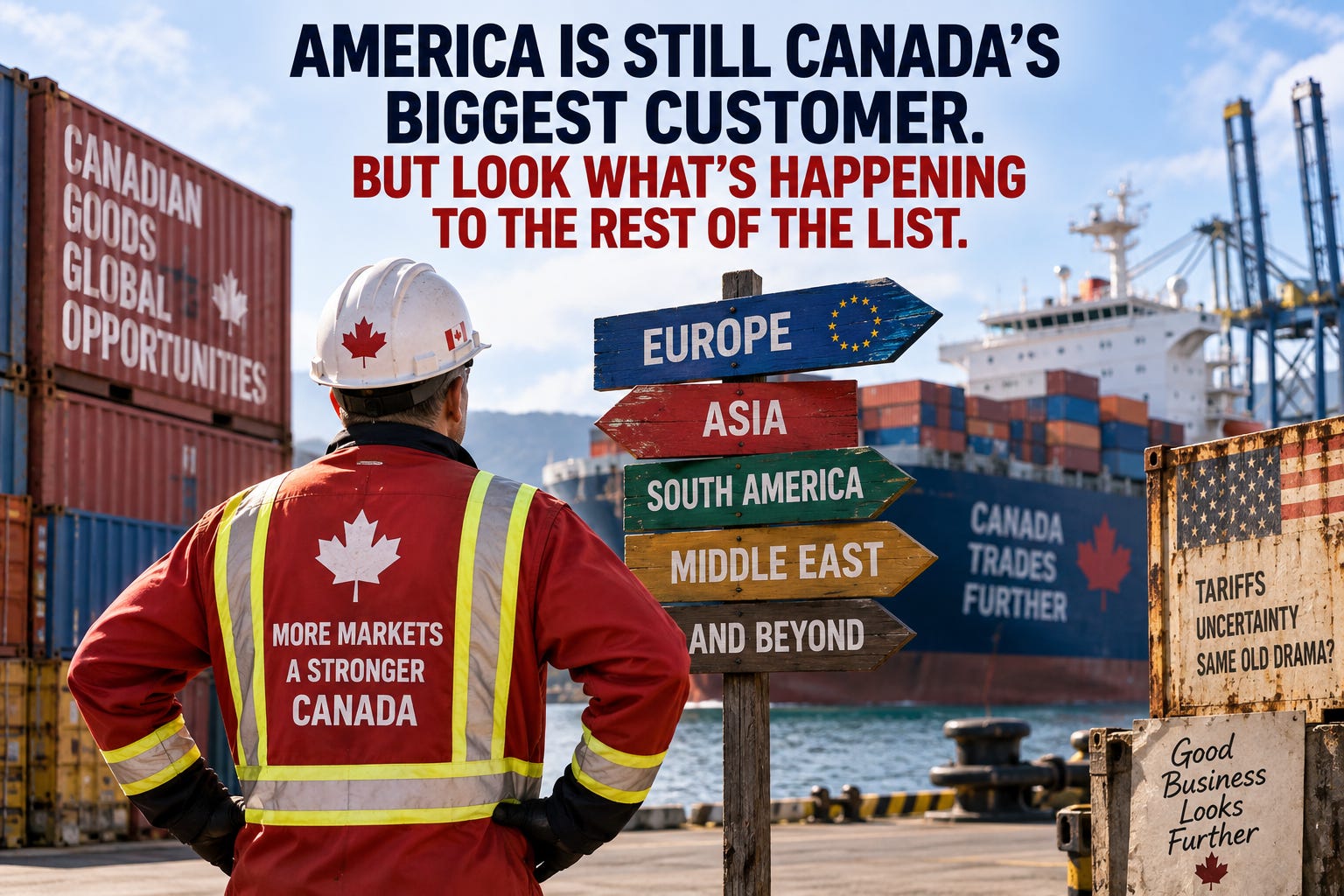
I found a number buried in the latest Canadian trade figures that deserves a hell of a lot more attention.
$25.6 billion.
That’s how much merchandise Canada exported to countries other than the United States in July.
It was an all-time record.
And suddenly this whole argument about Canada diversifying its trade gets a lot less theoretical.
We’re actually doing it.
According to Statistics Canada’s July trade report, exports outside the United States jumped 7.4% in a single month and reached $25.6 billion.
For the month, 33.7% of Canadian merchandise exports went somewhere other than the United States.
Now, before somebody gets carried away and declares that Canada has replaced the American market, we haven’t.
Not remotely.
The United States remains our largest customer by a country mile. Geography alone makes that relationship enormously valuable.
But that isn’t the interesting part anymore.
The interesting part is the direction we’re moving.
And we’ve been moving for a while.
Statistics Canada looked at the full year of 2025 and found something remarkable.
Canadian exports to the United States fell by $29.4 billion.
Exports to countries outside the United States rose by $27.6 billion.
Some of that increase came from precious metals, especially gold. But even after removing gold, silver and platinum-group metals from the calculation, non-U.S. exports still increased by $14 billion.
That’s not Canada replacing America.
That’s Canada discovering it has other phone numbers.
Aluminum showed us how fast things can move
This one is especially interesting because tariffs were supposed to give Washington leverage over Canadian aluminum.
Instead, Canadian metal started heading across the Atlantic.
Statistics Canada reported that exports of unwrought aluminum and aluminum alloys jumped 50.7% in May, driven largely by shipments to the Netherlands, Italy and Greece. They reached $1.2 billion that month.
Reuters later reported that Canadian aluminum exports to Europe had risen 276% in 2025, while shipments to the United States fell 25%. European shortages and higher prices also helped make that shift possible.
That’s an important distinction.
Canada didn’t suddenly become brilliant at diversification because somebody in Ottawa discovered a map.
Markets changed.
Tariffs changed the economics of selling into the United States.
Europe needed aluminum.
Canadian producers found buyers.
That’s what businesses do.
And once you’ve gone to the trouble of building those relationships, some of them tend to stick around.
Then I looked at what else Canada has been doing
On July 24, Canada signed a free-trade agreement with Ecuador.
That wasn’t a gigantic deal by itself.
But Ecuador completes Canada’s free-trade coverage along the Pacific coast of South America.
Then, on that same day, Canada and the United Arab Emirates announced they had concluded negotiations on a Comprehensive Economic Partnership Agreement designed to expand trade and investment between the two countries.
Europe is another matter entirely.
Canada already has CETA with the European Union, but the relationship is now being pushed considerably further.
Reuters reported this month that Prime Minister Mark Carney is pursuing deeper Canadian integration with Europe across defence, energy, critical minerals, research and other areas.
Canada is still heavily dependent on the American market, which is precisely why diversification has become such a strategic issue.
And that brings me back to that $25.6-billion number.
Because governments can announce trade missions until everybody falls asleep.
They can sign agreements.
They can shake hands.
They can issue communiqués nobody outside Ottawa reads.
Eventually I want to see the goods moving.
They’re moving.
Canada’s economy grew 0.8% in the second quarter of 2026.
Exports of goods and services rose 3.6% … the fastest quarterly increase in more than three years.
Passenger vehicle exports rebounded strongly. Energy exports increased. Metal products increased. Machinery and equipment increased.
That doesn’t mean everything is rosy.
July’s overall merchandise exports actually fell 2.3%, largely because of lower energy and metal exports.
Canada’s trade surplus dropped from $4.2 billion in June to $769 million in July.
Those numbers matter too.
But underneath them was something I find much more interesting:
Exports to the United States fell 6.6%.
Exports everywhere else rose 7.4%.
And non-U.S. exports set a record.
There’s the story.
Not “Canada doesn’t need America.”
That’s nonsense.
We do.
And America benefits enormously from Canada too.
The lesson is simpler.
For decades Canada built an economy around the convenience of having the world’s largest economy sitting next door.
Hard to blame us.
If you’ve got a gigantic customer living across the street, why haul your stuff halfway around the planet?
But convenience eventually became dependence.
And dependence works beautifully right up until the dependable part disappears.
That’s what changed.
Canada has learned that access to the American market can become a political bargaining chip.
So we’re doing what any business owner with half a brain would do after watching one customer become unpredictable.
We’re building the customer list.
Europe.
Asia.
South America.
The Middle East.
Not instead of America.
In addition to America.
That’s the part Washington may eventually regret.
Tariffs were supposed to create leverage.
But if they persuade Canadian companies and Canadian governments to spend the next decade finding other customers, building other supply chains and signing other agreements, something else happens.
The leverage starts shrinking.
One customer can push you around when they’re responsible for almost everything you sell.
It’s considerably harder when you’ve got options.
Canada doesn’t have enough options yet.
But for the first time in a very long time, we’re seriously building them.
And now the trade numbers are starting to show it.
The Recap…
Canada exported a record $25.6 billion in goods to countries outside the United States in July.
Non-U.S. exports jumped 7.4% in one month.
America is still our biggest customer.
But it isn’t the only number in Canada’s phone anymore.
The Gut-Punch…
Washington wanted more leverage over Canada.
Instead, it gave Canada a very expensive lesson in why depending on one customer is dangerous.
We appear to have learned it.
Source credit
Research independently verified using Statistics Canada trade and GDP releases, Global Affairs Canada material on the Canada-Ecuador FTA and Canada-UAE CEPA, and Reuters reporting on Canadian aluminum exports and Canada-Europe relations.
If you enjoy thoughtful conversations, Canadian stories, and the occasional smart-ass observation about the world we’re living in, you’re in the right place.
Subscribe free and get new stories, insights, and observations delivered directly to your inbox.
No paywall.
No spam.
No nonsense.
Leave anytime with a single click.
I promise not to take it personally.
This is very reassuring, thanks for identifying these trends. The human tornado that is our Prime Minister is also. My new car battery abruptly failed last week,which meant I had no brakes at all( how is it legal that the electronic Emergency Brake is allowed to fail?!) and I park on a slope heading to both traffic and the open Atlantic. Not only would the car not start or respond but started to roll backwards. Some how wobbly old me managed to hard wrench the 3000 lb car around in a big curve until it braced against a curb til the tow truck came. It was terrifying and exhilarating when it finally responded, can t help but see an analogy.