

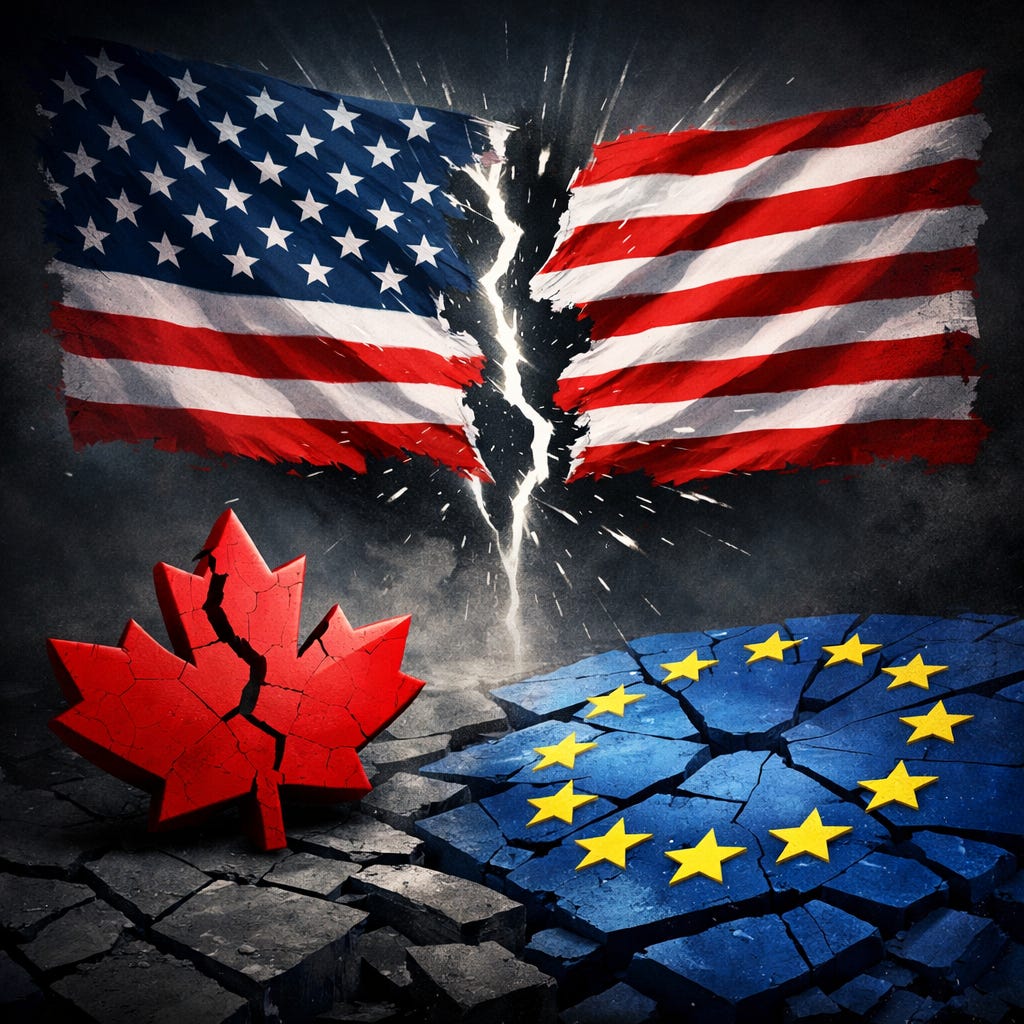
There’s a moment in any negotiation when you realize the other side isn’t playing by the same rulebook.
That moment just happened.
On February 20, the U.S. Supreme Court ruled… 6–3 …that the global tariffs imposed under emergency powers were illegal.
The law being used was never meant for trade wars. It was meant for genuine national crises.
Normally, that would end the story.
Instead, within hours, a new 10% global tariff then 15% was announced under a different legal authority.
Same policy. New paperwork.
If you’re Canada or the European Union, that’s not just frustrating… it’s alarming.
Because the issue isn’t tariffs anymore.
The issue is whether agreements with the United States mean anything if they can be rewritten overnight.
Canada’s Reaction Was Polite… But Blunt
Canada’s trade minister made it clear the ruling supported Canada’s long-standing position that the tariffs were unjustified.
Translation… we told you this wasn’t legal.
But Ottawa also warned businesses the fight isn’t over.
Steel, aluminum, autos… sectors already under pressure… still face uncertainty because new mechanisms can simply replace old ones.
Ontario’s premier called the decision a victory.
The Canadian Chamber of Commerce responded more cautiously… expect new tools to be used.
That’s the difference between politics and business reality.
Companies don’t care who wins a legal argument.
They care whether the rules will still exist tomorrow.
Europe’s Alarm Bells Are Louder
The European Union called an emergency meeting to reassess its trade relationship with the U.S.
Eight European countries issued a joint warning about a potential downward spiral in transatlantic relations.
The EU had already frozen parts of a trade agreement earlier after geopolitical tensions. Now they’re reconsidering whether moving forward even makes sense.
Here’s the real question behind the diplomacy…
How do you negotiate with a government if court rulings don’t actually constrain policy?
That’s not an insult.
It’s risk management.
The Money Behind the Chaos
Tariffs aren’t just politics. They’re revenue.
The United States collected roughly $287 billion in tariff income in 2025… nearly triple the previous year.
More than $130 billion of that came from the now-invalidated measures.
If that revenue disappears, it creates a massive budget hole.
So replacement tariffs appeared immediately.
From a financial perspective, the behaviour is predictable.
Governments protect revenue streams.
But from a credibility perspective, it’s devastating.
Deals Are Suddenly Worth Less
Countries like the UK, EU, India, and Japan spent months negotiating tariff terms.
Now they face a universal baseline rate anyway.
If negotiations don’t change outcomes, why negotiate?
That’s how trust erodes.
Not with dramatic speeches… but with quiet math.
The Legal Mess Isn’t Over
The Supreme Court didn’t resolve what happens to the billions already collected under illegal tariffs.
Businesses may have to sue individually to recover money.
That means years of litigation uncertainty while new tariffs continue.
Imagine paying a tax declared unlawful… and being told to fight for refunds case-by-case.
That’s not stability.
That’s friction.
Why Canada and Europe Are Really Concerned
This isn’t about tariff percentages.
It’s about predictability.
Trade agreements rely on three assumptions…
Laws matter
Courts matter
Commitments last
When those assumptions weaken, risk increases everywhere.
Europe already has retaliatory measures worth about $93 billion prepared.
Canada faces a major North American trade agreement review later this year.
Both are now negotiating with a partner that just demonstrated it has multiple ways to bypass constraints.
That changes strategy.
The Bigger Shift
Allies aren’t panicking.
They’re adapting.
Expect…
More trade diversification away from the U.S.
More regional alliances
More contingency planning
Slower negotiations with Washington
Not because they want conflict.
Because uncertainty is expensive.
And markets hate uncertainty more than they hate tariffs.
The Real Damage
The most important loss here isn’t money.
It’s credibility.
When the world’s largest economy looks unpredictable, everyone adjusts their behaviour.
Quietly.
Systematically.
And sometimes permanently.
The Recap…
The Supreme Court ruled U.S. tariffs illegal.
Hours later, new tariffs appeared anyway.
Canada and Europe aren’t celebrating… they’re questioning whether agreements with Washington still mean anything.
This story is bigger than trade.
It’s about trust.
The Gut Punch…
“When rules stop constraining power, partners stop trusting agreements.”
Source Credit:
Source: Analysis based on international trade statements, government releases, and reporting summarized from geopolitical coverage by House of EL
🔎 The GeezerWise Standard
This space is built on disciplined thinking.
Facts over spin.
Verification before amplification.
Good-faith discussion over tribal noise.
I use AI tools to help shape my spoken drafts into clear writing.
The judgment, conclusions, and final message are mine.
If you’re new here, this explains how I decide what’s worth sharing:
How I Decide What’s Worth Sharing → [link]
💌 Subscribe at GeezerWise.com to receive future letters:
www.geezerwise.com/subscribe
— Fred Ferguson
GeezerWise
#CanadaStrong
Thanks Fred, great article that doesn’t make any sense: Reduce government income by not collecting taxes on the ppl who have money. Raise government income by collecting taxes on the ppl who don’t. Enrich corporations, bankrupt the poor.
Two classes:
Elites vs Wage Slaves
DJT has always been a liar and why any country would believe what he says boggles my mind. He’s always been up front that laws don’t apply to him so ALL countries with any kind of “agreement “ MUST reconsider what is best for their country! SAD, SAD, SAD, 🤬🤬🤬