

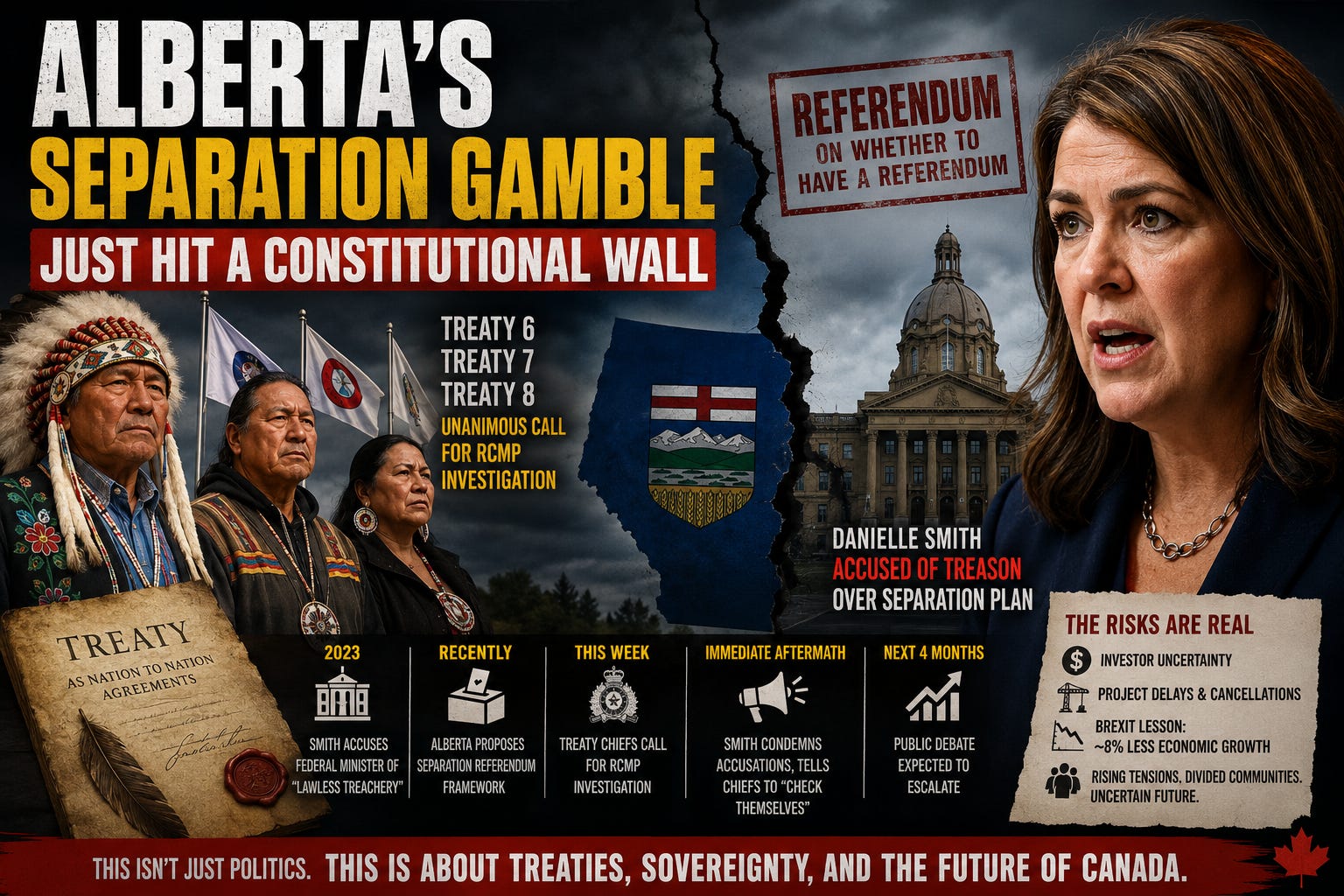
For years, Alberta separation lived mostly on bumper stickers, Facebook groups, and the occasional angry coffee-shop debate.
Not anymore.
This week, Chiefs representing Treaties 6, 7, and 8 unanimously called for the RCMP to investigate Premier Danielle Smith and her government’s actions surrounding Alberta’s proposed separation referendum framework.
That is not a minor political disagreement.
That’s a constitutional collision.
The Chiefs argue that any attempt to move Alberta toward separation would directly affect treaty relationships, constitutional obligations, and Canada’s sovereignty.
In their view, this is not simply a provincial political exercise. It touches agreements that predate Alberta itself.
Smith rejected the accusations immediately, calling them inappropriate and offensive.
And there lies the first irony.
Back in 2023, Smith herself accused a federal cabinet minister of “lawless treachery” during a dispute over federal environmental policies.
Apparently, accusations about loyalty to the country are acceptable when directed at Ottawa, but become outrageous when aimed back at Edmonton.
Politics has always had a short memory.
What makes this story important isn’t the legal argument alone.
It’s the fact that separation has moved from the political fringe into an actual government process.
The proposal being discussed has been described as a referendum on whether to hold a referendum. That sounds ridiculous because it is.
Yet beneath the awkward wording sits a serious reality… ideas that once attracted only a small but vocal minority now have a pathway into mainstream politics.
That’s where things become dangerous.
History shows that political movements don’t need majority support to create instability. They simply need enough influence inside a governing party to force issues onto the agenda.
Brexit is a textbook example.
A movement that many dismissed as political theatre eventually became national policy. Years later, Britain is still dealing with the economic consequences.
Various studies estimate UK economic growth has lagged significantly behind what might have occurred had it remained in the European Union.
The lesson isn’t that Alberta equals Brexit.
The lesson is that politicians often underestimate the forces they unleash.
Investors certainly pay attention to that risk.
Major infrastructure projects, energy developments, manufacturing investments, and long-term business planning depend on stability.
Capital dislikes uncertainty. The moment investors begin wondering whether constitutional battles could disrupt future projects, hesitation follows.
That alone should concern every Albertan.
But another shift is happening here.
For decades, First Nations were often treated as stakeholders to be consulted after major political decisions were already underway.
That era appears to be ending.
The Chiefs are not acting like observers. They are acting like constitutional participants.
And legally speaking, they have a strong argument for doing so.
Treaties are not symbolic documents. They are foundational agreements recognized within Canada’s constitutional framework.
Any discussion about changing the country’s structure inevitably raises questions about those agreements.
That reality makes this far bigger than a fight between a premier and a group of chiefs.
It becomes a debate about who holds authority, who has standing, and who gets a seat at the table when the future of a province… and potentially the country… is being discussed.
Unfortunately, the rhetoric is already getting uglier.
Comments from political insiders attacking First Nations communities have poured gasoline on an already volatile situation.
Once conversations shift from law and governance to race and resentment, rational debate becomes much harder.
And that’s exactly what Canada does not need.
The next few months will likely bring more headlines, more accusations, and more political theatre.
But beneath the noise is a simple question…
Was Alberta’s government elected to govern the province, or to create a pathway toward breaking up the country?
Because those are two very different jobs.
And voters may eventually demand a very clear answer.
The Recap…
A separation movement that once lived on the fringe is now sitting at the political table.
First Nations leaders have responded by demanding an RCMP investigation and arguing that treaty rights cannot simply be pushed aside.
This isn’t just an Alberta story anymore.
It’s becoming a national test of constitutional limits, political responsibility, and Canadian unity.
The Gut-Punch…
The biggest threat to Canada rarely arrives waving a flag.
It usually arrives disguised as “just asking a question.”
And sometimes the question itself changes the country.
Source credit:
Research compiled from reporting and public statements regarding Alberta’s referendum framework, responses from Treaty 6, 7 and 8 leadership, and reactions from Premier Danielle Smith and provincial officials.
🔎 The GeezerWise Standard
This space is built on disciplined thinking.
Facts over spin.
Verification before amplification.
Good-faith discussion over tribal noise.
I use AI tools to help shape my spoken drafts into clear writing.
The judgment, conclusions, and final message are mine.
If you’re new here, this explains how I decide what’s worth sharing:
How I Decide What’s Worth Sharing → [link]
💌 Subscribe at GeezerWise.com to receive future letters:
www.geezerwise.com/subscribe
— Fred Ferguson
GeezerWise
#CanadaStrong
Fred, Danielle Smith and the UCP never campaigned on separation, she has no mandate for Separation. I think the outcome of the last provincial election would have been much different. Unlike Quebec that has a separatist party, they have campaigned on separation. If they are elected, they have already said they will have another referendum on separation. Quebecers know full well what they are voting for.
Fred, this article was spot-on as usual. Certainly Danielle Smith knows about the connection between Alberta's Separatist movement and the MAGA enthusiasts south of the border. Yet she continues with her treasonous comments. It's common knowledge that a sizeable cohort of UPC supporters and some UCP MLAs are separatists at heart, and Maple MAGAs as well. A sleazy politician who is unable to stand up for Canada, that's DS. Holding on to power is more important to her than the good of the country. We're viewing this scenario now, in real time, in the US.