

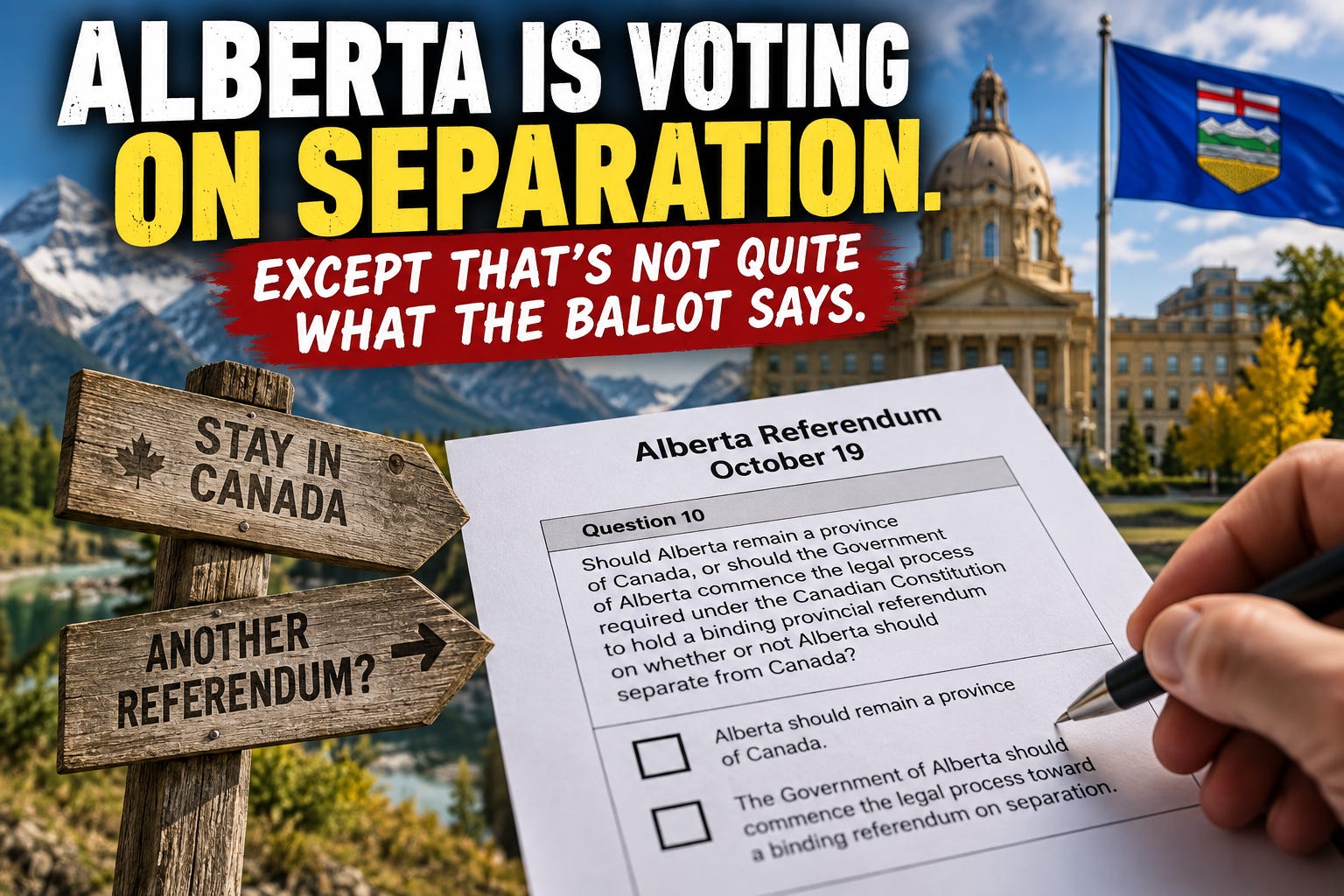
I went looking at Alberta’s October referendum because I kept seeing it described as a vote on Alberta separation.
That sounded pretty damned important.
Then I read the actual question.
And discovered something rather interesting.
Albertans are not voting October 19 on whether Alberta should leave Canada.
They are voting on whether Alberta should remain in Canada or whether the Alberta government should begin a process leading toward another referendum someday that actually would ask that question.
That distinction isn’t mine.
It’s right there in the ballot.
Elections Alberta says Question 10 reads:
“Should Alberta remain a province of Canada, or should the Government of Alberta commence the legal process required under the Canadian Constitution to hold a binding provincial referendum on whether or not Alberta should separate from Canada?”
Option 1 keeps Alberta in Canada.
Option 2 tells the Alberta government to start pursuing a future binding referendum on separation.
And here’s the part I think every Canadian should know before October 19:
Question 10 itself is officially non-binding.
That comes directly from Elections Alberta.
So this isn’t Alberta’s Brexit moment.
It’s potentially the beginning of a process that might eventually produce one.
And that process is considerably messier than those few words on the ballot make it sound.
Canada has been down this road before
We actually have some pretty solid law on what happens when a province wants to leave Canada.
Thank Quebec for that.
In 1998, the Supreme Court of Canada considered whether Quebec could simply declare independence following a referendum.
The answer was no.
A province cannot unilaterally leave Canada.
But the Court also said something important in the other direction.
If a clear majority of a province votes on a clear question in favour of secession, the rest of Canada cannot simply shrug and pretend nothing happened.
That would create a constitutional obligation to negotiate.
But negotiate is the important word.
A referendum doesn’t magically create a new country the following Tuesday.
The Supreme Court said negotiations would have to reconcile the interests of the separating province, the federal government, the other provinces and Canadians both inside and outside the province.
Then Parliament passed the Clarity Act in 2000.
And this is where Question 10 gets particularly interesting.
The Clarity Act says the House of Commons must determine whether a future referendum question is clear enough to represent an actual decision to leave Canada.
It even says a question merely asking voters for a mandate to negotiate cannot itself constitute that clear expression.
In other words, there isn’t a constitutional Easy Button labelled…
PRESS HERE TO LEAVE CANADA.
There are courts.
Parliament.
The provinces.
Constitutional negotiations.
And eventually a constitutional amendment.
Then come the things nobody can settle with a slogan.
Assets.
Debt.
Borders.
Minority rights.
Indigenous rights and territorial claims.
All specifically identified in federal law as matters that would have to be addressed.
That doesn’t mean Alberta couldn’t pursue independence.
It means nobody gets to pretend the path is simple.
And then there are the treaties
This isn’t some academic footnote either.
The citizen-led Alberta independence petition already ran smack into this issue.
In May, an Alberta Court of King’s Bench judge quashed approval of the petition after finding, among other things, that Alberta had breached its duty to consult affected First Nations.
The decision is under appeal.
And here’s where the original story I was looking at was already outdated.
The petition did not simply disappear.
Elections Alberta subsequently verified it.
The required threshold was 177,732 signatures.
After its verification process, Elections Alberta estimated 222,597 verified signatures.
So let’s give the separatist movement its due factual credit:
They cleared the threshold.
But Elections Alberta also says the next steps in that citizen-initiative process remain on hold pending the appeal and further direction from the courts.
That’s a much more accurate description than either “separation is happening” or “the separatist movement has collapsed.”
Neither is true.
Danielle Smith put a different question on the ballot
While that legal fight was unfolding, Premier Danielle Smith announced on May 21 that her government would put its own question before Albertans on October 19.
Smith has publicly said she supports Alberta remaining in Canada and intends to vote that way herself.
She has also said her government will respect the direction Albertans give it.
That’s how we ended up with Question 10.
And I think Canadians should pay attention to its wording.
Not because I’ve discovered some secret plot hidden between the commas.
I haven’t.
But because words matter enormously when you’re talking about breaking up a country.
The Supreme Court said so.
Parliament said so.
The Clarity Act says so.
A future referendum actually seeking independence would have to produce an unambiguous expression that Albertans want Alberta to cease being part of Canada and become an independent state.
October’s Question 10 doesn’t ask that.
It asks whether the government should pursue the process toward another referendum that would.
That is a very different thing.
Elections Alberta also managed one hell of an avoidable mistake
There’s another issue floating around online that I checked because it sounded almost too ridiculous to be true.
It wasn’t.
Albertans were told they could vote by mail without needing a special reason.
Then some early special-ballot packages arrived containing a declaration saying:
“I declare that I am unable to vote at an advance voting place or a voting place on Election Day.”
Oops.
Elections Alberta acknowledged the problem on September 3.
It explained that the sentence was leftover language from an older version of the Election Act.
Voters who received it were told they could cross out the sentence and complete the rest of the declaration.
Later packages were changed.
I’m not going to manufacture a conspiracy out of that because I haven’t found evidence for one.
But on a referendum containing ten questions… including one touching the future of Alberta inside Canada… sending voters obsolete instructions was one hell of an administrative screw-up.
So what happens October 19?
Albertans vote.
That’s it.
Question 10 is important. The political message coming from millions of voters could be enormous.
But it isn’t independence day.
If Option 1 receives the greater support, Albertans will have expressed their preference that Alberta remain a Canadian province.
If Option 2 receives greater support, the provincial government will have received political direction through a non-binding referendum to pursue the process toward a future binding referendum.
And if Alberta eventually reaches that second referendum?
Then things get serious.
A clear question.
A clear majority.
The Clarity Act.
Constitutional negotiations.
First Nations and treaty rights.
Assets and liabilities.
Borders.
And ultimately constitutional amendment.
None of those outcomes is predetermined.
That’s the part I wanted to understand.
Because “Alberta votes on separation October 19” makes one hell of a headline.
It just isn’t quite what Alberta is voting on.
The Recap…
Alberta’s October 19 Question 10 is not a binding vote to leave Canada.
It’s a non-binding choice between remaining in Canada and directing the Alberta government toward the legal process for a future binding referendum.
And even that future vote couldn’t simply make Alberta independent overnight.
Canada’s Constitution, Supreme Court precedent, the Clarity Act, First Nations treaty rights and negotiations with the rest of Canada would all come into play.
Sometimes the most important part of a referendum is reading the damned question.
The Gut-Punch…
On October 19, Alberta isn’t deciding whether to leave Canada. It’s deciding whether to start down the road toward a vote that could. Those are not the same thing.
Source Credit
Elections Alberta… 2026 Provincial Referendum and official Question 10; Elections Alberta… citizen initiative petition verification results; Government of Alberta — Premier Danielle Smith’s May 21 address; Supreme Court of Canada… Reference re Secession of Quebec (1998); Government of Canada… Clarity Act; Elections Alberta… September 3 special-ballot clarification.
If you enjoy thoughtful conversations, Canadian stories, and the occasional smart-ass observation about the world we’re living in, you’re in the right place.
Subscribe free and get new stories, insights, and observations delivered directly to your inbox.
No paywall.
No spam.
No nonsense.
Leave anytime with a single click.
I promise not to take it personally.
Danielle Smith is working with trump on his plan to break up Canada. And the equalization payment s ( as we finally understand them !) are from The Federal Government! NOT ALBERTA! We see the trump funded separatists hand and game fully described in the Globe and Mail . Smith belongs with trump at mar a lago with her American oil men now living in Calgary, she is just like THEM. She isn’t a supportive Canadian. This is a manipulative rouse and we must call it out while, Canada and the World tries desperately to survive trump and Russia’s PLANS to crush alll democratic countries…..Daniel Smith is helping trump, a traitor to us and supporting those who wish to harm us. Enough of this GAME of manipulation, enough! Enough! Enough!
Re: See Brexit