

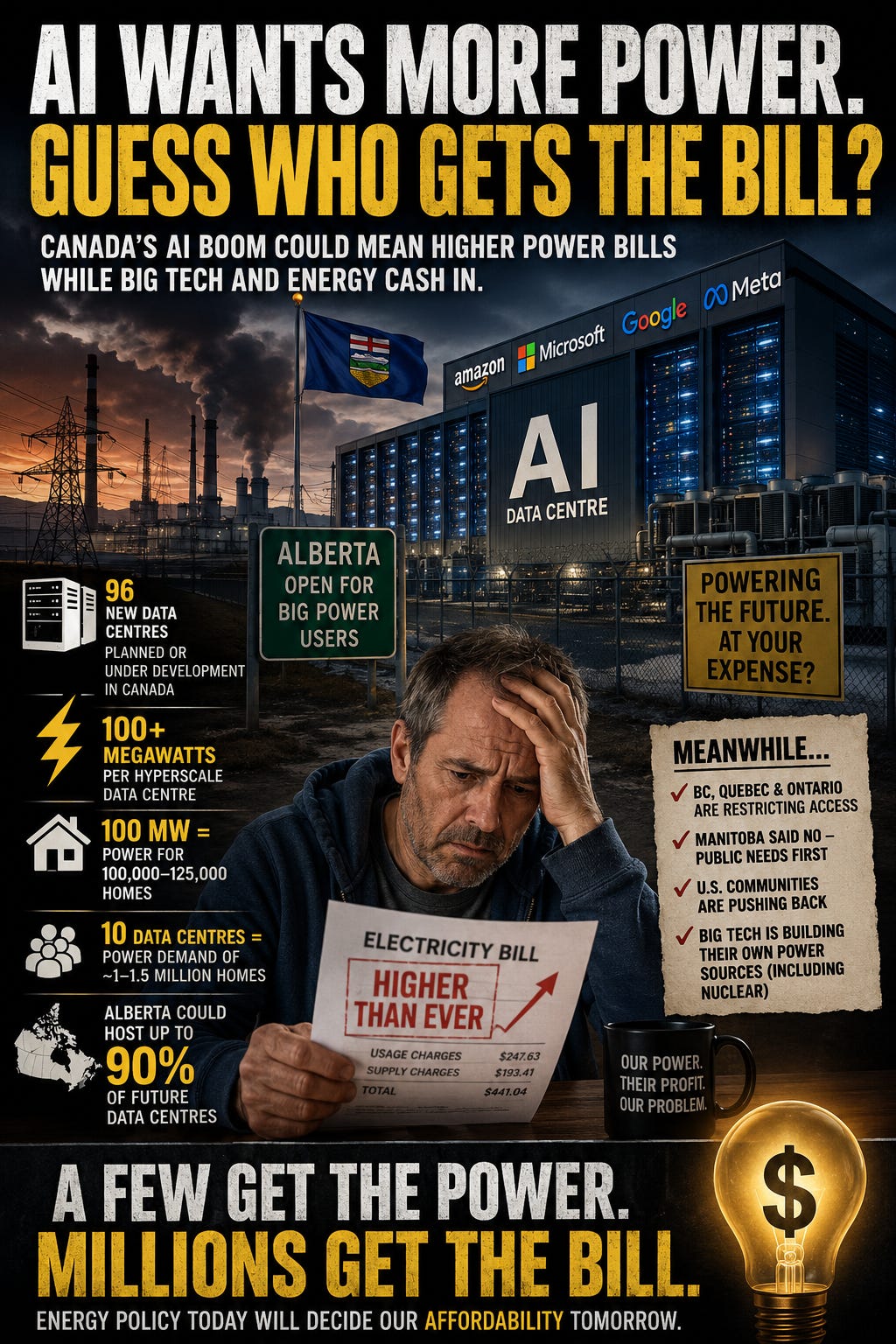
For years, we were told the future would be electric.
Electric cars. Smart homes. Clean energy.
Now there’s a new hungry beast at the table.
Artificial intelligence.
And this thing eats electricity like a teenage boy after hockey practice.
Quietly… while most of us were arguing about grocery prices and mortgage payments… Canada has been lining up for an explosion of AI data centres. Not five or ten.
Ninety-six.
That’s how many large-scale facilities are now planned or under development across the country.
Here’s the part most people haven’t heard yet…
A huge chunk of them could end up in Alberta.
Why?
Simple.
Money likes easy rules.
And Alberta has one thing the big tech crowd loves: a deregulated electricity market.
Translation?
If you want massive amounts of power, Alberta is rolling out the welcome mat.
Meanwhile, provinces like BC, Quebec, and Ontario… places with cheaper hydro and regulated systems… have started tightening the screws.
Some are slowing approvals. Others are protecting electricity for residents and existing industry before handing giant chunks of power to data companies.
Alberta took the opposite route.
Come on in.
Plug in.
Use what you want.
Sounds great for investment headlines.
But there’s a catch nobody likes talking about.
You don’t just promise electricity.
You have to make it.
And AI is hungry.
Really hungry.
A single hyperscale AI data centre can use more than 100 megawatts of electricity.
That’s roughly enough power for somewhere between 100,000 and 125,000 homes.
One facility.
Not ten.
One.
Now imagine several landing in the same province at roughly the same time.
Ten major facilities?
You’re suddenly talking about electricity demand similar to what well over a million homes might use.
That’s not “normal growth.”
That’s a power surge with steel-toed boots.
And unlike a new subdivision or slow population growth, these facilities don’t creep in gradually.
They arrive like someone plugging an industrial freezer into your kitchen outlet and saying…
“Don’t worry. The wiring will figure itself out.”
Meanwhile, the biggest tech companies on earth… Amazon, Microsoft, Google, Meta… already know where this is heading.
That’s why some are scrambling to secure their own power sources.
In some places they’re investing in nuclear.
In others, private energy deals.
Because when electricity becomes scarce, the people with the biggest chequebooks usually eat first.
And that’s where ordinary Canadians should probably start paying attention.
Because electricity markets don’t magically absorb giant demand spikes.
Something gives.
Usually price.
That’s already becoming a political fight in parts of the United States where residents are asking a fair question…
Why are families paying more while giant corporations consume enough electricity to power entire cities?
Canada isn’t immune to the same argument.
In fact, Manitoba recently rejected a major project partly because public energy needs came first.
That’s a sentence worth reading twice.
Public needs came first.
Funny how radical that sounds these days.
Now here’s the contradiction nobody wants to touch.
For years, politicians panicked about electric vehicles overwhelming the grid.
Remember that?
Too much strain.
Too much demand.
Can’t support it.
Yet somehow many of those same voices are suddenly perfectly comfortable with giant AI facilities that can consume vastly more electricity than massive EV adoption ever would.
Apparently electricity demand is terrifying…
Until billion-dollar companies show up with investment promises.
Then suddenly we’re told everything will be fine.
Maybe it will.
Maybe Alberta becomes an AI powerhouse.
Maybe it creates jobs and diversifies the economy.
But here’s the uncomfortable question…
Who benefits?
And who pays?
Because if a small group makes fortunes while millions absorb higher utility bills…
that isn’t innovation.
That’s cost transfer.
The truth is this isn’t really an AI story.
It’s an energy story.
A policy story.
A “who gets access to essentials” story.
Because electricity isn’t optional anymore.
It’s as basic as roads and water.
And once demand outruns supply, somebody always gets squeezed.
The question is whether governments plan ahead…
or wait until people open their power bills and start asking why “the future” suddenly costs so damn much.
The Recap…
Ninety-six new AI data centres are planned in Canada.
One major facility can use enough electricity to power over 100,000 homes.
Guess which province is rolling out the welcome mat?
This isn’t really an AI story.
It’s a “who gets the power… and who gets the bill” story.
The Gut-Punch…
AI might be artificial.
Your hydro bill won’t be.
And if governments get this wrong, a handful of corporations could get rich while ordinary Canadians pay monthly for a boom they never agreed to join.
Source credit:
This article was inspired by reporting and public discussion around Canada’s planned AI data-centre expansion, provincial energy policy, deregulated electricity markets, and emerging concerns about grid strain and affordability.
🔎 The GeezerWise Standard
This space is built on disciplined thinking.
Facts over spin.
Verification before amplification.
Good-faith discussion over tribal noise.
I use AI tools to help shape my spoken drafts into clear writing.
The judgment, conclusions, and final message are mine.
If you’re new here, this explains how I decide what’s worth sharing:
How I Decide What’s Worth Sharing → [link]
💌 Subscribe at GeezerWise.com to receive future letters:
www.geezerwise.com/subscribe
— Fred Ferguson
GeezerWise
#CanadaStrong
Good summary, as always, Fred.
This hasn't quite happened States-side yet, but I would think that the Canadian position (aligning both with Carney's AI framework and his electrical grid expansion) would be that for a "permit" (or at least a feasibility plan) for any data centre or cryptocurrency venture, etc., etc. would be to outline HOW it will self-generate all/most of its power needs. So, are they building wind turbines? Solar panels? Modular Nuclear Reactors?
And then secondarily, how are they handling the cooling problem (meaning, not consuming all water that might be needed for other just-as-important purposes (like farming, drinking, etc.). How about community initiatives where the "Heat gets Sunk" somehow, to then be drawn out in winter to heat local towns/buildings? AKA, recycle the heat somehow? So with this, the water becomes more like a contained radiator system, rather than a constant intake/discharge.
There's also a 3rd concern, being 24/7 "noise pollution." Not sure what to do about that one.
Anyway, we're seeing great success in our military procurement, with insistence on economic benefit to Canada (the USA being the big holdout - but I'm seeing that being a crucial negotiating element within the CUSMA discussions). So, why can't we insist on something similar here for data centres —meaning environmentally (more) friendly cogeneration of power? Modular nuclear reactors, solar, wind, etc.
Not sure how ROC (Rest of Canada) can enforce that upon Alberta (here we go again, "Ottawa dictating how we should do things" . . . . ).
But really, any such proposal for a data centre should address at least these three aspects.
Alberta's position is predicated on the belief, now possible, that it can generate the electricity needed, profitably, with fossil fuel powered systems. This is a multiple win for the Power Province and all we have to do is hold our nose regarding the climate change effect. Apparently we as a nation are willing to do so in the short term to provide revenue to build for the long term. It may be a necessary gamble to fund the creation of Fortress Canada.