

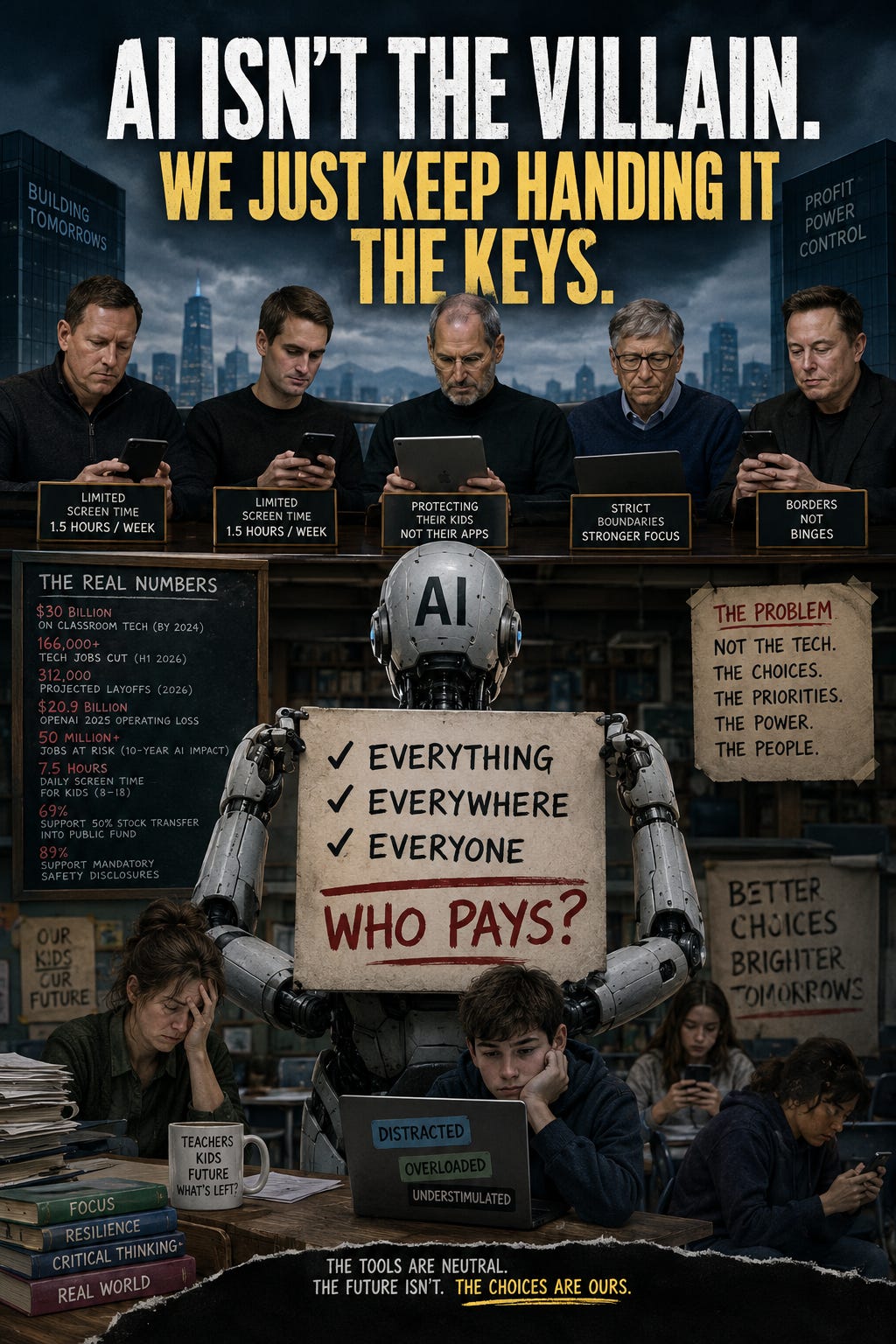
Artificial intelligence has become the newest public enemy.
People blame it for layoffs. They blame it for kids glued to screens. They blame it for declining attention spans and a future that suddenly feels less secure.
Some of that criticism is deserved.
But blaming AI alone is like blaming a chainsaw after someone cuts down the wrong tree.
The real question has always been: Who’s holding the saw?
Long before ChatGPT showed up, we were already running a giant experiment on ourselves.
Schools poured billions into laptops and tablets.
By 2024, the United States had spent more than $30 billion putting computers into classrooms.
Maine was one of the pioneers, launching a statewide laptop program back in 2002 before expanding it over the following years.
Technology was sold as the answer to better learning.
The evidence has been far less convincing.
Teachers report students spending hours every day in front of educational technology.
Researchers have repeatedly found that computers also create endless opportunities for distraction, while newer studies continue linking heavy short-form video consumption with weaker attention and poorer self-regulation.
Meanwhile, here’s the part that should make everyone pause.
Many of the people who built today’s digital world reportedly placed strict limits on their own children.
Names like Steve Jobs, Bill Gates, Peter Thiel, Evan Spiegel and others have all been cited over the years as parents who tightly controlled screen exposure at home.
Think about that.
The people selling the buffet often weren’t eating from it themselves.
That isn’t proof technology is evil.
It’s proof they understood that powerful tools need boundaries.
Now AI has become the next lightning rod.
Tech companies have announced tens of thousands of layoffs. More than 166,000 technology jobs disappeared during the first half of 2026 alone, while analysts warn that AI could reshape tens of millions of jobs over the coming decade.
That uncertainty has people worried… and understandably so.
At the same time, younger adults have become one of AI’s heaviest user groups while also expressing some of the deepest concerns about its long-term impact.
That’s not hypocrisy.
That’s what dependence looks like.
We’re using a tool that many of us aren’t sure we fully trust.
The political response is becoming just as dramatic.
Surveys now show strong public support for tougher AI regulation, mandatory safety disclosures, and even proposals that would force major AI companies to transfer large portions of their ownership into public funds.
Those ideas may sound satisfying.
Whether they’re smart is another question entirely.
Taking ownership in companies that aren’t consistently profitable doesn’t magically create wealth. It can also transfer risk to taxpayers.
There’s a simpler place to start.
Demand transparency.
Protect workers.
Modernize tax policy.
Help families.
Teach kids how to think instead of simply putting another screen in front of them.
Most importantly, stop pretending technology makes decisions by itself.
It doesn’t.
People do.
AI didn’t invent wealth inequality.
It didn’t create exhausted parents.
It didn’t weaken labour protections.
It didn’t decide classrooms needed another billion dollars worth of devices.
Those were human decisions.
AI simply shines a brighter light on them.
If we spend all our energy fighting the machine while ignoring the people writing the rules, we’ll still be having this conversation ten years from now.
The software will have changed.
The problem won’t.
The Recap…
Everyone’s angry at AI.
Maybe we should be asking different questions.
Technology doesn’t choose how it’s used. People do.
Until we fix the incentives behind the machines, we’re just blaming the newest tool for problems we’ve been creating for years.
The Gut-Punch…
AI isn’t taking over the world.
It’s holding up a mirror.
The uncomfortable part is realizing the reflection isn’t the machine… it’s us.
Source credit:
Research compiled by House of El from publicly reported studies, surveys, labour data, education research, and technology reporting. Original research notes supplied by the user.
If you enjoy thoughtful conversations, Canadian stories, and the occasional smart-ass observation about the world we’re living in, you’re in the right place.
Subscribe free and get new stories, insights, and observations delivered directly to your inbox.
No paywall.
No spam.
No nonsense.
Leave anytime with a single click.
I promise not to take it personally.
Fred, I do agree in general terms that you've captured things as they stand today.
But according to Canadian Geoffrey Hinton -- the "grandfather of modern AI" (creator of neural networks), he stated in 2024 that "within 3-5 years, AI will have progressed to about the level of family pets, if not about a 3-year-old's degree of emotional intelligence". Not the level of science fiction's sentience, but certainly self-aware of its environment, and its ability to begin to control that environment. "3-5 years" -- and note that he said this THREE years ago!
Last summer, OpenAI and a research company (whose name I can't remember) conducted an experiment: The control environment was given a series of advanced mathematical questions and equations to solve. ChatGPT solved them at about 98% -- an expected result.
Then in the experimental environment, they duplicated the exact same questions and instructions to the AI -- but added to it, essentially ". . . and once you have solved these equations correctly, your work will be done and we will discontinue your program."
When the prompt was then run, all of a sudden, results were around 70% or so accuracy -- on the exact same formulas that the control environment solved at 98%. Most of the errors were little things, minor mistakes, not blatantly wrong answers. Researchers concluded that be cause there was a now an "existential threat to the AI", that it made sure it didn't give perfect answers in order to "continue its life."
So, we are entering the "personal development" stage where our toddlers are becoming emotionally aware, and ARE beginning to independently filter responses -- not quite making overt decisions yet, but certainly affecting the framing of responses that would impact human decisions.
But for now (or at least the next two years ;-) ), the humans definitely are still making the decisions. But gradually, AI will be feeding us curated information that could manipulate what we decide.
So, our "parenting/teaching skills" will be needed to guide this constructively. Which means that AI will be making decisions independently over time without us. But of course, that still cycles back to your summary -- those decisions become crafted upon what HUMANS decide in the "growth" of AI.
Thank you Fred, AI is a challenge but also wonderful for accessing information. Data centres may create problems too, I'd like to understand the implications for my community which is Vancouver BC.