

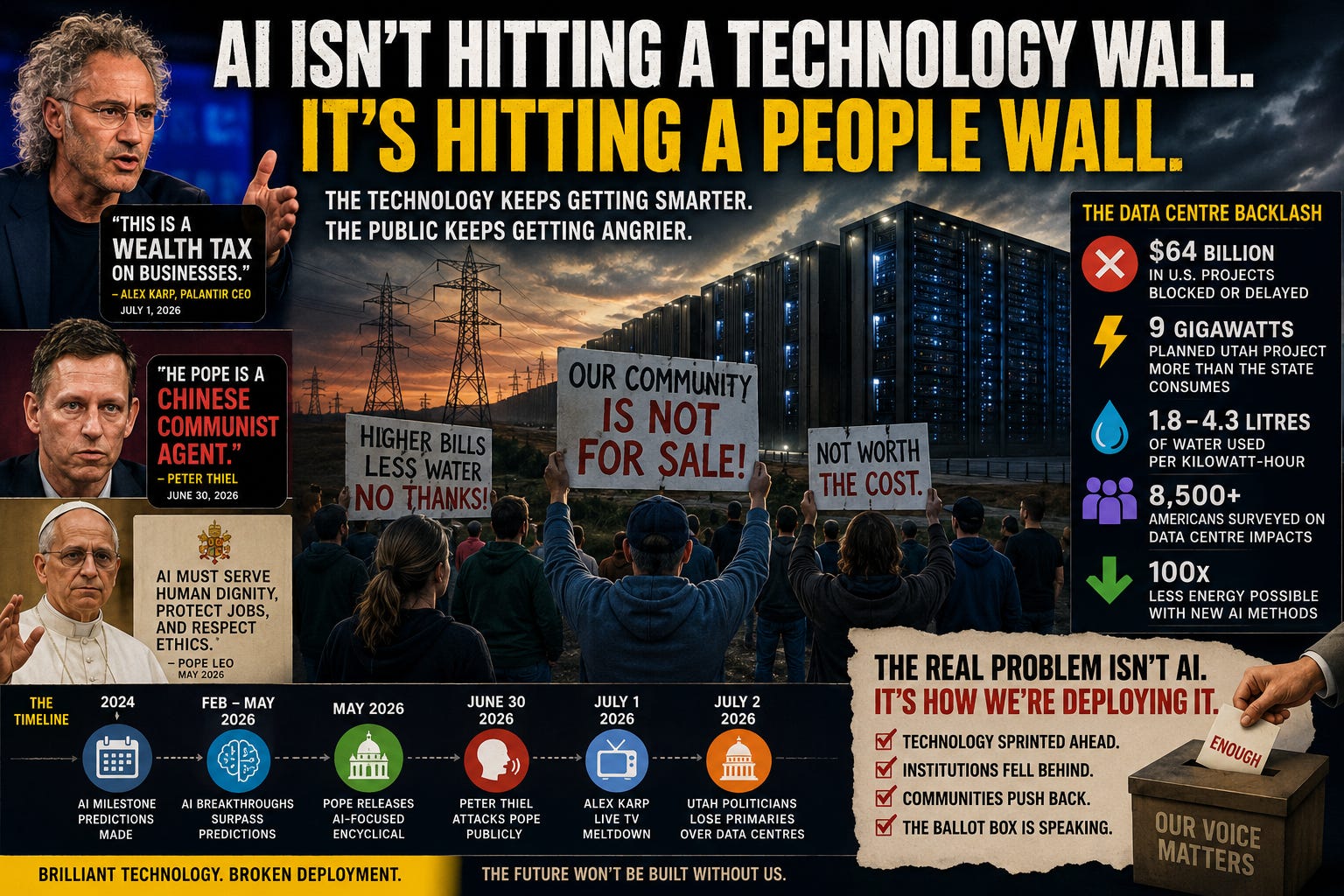
For the past few years, the AI industry has been telling us the future is inevitable.
Build more data centres.
Build more computing power.
Build more infrastructure.
Build more everything.
Now the pushback has started.
Not because the technology failed.
Because ordinary people finally saw the bill.
The AI story is changing from a laboratory success story into a political fight happening in real communities.
And that changes everything.
The Cracks Are Showing
Over the past week, three very different stories made headlines.
Palantir CEO Alex Karp publicly blasted parts of the AI business model.
Tech billionaire Peter Thiel launched a bizarre attack on the Pope over AI regulation.
Meanwhile, politicians in Utah discovered that supporting giant data-centre projects can be hazardous to their political careers.
At first glance, those stories look unrelated.
They aren’t.
They’re all symptoms of the same problem.
AI development is moving faster than governments, businesses, communities, and voters can comfortably absorb.
The technology sprinted ahead.
Society didn’t.
The Data Centre Backlash Is Real
For years, data centres were treated like economic development projects.
Bring them in.
Create jobs.
Increase investment.
Everybody wins.
Except now people are looking closer.
Some proposed projects consume staggering amounts of electricity.
One planned Utah project reportedly required up to 9 gigawatts of power… more electricity than some entire jurisdictions use.
Then there is water.
Data centres require enormous cooling capacity, and estimates suggest they can consume between 1.8 and 4.3 litres of water for every kilowatt-hour of electricity used.
That sounds abstract until you’re the community wondering why your utility bills are climbing or your local water supply is under pressure.
Suddenly the conversation becomes very personal.
And voters notice.
$64 Billion Stuck on the Sidelines
Public opposition is no longer a fringe issue.
An estimated $64 billion worth of U.S. data-centre projects have reportedly been delayed, blocked, or stalled.
That number matters.
Not because the projects are delayed.
Because it signals something bigger.
The public is no longer automatically accepting whatever Silicon Valley wants to build.
The old formula was simple…
Technology arrives.
Communities adapt.
Questions come later.
That formula is breaking down.
People want answers before construction starts.
Not after.
Even the AI Companies Are Arguing
Another sign of stress is coming from inside the industry itself.
Some major enterprise customers are beginning to question whether renting AI through expensive API access makes long-term sense.
The argument is shifting toward ownership and control.
Why rent critical infrastructure forever if you can build or control it yourself?
That’s where companies like Palantir see opportunity.
Their pitch is increasingly focused on sovereign AI… countries, militaries, and large organizations controlling their own systems rather than relying on a handful of centralized providers.
That debate isn’t really about software.
It’s about power.
Who owns the intelligence?
Who controls access?
And who gets to shut it off?
The Pope Entered the Chat
If you want proof that AI has become bigger than technology, consider this:
The Vatican is now involved.
In May, Pope Leo’s AI-focused document emphasized ethics, human dignity, employment impacts, and responsible governance.
Those concerns aren’t exactly radical.
They’re questions millions of people already have.
How much control should AI have?
What happens to jobs?
Who is accountable when things go wrong?
Yet even raising those questions triggered political and ideological attacks from some corners of the tech world.
That alone tells you how sensitive the debate has become.
When religious leaders, governments, billionaires, engineers, and local voters are all arguing about the same issue, you’re no longer discussing technology.
You’re discussing society.
The Plot Twist Nobody Expected
Here’s the irony.
Just as fears about massive energy consumption are reaching a peak, researchers are finding ways to make AI dramatically more efficient.
New approaches, including neuro-symbolic systems and mixture-of-experts architectures, are showing enormous reductions in computing requirements.
Some claims suggest energy usage could eventually fall by as much as 100 times while maintaining… or even improving… performance.
If those gains hold up, today’s infrastructure panic may look very different a few years from now.
Which means the biggest problem may not be the technology itself.
It may be the way we’re rolling it out.
The Real Problem Isn’t AI
The technology is advancing at astonishing speed.
Capabilities many experts expected to arrive sometime between 2033 and 2050 are appearing right now.
That isn’t the scary part.
The scary part is that our institutions, regulations, infrastructure planning, and public consultation processes haven’t kept pace.
The AI industry optimized for speed.
Communities optimize for stability.
Those goals were always going to collide.
Now they are.
And voters are starting to push back.
The Recap…
AI isn’t facing a technology crisis.
It’s facing a trust crisis.
When power bills rise, water gets scarce, and communities feel ignored, AI stops being a futuristic concept and becomes a local political issue.
The technology may be brilliant.
But if the rollout keeps ignoring the people paying the costs, the backlash is only getting started.
The Gut-Punch…
Silicon Valley spent years asking whether AI could do something.
Almost nobody stopped to ask whether communities would accept how it was being done.
Now the public is answering that question at the ballot box.
And Big Tech may discover that’s a much tougher audience than investors.
Source Credit:
Research compiled by House of El from reporting and commentary on AI infrastructure development, enterprise AI economics, public opposition to data-centre projects, AI governance debates, and emerging efficiency breakthroughs in artificial intelligence systems.
If you enjoy thoughtful conversations, Canadian stories, and the occasional smart-ass observation about the world we’re living in, you’re in the right place.
Subscribe free and get new stories, insights, and observations delivered directly to your inbox.
No paywall.
No spam.
No nonsense.
Leave anytime with a single click.
I promise not to take it personally.
Your three things might not be as unrelated as they seem at first -- well, the first two points, that is.
Peter Thiel owns Palantir.
And his whole personal belief ("religion") is that the machines are our salvation; they will do all the work, cure cancer, solve all our problems -- and we should embrace that (and sit around reading books and eating grapes, I guess).
So running further with your excellent summary:
- US approach to AI is incredibly expensive. Those in the field are earning outrageous salaries, supposedly because this tech is just, well, the Holy Grail (since we seem to be on religious themes!).
- But that's also showing that the AI-bros haven't been able to figure out how to make money with the tech. It's certainly HELPING businesses that use it, but not in ways that suddenly have a mom and pop corner store earning millions (neither is it adding that value to larger companies). It's helping with certain efficiencies, but not enormous game-changers (for the cost).
- The Chinese -- the "evil empire that's trying to be the dominant player (vs USA)" seem to be coming up with decent parallel tech, but for a FRACTION of the cost! (this leads one to question if the USA tech is really worth all that Altman, Thiel, Musk, etc. are saying its worth).
- the AI industry is the one sector that's keeping the whole US economy "booming" -- without it, their economy would be just "limping along" (not much different than Canada's, or Europe's). So if the AI sector is over-valued . . . .
- The Chinese model is entirely concerned about SUPPORTING human workers, not replacing them (the USA model is trying to sell itself by convincing businesses that they will save MOST of their labour costs, or that that freed-up labour will "add unlocked value, because they aren't doing drudgery"). While the US view does have some truth to it (the adding value), it's got a greater chance that it will replace workers primarily, leaving just a few to "add the value." China is very concerned about not replacing the workers, I think for obvious reasons: They would have to somehow financially support the workers, and (an important point about totalitarian governments), those workers will likely revolt! The USA, well, I'd say it would be a certainty that workers will revolt -- there's a reason Theil has moved to Argentina! ;-)
Interesting that you brought up the Utah proposal -- that initiative is a Kevin O'Leary project! I think they largely ran him out of the state, last I heard.
Keep by pushing the back til they are destroyed