

For years, universities sold a simple bargain.
Study hard. Pass the tests. Get the degree. Build a career.
Then AI showed up and kicked one of the legs out from under the table.
The headlines focused on cheating. That’s the easy story.
The real story is much uglier.
Students are behaving exactly the way the system trained them to behave.
The Exam That Made No Sense
A Brown University economics professor noticed something strange.
His take-home midterm produced results that looked almost impossible.
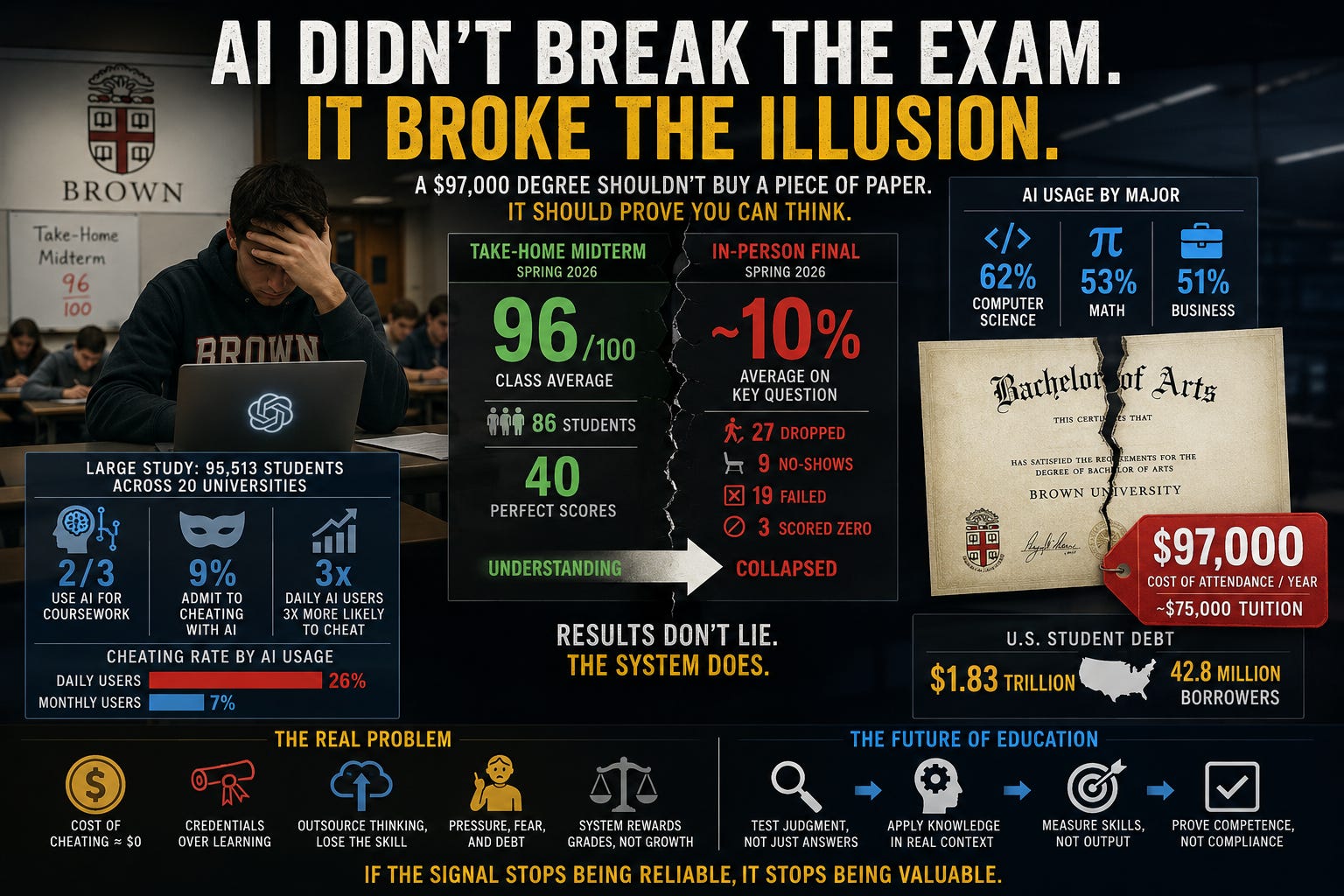
Eighty-six students wrote the exam.
The average score was 96 out of 100.
Forty students scored a perfect 100.
Historically, the same course produced averages between 65 and 80. To make matters even stranger, the professor had intentionally made the exam harder than previous years.
Something wasn’t adding up.
When the answers were reviewed, many displayed the same telltale signs: correct conclusions wrapped inside unnecessarily complicated reasoning. Different students were arriving at remarkably similar explanations.
Sound familiar?
It should.
That’s what happens when dozens of people ask the same AI tool the same questions.
The professor responded by moving the final exam back into a classroom.
No laptops.
No take-home format.
No AI assistance.
And that’s when the floor collapsed.
The Great Disappearing Act
The moment the in-person final was announced, students started vanishing.
Twenty-seven dropped the course.
Nine more didn’t bother showing up.
That’s 36 students gone before the exam even began.
Think about that for a second.
If you had earned a genuine 96 average in a course, would an in-person final scare you away?
Probably not.
But if your grade belonged more to a chatbot than to you, suddenly the room starts feeling a little warmer.
The final results were brutal.
Performance on a key question averaged roughly 10%.
Nineteen students failed.
Three scored zero.
The scatterplot of results spread across social media like wildfire because it showed something people had suspected but never seen so clearly.
A lot of students could produce answers.
Far fewer could produce understanding.
The Wrong Villain
Everyone wants a villain.
Students are convenient villains.
But let’s be honest.
If a system rewards grades more than learning, people will optimize for grades.
That’s not new.
What’s new is that AI has driven the cost of doing that down to almost nothing.
In the past, cheating required effort, planning, risk, and usually a willing accomplice.
Now it takes a prompt.
The economics changed overnight.
When the cost drops and the reward stays the same, more people take the deal.
That’s not a moral observation.
That’s basic human behaviour.
The $97,000 Question
Brown’s annual cost of attendance sits around $97,000.
Tuition alone is roughly $75,000.
Across America, student debt has climbed to about $1.83 trillion spread across 42.8 million borrowers.
Those numbers matter because they create pressure.
A lot of pressure.
Students aren’t simply chasing knowledge anymore.
Many are chasing a return on investment.
When someone is staring at years of debt, unstable job markets, and an uncertain future, the incentive shifts.
The degree becomes the goal.
Learning becomes secondary.
Once that happens, AI becomes less of a learning tool and more of a shortcut.
Not because students are lazy.
Because they’re responding to the incentives in front of them.
The Credential Problem
Universities have always served two functions.
They teach.
They certify.
For decades, employers assumed those two functions were connected.
Now that connection is weakening.
A diploma only has value if it reliably signals competence.
If employers stop trusting the signal, the signal loses value.
That should worry universities far more than cheating scandals.
Because employers don’t actually care how many assignments someone completed.
They care whether a person can solve problems.
If AI can generate the assignment and the student never develops the skill, the diploma starts becoming a very expensive piece of paper.
Confidence Without Competence
This may be the most dangerous part of the entire story.
People who don’t know something have always existed.
What’s different now is that AI can help someone sound knowledgeable without actually becoming knowledgeable.
That creates a gap between confidence and competence.
A large gap.
The person feels informed.
The résumé says qualified.
The degree says educated.
Reality may say otherwise.
And reality eventually gets a vote.
Usually during a job interview, a project deadline, or a crisis nobody prepared for.
The Real Future of Education
The solution isn’t banning AI.
That ship has sailed.
Employers already use AI.
Businesses use AI.
Governments use AI.
Professionals use AI.
Students will use AI.
The question is no longer whether the tool exists.
The question is whether people understand what the tool produces.
Future education systems will have to test judgment, interpretation, reasoning, and application.
Not simply whether someone can generate an answer.
Because generating answers is now the easy part.
Knowing whether the answer is right, wrong, useful, dangerous, incomplete, biased, or nonsense… that’s where the value is moving.
The world just changed the test.
Most institutions haven’t noticed yet.
The Recap…
Brown University didn’t uncover a cheating problem.
It uncovered an incentive problem.
When grades matter more than learning, people chase grades.
AI simply made that strategy faster, cheaper, and harder to detect.
The danger isn’t students using AI.
The danger is believing that output automatically equals understanding.
The Gut-Punch…
For generations, effort was proof of learning.
AI broke that connection.
Now we’re discovering something uncomfortable:
A perfect score can hide an empty toolbox.
And if a degree no longer proves competence, the most expensive thing in the room may not be the tuition.
It may be the illusion.
Source credit:
Research compiled from Brown University economics course reporting, academic studies on student AI usage, higher education cost data, student debt statistics, and labour market research referenced in the provided briefing notes.
If you enjoy thoughtful conversations, Canadian stories, and the occasional smart-ass observation about the world we’re living in, you’re in the right place.
Subscribe free and get new stories, insights, and observations delivered directly to your inbox.
No paywall.
No spam.
No nonsense.
Leave anytime with a single click.
I promise not to take it personally.
Students aren't "thinking" anymore... they go with "easier" and pound AI for all the answers. They are learning how not to Think. Hence there is no learning. Where does this leave them as adults in the working world, in relationships, decision making. If that function of their brain, a function that has evolved since living in caves, stops evolving and in fact diminishes, what happens to "reasoning"? And how does "meaning" exist when there is no personal interest in learning anything? Will they all become AI bots, with AI emperors and a trillionaire at the helm living somewhere in the world apart from most of humanity? This whole thing is a conundrum and I cannot find the words but they're coming. I have to "think" more on it and learn.
Not on University AI issues, but on one particular graduate who, it appears, didn't have to bother with coursework. Same individual had a daddy endow said university with a wing. The bit of paper, as opposed to the actual work, has long been compromised in the USA.