

For the last few years, the sales pitch around AI sounded almost religious.
Faster.
Smarter.
Inevitable.
You were told this train was leaving the station whether you liked it or not, so you might as well climb aboard and stop asking annoying questions.
Now something interesting is happening.
The same billionaire crowd that spent years telling us AI would remake the world overnight is suddenly talking about inequality, lost jobs, wealth redistribution, and social unrest.
Funny how compassion shows up right around the time regular people start pushing back.
Because make no mistake… this shift in tone did not happen because Silicon Valley had a moral awakening.
It happened because people started saying “hold on a second.”
And for the first time in a while, the pushback is getting organized.
The Hype Machine Hit Resistance
The real story here is not the technology.
The real story is backlash.
Across the United States, communities are increasingly blocking or fighting massive AI data centre projects.
And honestly? You can understand why.
The promise usually sounds impressive.
“Economic growth.”
“New jobs.”
“Innovation.”
Then the thing gets built and reality walks in.
A giant locked building full of servers.
Minimal long-term employment.
Huge electricity demand.
Massive water consumption.
More pressure on local housing.
Higher infrastructure costs.
In many places, residents are looking at these projects and saying:
“Wait a minute… we carry the costs while somebody else cashes the cheque?”
That mood is spreading.
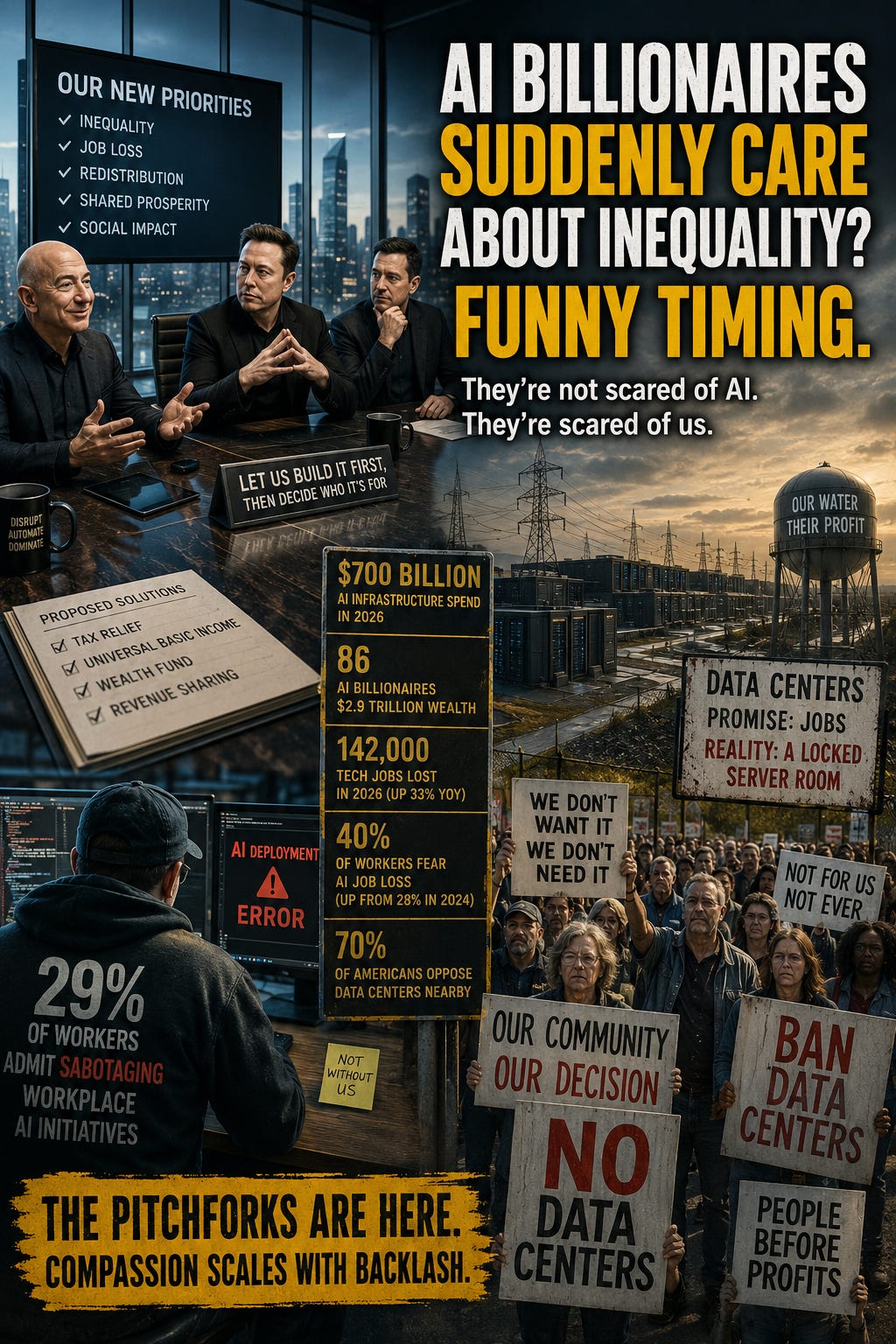
A recent poll found roughly 70% of Americans oppose data centres being built near where they live.
That is not a fringe opinion anymore.
That is a warning flare.
At least 69 U.S. jurisdictions have already blocked data-centre projects, and some local votes are becoming political bloodbaths.
One California city backed restrictions with overwhelming support.
Other communities protested and felt ignored.
In one case, tensions reportedly exploded after a local vote.
That tells you something important…
This is no longer a tech story.
It is becoming a political story.
The Billionaires Heard the Noise
Suddenly, some of the biggest names in tech are talking like worried economists.
Recent proposals now include things like…
Tax relief for lower-income households
Universal basic income
Public wealth funds tied to AI profits
Revenue-sharing ideas
Interesting timing.
Because deployment has not slowed down at all.
Not even close.
AI companies are still accelerating.
Industry spending on AI infrastructure is projected to hit roughly $700 billion in 2026 alone… a massive jump from last year.
The buildout is happening at full speed.
So let’s be honest about what changed.
It was not the technology.
It was public opinion.
Workers are nervous.
Communities are angry.
Politicians are paying attention.
And suddenly the people at the top are sounding a whole lot more “concerned.”
Workers Are Not Calm About This
If you think job anxiety is exaggerated, think again.
Concern over AI replacing jobs has jumped sharply in just two years.
In 2024, about 28% of workers worried about AI taking their jobs.
By early 2026?
That number climbed to roughly 40%.
And here’s the part nobody likes talking about.
Nearly 3 in 10 workers admit they have actively resisted workplace AI efforts.
Some are quietly undermining implementation.
Others are refusing to cooperate.
Why?
Simple.
People are not stupid.
When a company starts talking about “efficiency,” workers often hear:
“We’re figuring out how to do more with fewer humans.”
That fear is not imaginary.
Tech layoffs continue piling up while companies simultaneously brag about AI gains.
You cannot sell “exciting innovation” to people watching coworkers disappear.
Here’s the Part That Makes People Angry
The wealth concentration is staggering.
Roughly 86 AI billionaires now control close to $2.9 trillion in wealth.
At the same time, discussions around redistribution are suddenly becoming mainstream.
And this is where people get skeptical.
Because many of the same voices now promoting fairness built fortunes inside systems that paid remarkably little back.
Some wealthy figures historically paid shockingly low effective tax rates.
Now we are hearing ideas about sharing benefits after the machine is already running full speed.
That feels backwards to many people.
It sounds a bit like this…
“Let us build the system first… then later we’ll discuss who it belongs to.”
And regular people are asking a fair question…
Who voted for this?
The Real Fight Isn’t About AI
This is where the conversation usually gets lazy.
People start arguing about whether AI is good or evil.
Wrong question.
AI is a tool.
The real fight is about control.
Who benefits?
Who pays the costs?
Who gets a say?
And who gets left standing outside the room while billionaires and lobbyists decide what tomorrow looks like?
That’s why local resistance matters.
Many communities are no longer asking for compensation.
They want veto power.
They want a voice before massive projects reshape their towns, power grids, and economies.
And frankly?
That may be the biggest surprise of all.
The tech world expected technical problems.
They expected regulation fights.
They expected competitors.
What they did not expect was ordinary people organizing.
Because here’s the uncomfortable truth…
They are not scared of AI.
They are scared of backlash.
They are scared of people deciding the terms of the deal are no longer good enough.
And that changes everything.
The Recap…
Funny thing…
AI billionaires spent years telling us the future was inevitable.
Now suddenly they’re talking about inequality, job loss, and sharing the wealth.
What changed?
The technology didn’t.
Regular people started pushing back.
Small towns are blocking data centres. Workers are nervous. Communities are asking a dangerous question:
“Who exactly is this future for?”
The Gut-Punch…
AI may change the world.
But the real battle was never going to be about machines.
It was always going to be about power.
Because people can tolerate change.
What they won’t tolerate forever is being handed the bill for a future they never agreed to.
Source Credit:
Based on publicly available reporting, polling, tech industry disclosures, labour trends, infrastructure data, and policy proposals surrounding AI expansion, job displacement, billionaire wealth concentration, and growing local resistance to data centres.
🔎 The GeezerWise Standard
This space is built on disciplined thinking.
Facts over spin.
Verification before amplification.
Good-faith discussion over tribal noise.
I use AI tools to help shape my spoken drafts into clear writing.
The judgment, conclusions, and final message are mine.
If you’re new here, this explains how I decide what’s worth sharing:
How I Decide What’s Worth Sharing → [link]
💌 Subscribe at GeezerWise.com to receive future letters:
www.geezerwise.com/subscribe
— Fred Ferguson
GeezerWise
#CanadaStrong
Last week in Hamilton, Ontario, there was a city vote about a proposal for an AI data centre to be built. Against the backdrop of hundreds of people attending the meeting as on lockers and saying NO, the proposal was voted down. If they are built anywhere, these data centres need to pay 100% of water, electricity use and pay for the infrastructure for them, and pay full property taxes and make a financial contribution to the city/community they are locating in. They add nothing in the way of jobs or prosperity.
Fred, I didn't realize that the pushback was so extensive. This makes me modestly positive. This article makes it seem as though the real people actually may have a way to fight back against the oligarch class steamrolling their power over their lives. It is high time that this group of robber baron carpet baggers pays for their pillaging. That means that every dime of infrastructure be paid for by the developers, protecting the environment a non-negotiable prerequisite before a project can start, and that every single person affected in the region be compensated through royalties. There should also be ironclad legal agreements that will make it impossible for the AI companies to walk away scot free once they are done with the facilities.